In our modern world, where the quest for sustainable solutions is more urgent than ever, bioplastics emerge as a beacon of hope. This innovative material, derived from renewable biomass sources, is set to play a pivotal role in engineering a plastic free future. The development and application of bioplastics involve various types of engineers, each bringing their unique expertise to tackle environmental challenges.
What are Bioplastics?
Bioplastics are not a monolithic group; they comprise a diverse range of materials with varying properties and functionalities. This diversity allows them to be tailored to specific applications and needs. The term bioplastics represent a dynamic and evolving category of materials that are redefining our approach to manufacturing and waste management.
Unlike traditional plastics, which rely heavily on fossil fuels like petroleum and contribute to environmental degradation, bioplastics are derived from renewable resources, offering a more sustainable alternative. The most common sources for bioplastics are plant-based materials like corn starch, sugarcane, and cellulose. These renewable resources absorb carbon dioxide as they grow, which can help offset the carbon emissions when the bioplastics are eventually broken down or incinerated.
The Nature of Bioplastics
The SPI Bioplastics Division of the Plastics Industry Association defines “bioplastics” as “partially or fully biobased and/or biodegradable” and this definition is now accepted globally. A biobased bioplastic has some or all of its carbon produced from a renewable source (plant or sometimes animal). Biodegradable plastics are those that degrade into carbon dioxide (CO2), methane (CH4), and water (H20) through biological action in a defined environment and in a defined timescale. These environments include composting, anaerobic digestion, and marine and soil environments. A common misperception is that “biobased” and “biodegradable” are related or mean the same thing. They are not. A bioplastic that is biobased may not necessarily biodegradable, and a biodegradable bioplastic may not be biobased. The diagram below from the paper “Challenges and opportunities of biodegradable plastics: A mini review” published in the Waste Management & Research: The Journal for a Sustainable Circular Economy (WM&R) by the International Solid Waste Association shows the difference between being bio-based and being biodegrable and gives examples of plastics available on the market.
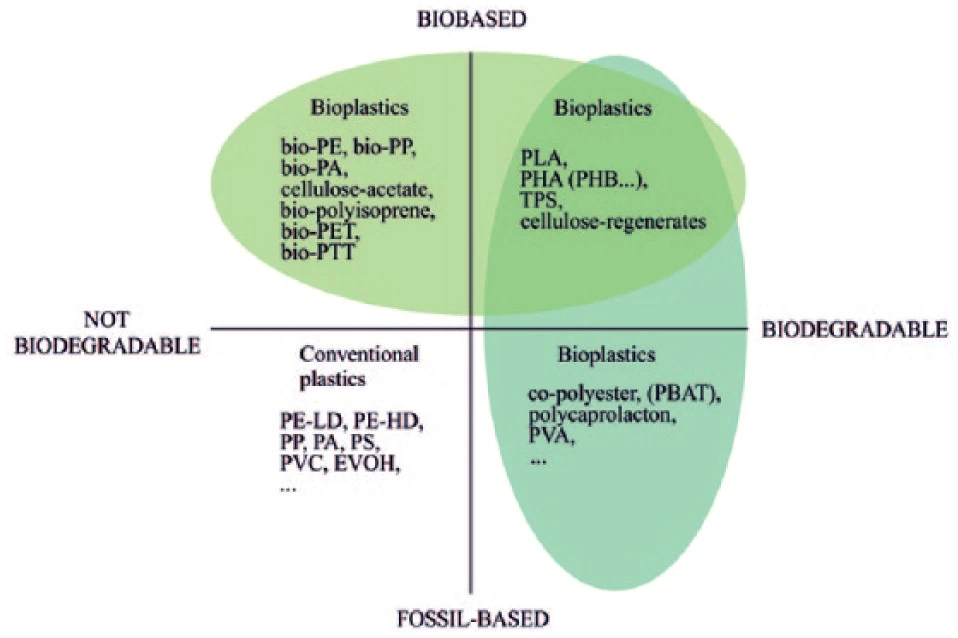
Source: International Solid Waste Association
Types of Bioplastics
Biodegradable Plastics
- Definition: “Biodegradable” means something can breakdown by microorganisms, fungi, etc. Note: Not all of these materials can be fully broken down and only in certain select environments.
- Nature and Use: Biodegradable plastics are designed to decompose naturally, often with the help of microorganisms under specific conditions such as in industrial composting facilities. They can break down into water, carbon dioxide, and biomass, leaving minimal environmental impact.
- Applications: These biodegradable alternative to plastics are commonly used in packaging, agricultural films, disposable cutlery, and other items where disposability and minimal environmental impact are critical. The use of biodegradable plastics is particularly advantageous in reducing plastic pollution, especially in single-use products.
- Types of Biodegradation:
-
- Anaerobic (landfills)
- Aerobic (home Composting)
- Industrial Composting
- Soil
- Fresh Water
- Marine Water
-
Bio-based Plastics
- Definition: The term “bio-based relates to where the carbon in a material came from. In this case, from living organisms. If it is rapidly renewable, then yes it is biobased.
- Composition: Bio-based plastics are made from biological substances but do not necessarily break down biologically. Their environmental benefit comes from the renewable nature of their sources rather than their disposability.
- Usage: They find application in creating durable goods such as automotive parts, electronics, and construction materials. Bio-based plastics offer a sustainable alternative in industries where long-lasting materials are essential.
Biopolymers
- Varieties: This category includes both naturally occurring polymers like cellulose, chitosan, and proteins, as well as synthetic polymers derived from bio-based monomers.
- Potential: Biopolymers are particularly exciting due to their vast potential in various applications. From biodegradable films and coatings to bio-based plastics for durable goods, they represent a frontier in material science, merging the benefits of bio-based sources with the functionality of traditional plastics.
Related: How University Labs Are Shaping the Future of Biodegradable Plastics
Examples of Bioplastics and Conventional Plastics
Biobased & Biodegradable
These polymers are produced using rapidly regenerative feedstocks (plants, wastes, residual gases) and will biodegrade at end of life. While some of these polymers only biodegrade in certain environments, PHAs will biodegrade in most natural environments, including the oceans.
- PHA: PolyHydroxyAlkanoates
- PHB: PolyHydroxyButyrate
- PLA: PolyLacticAcid
- PBS: PolyButylene Succinate or sometimes written PolyTetraMethylene Succinate
- Starch blends
- etc.
Fossil-Based & Biodegradable
These polymers are produced using ancient fossil carbon (generally from petroleum) but due to their molecular structure, they have the ability to be biodegradable.
- PBAT: PolyButylene adipate-co-terephthalate
- PCL: Polycaprolactone
- PLGA: Poly(lactic-co-glycolic acid)
- etc.
Biobased & Non-Biodegradable
While these polymers are made using rapidly regenerative feedstocks (mostly plants), they will not biodegrade once they are no longer needed. These polymers have the same molecular structure as their fossil-based counterparts.
- Bio-PE: Bio-Polyethilene
- Bio-PET or Bio-PETE: Bio-Polyethylene terephthalate
- Bio-PA: Bio-Polyamide
- Bio-PTT: Bio-Polytrimethylene terephthalate
- etc.
Fossil-Based & Non-Biodegradable
These polymers are made with ancient fossil carbon (from petroleum) and will not biodegrade. They represent the majority of today’s polymers and what we consider “conventional plastics”:
- PE: Polyethylene
- PP: PolyPropylene
- PET or PETE: Polyethylene terephthalate
- etc.
Related: Why Big Companies Should Invest in Sustainable and Innovative Plastic Alternatives?
Advancing Technology in Bioplastics
The field of bioplastics is rapidly advancing, driven by ongoing research and development. Engineers and scientists are continuously exploring new sources of biomass, developing more efficient production processes, and enhancing the properties of bioplastics to broaden their applications. The goal is not only to replace conventional plastics but to do so in a way that is both environmentally responsible and economically viable.
Bioplastics are at the forefront of a material revolution. With their diverse types and applications, they hold the promise of a more sustainable future, where our reliance on fossil fuels is significantly reduced, and materials are in harmony with the environment. As we continue to innovate and advance in this field, bioplastics are poised to play a crucial role in shaping a greener, more sustainable world.
The Role of Engineers in Bioplastics
The creation and refinement of bioplastic materials involve various engineering disciplines. From chemical engineers developing the compounds to materials engineers working on the application and recycling processes, each type plays a crucial role.
According to Vista Projects, a leading engineering consulting firm, there are numerous types of engineers, each with a specific focus area. In the context of bioplastics, the most relevant are:
- Chemical Engineers: These professionals are at the forefront of bioplastics. They work on developing and optimizing the processes that convert biomass into bioplastics. Their work involves researching raw materials, experimenting with formulations, and scaling production processes.
- Materials Engineers: They focus on the properties and applications of bioplastics. Their role is critical in determining how bioplastics can be used effectively in various industries, ensuring that the material meets necessary specifications and performance standards.
- Environmental Engineers: These engineers play a key role in assessing the environmental impact of bioplastics. They study the life cycle of these materials, from production to disposal, and work on strategies to minimize their environmental footprint.
Bioplastics and Sustainability
The emergence of bioplastics marks a significant stride in our journey towards a more sustainable future. These materials are an answer to the urgent call for eco-friendly alternatives to conventional plastics, which are a major contributor to environmental degradation.
Impact on Carbon Footprint
One of the significant advantages of bioplastics is their potential to reduce the overall carbon footprint. Traditional plastic production is a major contributor to carbon emissions. In contrast, bioplastics, derived from biomass, can significantly lower these emissions. By replacing fossil fuel-based materials with those derived from renewable sources, we can make a substantial impact on reducing global carbon emissions.
Reducing Greenhouse Gas Emissions
One of the most compelling advantages of bioplastics is their potential to substantially curtail greenhouse gas emissions. The production process of bioplastics generally requires less fossil fuel compared to traditional plastics, as they are derived from renewable resources like plants which absorb carbon dioxide from the atmosphere. This cycle of carbon absorption and usage presents a more sustainable loop as opposed to the linear, carbon-intensive process of conventional plastics.
Mitigating Landfill and Marine Pollution
When biodegradable bioplastics are properly disposed of, their impact on landfill and marine pollution can be significantly lessened. These bioplastics can decompose into harmless natural compounds, thereby reducing the accumulation of persistent waste in the environment and protecting marine ecosystems from the deleterious effects of plastic pollution.
Challenges in Sustainability
However, the road to sustainability via bioplastics is laden with challenges. The cultivation of biomass for bioplastics requires land and resources, which could otherwise be used for food production. This competition for resources is a critical concern, particularly in regions where food security is an issue. Additionally, not all bioplastics degrade efficiently in natural environments, and some require specific conditions to break down, which poses a challenge in waste management.
Engineers’ Role in Addressing Challenges
Engineers play a pivotal role in tackling these challenges. They are involved in developing innovative agricultural practices that minimize the impact on food resources, improving the efficiency of bioplastic production, and enhancing the biodegradability of these materials. Their work is crucial in ensuring that bioplastics fulfill their promise as a sustainable material.

Bioplastics in Various Industries
Packaging Industry
The packaging sector is one of the most enthusiastic adopters of bioplastics. By using biodegradable materials, this industry can significantly reduce its environmental footprint.
Bioplastic packaging solutions are increasingly being used for food packaging, carrying bags, and protective packaging, offering a sustainable alternative to traditional plastic packaging.
Automotive and Aerospace Industries
In the automotive and aerospace industries, bio-based plastics are being used for parts and components. These materials contribute to weight reduction, which in turn enhances fuel efficiency and reduces emissions. Bio-based plastics in these sectors are valued for their durability, light weight, and lower environmental impact.
Medical Field
Bioplastics are making groundbreaking advancements in the medical field. They are used in a variety of medical applications, including implants and devices. Their biocompatibility reduces the risk of rejection and adverse reactions, making them a safer choice for patients. Bioplastics in the medical field exemplify the versatility and potential of these materials in critical applications.
Related: Plastic-Free Blister Pack: A Sustainable Packaging Solution
The Future of Bioplastics
Continued Innovation and Collaboration
The future of bioplastics hinges on continued innovation and cross-disciplinary collaboration. Engineers, scientists, and industry leaders must work together to enhance the production processes, making them more efficient and less resource-intensive. By doing so, bioplastics can become a more accessible and viable option across various sectors.
Research and Development
The ongoing research in bioplastics is vibrant, with a focus on exploring new sources of biomass, refining biodegradability, and making bioplastics competitively priced compared to traditional plastics. The development of bioplastics with enhanced properties – such as increased strength, flexibility, or heat resistance – can broaden their application in industries previously reliant on conventional plastics.
A Sustainable Lifestyle
As we move forward, bioplastics stand as a symbol of a sustainable lifestyle, where the materials we use are in harmony with the environment. They offer a vision of a future where our material needs do not come at the cost of our planet’s health. Bioplastics are not just an alternative to traditional plastics; they represent a paradigm shift in how we view and use materials in our daily lives.
Endnote
Bioplastics represent a significant step towards a more sustainable future, and engineers are the driving force behind this revolution. By integrating the expertise of chemical, materials, and environmental engineers, the potential of bioplastics can be fully realized. The journey to a greener future is complex and challenging, but with the continued efforts of engineers and the industry, bioplastics can play a crucial role in shaping a more sustainable world. The power of bioplastics lies in their ability to merge environmental responsibility with technological innovation, paving the way for a future where sustainability is not just an aspiration but a reality.