The Invisible Threat: Microplastics Are in Our Bodies
Emerging research reveals that microplastics have been detected in human blood (1), brain tissue (2), testicles and semen (3), breast milk (4), and even placentas (5). These tiny particles don’t simply pass through the body; they can build up over time, leading to inflammation (6), hormone disruption (7), and possible long-term health effects.
How Can I Test My Exposure to Microplastics?
Through our Microplastic Exposure Quiz
Find out what is YOUR potential exposure level of microplastics based on lifestyle and environmental factors.
⚠️ Below FREE 3-minute quiz is for informational purposes only and does not constitute medical or scientific advice. Microplastic exposure estimates are based on common lifestyle factors and available research studies.
Common Questions and Answers About Microplastics
Microplastics are extremely small plastic fragments, defined as measuring under 5 millimeters in size. They are usually invisible to the naked eye and can be inhaled or ingested.
Microplastics are divided into two main categories depending on where they are coming from.
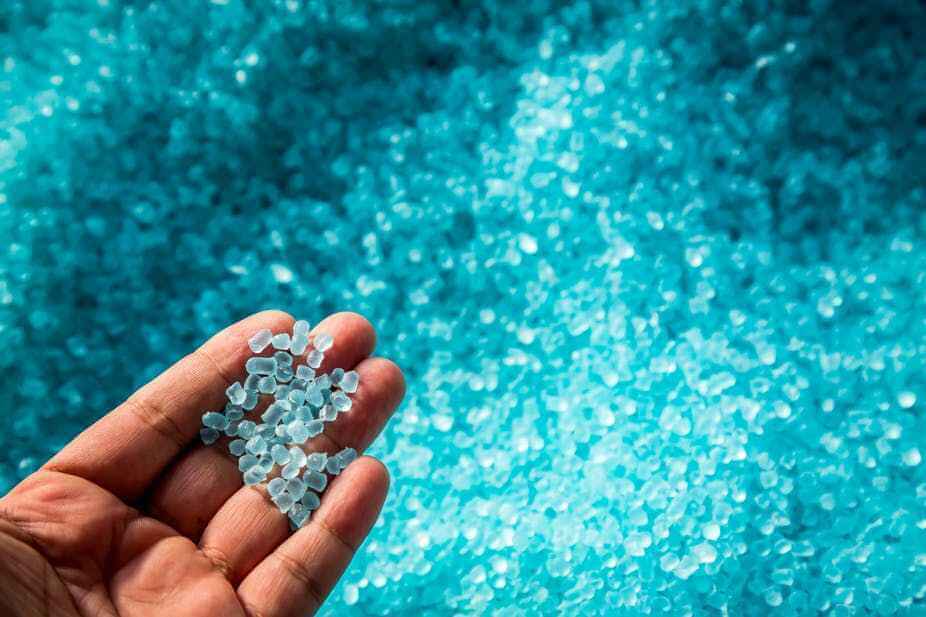
Primary microplastics: are intentionally made for use in products like microbeads found in personal care items, or plastic pellets, also called nurdles, used in manufacturing, and are usually transported via sea in shipping containers.
Secondary microplastics: microplastics that can also form when larger plastic items break down over time, like fibers from synthetic clothing, tire wear particles, paint wear particles, plastic fragments etc. These particles are created through weathering, wear and tear, and other environmental degradation processes and are now widespread in our environment: they are present in the ocean, rivers, soil, and even in the air we breathe.
Nanoplastics are ultra-small plastic particles measuring between 1 and 1,000 nanometers in size. They are so small that they’re invisible to the naked eye. For comparison, an average human hair is roughly 80,000-100,000 nanometers wide. They are a sub-category of microplastics and they form when larger plastic materials break apart over time through environmental wear and tear.
Yes, there is. PlasticTox have developed a world-first microplastics blood test kit to be done at home. It’s a dry blood test that is ordered online, The blood sample is collected at home, then sent to the lab. Within 3 weeks the results are sent via e-mail. Find out more about PlasticTox.
How Can I Further Test My Microplastic Exposure Levels?
Through the PlasticTox Microplastics Blood Test
If you want to further understand what your microplastic exposure levels in your blood are, PlasticTox by ArrowLab Solutions has recently launched a world-first microplastic blood test kit. PlasticTox uses a collection kit to obtain a sample of dried human blood, tested by utilizing cutting-edge microscopy to detect any of the following microplastics and nanoplastics in your blood:
– polyethylene terephthalate (PET)
– polyamides (PA)
– polypropylene (PP)
– polyethylene (PE)
– polyurethane (PU)
– polyvinyl chloride (PVC)
– polystyrene (PS)
They also developed a world-first microplastic oral fluid test kit. This will show all detectable microplastics present in your saliva.
Utilizing this cutting edge technology, each self collected sample is tested for each known polymer. Results include the number of contaminants, sizes of detected plastic particles, and calculated concentration of plastic particles in your saliva.
PlasticTox’s technology is peer-reviewed and clinically approved.
Check out the PlasticTox at-home Microplastic Testing Kits.
Scientific Studies
- (1) https://www.sciencedirect.com/science/article/pii/S0160412022001258
- (2) https://www.nature.com/articles/s41591-024-03453-1
- (3) https://pubmed.ncbi.nlm.nih.gov/36948312/
- (4) https://pmc.ncbi.nlm.nih.gov/articles/PMC9269371/
- (5) https://www.sciencedirect.com/science/article/pii/S0160412020322297
- (6) https://www.mdpi.com/2073-4409/13/21/1788
- (7) https://pmc.ncbi.nlm.nih.gov/articles/PMC9885170/