

Remember those ads about how convenient is non-stick cookware?
Finally, no eggs stuck onto your frying pan, and no more scratching them out while cleaning your stainless steel pan? Cooking made easy, right?
The “non-stick magic” was repeatedly announced for many cooking appliances including frying pans, woks, pots, casseroles etc. you name it.
We were all told that, as long as you’re using a wooden spoon or spatula and you’re not scratching the surface coating of this cookware, you’d be fine. Well, that’s easier said than done. Haven’t you noticed how your nonstick cookware coating wears thin over time? And it needs to be replaced every year?
Well. Enough with throwing away pans and pots, and harming our health. We tested 11 brands of toxin-free cookware with no coatings, so you don’t have to.
Is Non-stick Cookware Dangerous for Your Health?
Yes, it is. Over time that surface is not as thick, shiny, and non-stick any longer, and sooner or later, you end up using your stainless steel fork, knife, spoon or any other metal tool and the results are scratches on the surface.
To help you figure out which non-toxic skillets, pots and pans are best for your kitchen, we use our product testing insights, as well extensive research and reviewed peer-reviewed studies to determine the safest cookware brands options. The list of all studies is cited at the bottom of this article.
Does Scratched Non-stick Cookware Leach Microplastics?
Yes, it does. A late 2022 study titled “Raman imaging for the identification of Teflon microplastics and nanoplastics released from non-stick cookware (1)” by the Australian Newcastle and Flinders University, and published in the Science of The Total Environment Journal, found that even one surface crack on a Teflon-coated pan could release approximately 9,100 microplastic particles. Furthermore, through their Raman imaging and algorithm models, they found that broken coating on your non stick cookware may lead to the release of 2,3 million microplastics and nanoplastics, that leach into your food and contaminate it in the form of PTFE (Polytetrafluoroethylene) / PFOA (Perfluorooctanoic acid) “forever chemicals”. These groups of chemicals also called PFCs (Perfluorochemicals) and are used to make fluoropolymer coatings and products that resist heat, oil, stains, grease, and water.
Is the Claim PFAS Free, PTFE Free, and PFOA Free in Non-stick Cookware Enough?
No, such claims are not enough. Because PFAS, PFOA and PFTE have received such a bad reputation, companies have started replacing those chemicals with other forever chemicals of the same family like Gen X (2). Overall, there are thousands of different proprietary forever chemicals.
Don’t be fooled by PFOA – PFTE free label claims on products (3) – the absence of one chemical doesn’t exclude the presence of another one, safe non stick cookware doesn’t exist, as demonstrated by a 2020 test by the US based not-for-profit organization Ecology Center (4)
“PFOA-free doesn’t mean PFAS-free. In fact, most pans labeled PFOA-free were coated with PTFE without clearly indicating that.” Ecology Center
Do you remember when the claim BPA-free was placed on every plastic product? Well, manufacturers replaced bisphenol A (BPA), with other bisphenols (5), including bisphenol F (BPF) and bisphenol S (BPS), therefore the claim on the product is still correct, but that doesn’t mean it is safe. Well, the same principle can be applied here.
What are the Toxic Cookware Coatings to Avoid?
Let’s dive in the terminology of these synthetic chemicals to better understand what they are, and how to avoid them. Here are just a few of the many available on the market.
PFAS aka “Forever Chemicals”
- PFAS (per- and polyfluoroalkyl substances) are also known as “forever chemicals”, because once they are in the environment and in our bodies, they don’t biodegrade, they don’t break down. These chemicals can be found in a huge amount of items we come into contact with everyday from household items to food packaging. Forever chemicals is the broad term for the whole family of Perfluorochemicals (PFCs). A 2025 study published in the Journal Environmental Research (6) identified adolescents as an especially vulnerable risk group to specific types of PFAS. In fact, higher levels of PFOA and PFHpA (Perfluoroheptanoic acid) in the blood were linked to a much higher risk of developing fatty liver disease (now called MASLD – metabolic dysfunction-associated steatotic liver disease) in children and young adults. The risk is even worse for people who have certain genes, are older, or smoke.
Teflon™ (brand name) or PTFE
- Teflon is the brand name behind the most famous PTFE (Polytetrafluoroethylene) non-stick coating and the petrochemical giant DuPont is the inventor of this synthetic chemical since the 1930s. It’s now owned by the Chemours company which was founded in 2015 as a spin-off of Dupont. Teflon is not just used in cookware but also on other products like fabric to make then waterproof. Over the years, other chemical manufacturers have made similar coatings without using that branded name.
PFOA
- PFOA (Perfluorooctanoic acid) is a chemical that was previously used to manufacture Teflon, and it’s also known as C8. It has been linked to health conditions such as kidney and liver disease (7). If you haven’t done it yet, please watch the movie “Dark Waters” by Todd Haynes, as it tells the true story of how US attorney Robert Bilot managed to bring to court chemical manufacturing corporation DuPont after they contaminated the town of Parkersburg, in West Virginia with this unregulated chemical.
- The good news: all non-stick cookware produced in the United States has been PFOA-free since 2013, as a result of the U.S. EPA’s PFOA Stewardship Program, which successfully encouraged manufacturers to eliminate the chemical from their production processes by 2015.
PFOS
- Perfluorooctane sulfonate (PFOS) is another man made fluorinated compounds that repels oil and water. This Technical Factsheet by the US EPA (8) includes more details on PFOS/PFOA.
Gen X
- Gen-X is a trademark for another chemical compound that has been developed to replace PFOA (C8) and other PFAS, mainly based on the ammonium salt of hexafluoropropylene oxide dimer acid (HFPO-DA). It is what environmental health scientists consider as a “regrettable substitution” as it has also been linked to neonatal mortality, low birthweight, and hepatomegaly in the Sprague-Dawley rats (9).
Ceramic Nonstick Coatings
- Yes, contrary to all other non-toxic blogs, we also list “ceramic” coating here. Why? Because, the coating is not pure ceramic, it’s just marketing and a lot of greenwashing. Shall we call coin a new word and call it “healthwashing”? Silica is used in the process but other various substances are also used to manufacture these coatings including: silane, aluminum oxide, tetraethoxysilane, methyltrimethoxysilane, potassium titanate, Zirconium (IV) Propoxide (ZTP), Colloidal Silica (CS), Polydimethoxysilane (PDMS), and Fluoralkylsilane (FAS). See the section below on ceramic non-stick cookware.
Based on this overview, and on the fact that many forever chemicals have been substituted by others over the years, why would you believe that safe non-stick pans exist?
Cooking is an essential part of our daily lives, but the type of cookware we use can significantly impact our health. When we discovered that many traditional pieces of cookware release harmful chemicals and even release toxic fumes when exposed to high temperatures, we had to act. To make informed choices for your kitchen, you need to know which cookware isn’t toxic and is safe, as this is the best for your health and for the environment. Opt for coating-free, and therefore plastic-free cookware.
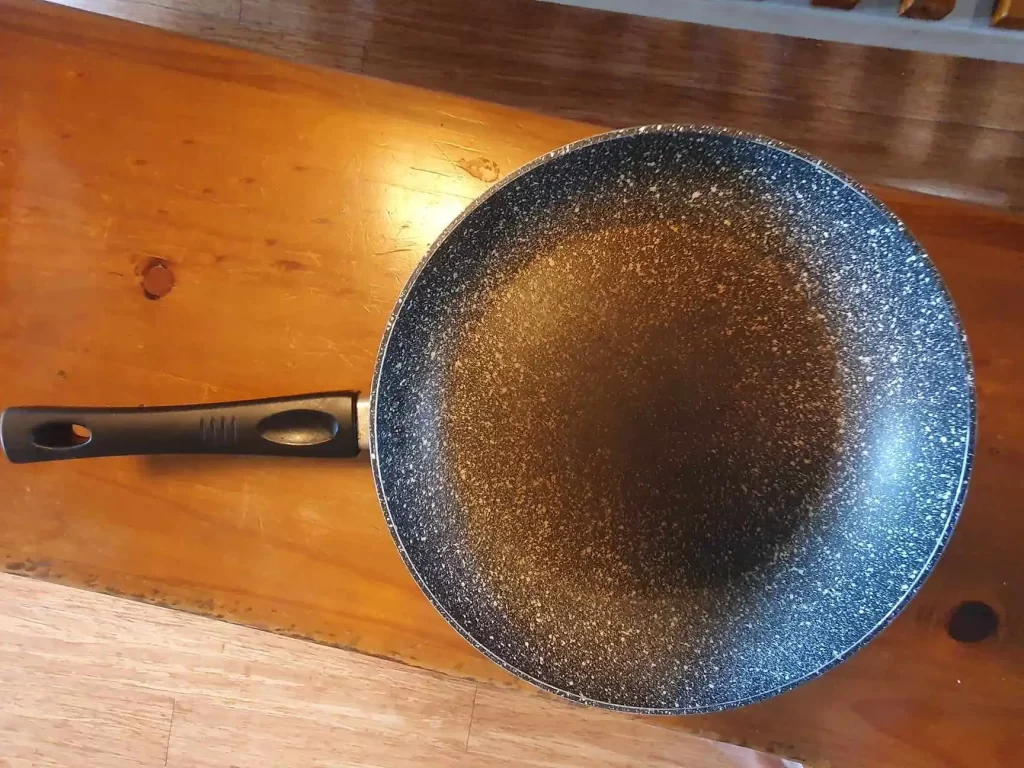 Credit: Image by I’m Plastic Free / Simona Paganetto testing stone ceramic coated cookware, and showing the result after one year of purchase.
Related: The Best Non-Toxic Small Kitchen Appliances That Don’t Shed Microplastics
What are the Safest Non-Toxic Cookware Materials?
To identify non-toxic cookware, we’d like to point out the safest cookware materials on the market, the ones that have existed for centuries and despite not being the most convenient or budget, they are some of the safest and healthiest avalable on the market:
Cast Iron
- A material that has been used since ancient times and withstands the test of time. It heats very well and evenly throughout the product It offers a natural way to increase your body iron levels. One of the cons is that it is a material that is a bit heavy to handle.
Enameled Cast Iron
- A cast iron that has a vitreous enamel glaze (non-porous like glass) applied and fused to the surface to prevent rusting, eliminate the need to season the metal, and allow more thorough cleaning. Enameled cast iron is excellent for slow cooking and drawing flavor from foods.
Wrought Iron
- Wrought Iron is iron that has been heated and then worked to the preferred shape with tools. The main difference to cast iron is that cast iron is melted, poured into a mold, and then allowed to solidify.
Stainless Steel
- If you’re allergic to nickel, buy food-grade nickel-free stainless steel, usually stainless steel (21/0), which means 21% added chromium and no nickel. Stainless steel is not the best at conducting heat, which is extremely important when cooking. Therefore, full-clad cookware is to be preferred because it is more heat-responsive. Full-clad means that the entire body of the pan, and not just its cooking surface, is made of bonded layers of stainless steel with a core made of aluminum or copper, like a sandwich where the stainless steel is always on the outside.
Carbon Steel
- It is lighter than cast iron and more heat conductive and stick-resistant than stainless steel. The smooth cooking surface is great for cooking eggs, like a non-stick pan, but the seasoned vegetable oil coating tolerates far higher heat, and gets better with use and care.
Glass
- As a non-porous material, it is inert and doesn’t hold to any flavor or odor, it is durable. It’s not non-stick though and it requires some form of fat or grease when used at high temperatures. Make sure it is lead and cadmium-free.
Pure Ceramic (Not to be Confused with Ceramic Coating)
- Pure ceramic cookware doesn’t have to be confused with ceramic-coating. The first one is made of 100% ceramic, or better clay and has absolutely no metal or synthetic content. It has a silica-based glaze that gives it a shiny, smooth surface after baking in a kiln. The latter is only a synthetic coating, please see our note below.
These materials are not advertised as non-stick and with reason! They require a bit more care in handling and use but at least they have no synthetic coating. Avoid also copper or aluminum cookware as these materials migrate into food, particularly acidic one.
Titanium
Titanium is not a new material, it has been used in the medical device industry for decades, for example in orthopedic implants, because of its strength, light weight, and biocompatibility with the human body. However, in the last few years, titanium surface pans have come into the market. We have tested and reviewed one brand below.
Related: 13 Non Toxic, Plastic Free Electric Kettles for a Healthy Cup
Is “Healthy Ceramic Coated Nonstick Cookware” Safe?
You might have noticed that we haven’t included non-stick ceramic-coated cookware like Caraway cookware, Bialetti, GreenLife, GreenPan, Our Place etc. in our list because, in our opinion, every synthetic coating triggers some health concerns. Ceramic coating, like Teflon cookware coating, wears out over a short time (usually one year) and it can be damaged easily. This can expose heavy metals like lead, cadmium, neurotoxic aluminum (which is often used as a base) in direct contact with food and be potentially harmful. Have you asked yourself why? So how can manufacturers call these options “healthy”?
Is Ceramic Coated Cookware Made Of Ceramic?
No, ceramic non-stick cookware is not made of ceramic! The apparently non-toxic glass-ceramic thin coating is made from silicone dioxide which is a byproduct of sand. During manufacturing, a process called sol-gel (10) transforms the material and various chemicals like silane, aluminum oxide, tetraethoxysilane, methyltrimethoxysilane, potassium titanate, zirconium (IV) propoxide (ZTP), colloidal silica (CS), polydimethoxysilane (PDMS), and fluoralkylsilane (FAS) (11) into a gel that gives its non-stick properties. Because of its smooth and glossy “look and feel” it’s labeled as ceramic as this word gives people a perception of an “artisanal product”.
In reality though, it’s another synthetic-based polymer coating that is softer than metal, so the surface degrades with normal use. The coating releases some silicone oil that once heated prevents the food from sticking onto the pan, but once that’s finished your food will start sticking. This usually happens after only one year … and yet… another frying pan going to landfill adding to the millions already there, right? Not, that’s not what we mean with zero waste cooking.
In fact, we are not the only ones who are skeptical of the marketing techniques of such products, in 2019 a class action (12) was filed in California against GreenPan.
Furthermore, scientists have reported on the possible release of titanium dioxide nanoparticles from non-stick coatings into food (13). If the manufacturers are not transparent about the coating material they use, what else are they also not transparent about?
This video is a great explainer about the difference between pure ceramic cookware and ceramic coated cookware.
11 Best Non-toxic Cookware Brands with No Synthetic Coatings
In the next section, we’ll share the best non-toxic cookware we could scout, exploring the materials available as non-toxic alternatives to disposable non-stick pans. We’ll answer important questions about cookware safety and provide detailed insights into the top options on the market. By the end of this article, you’ll be equipped with the knowledge you need to make your kitchen a healthier place.
This post contains affiliate links, which means we may receive a small commission, at no cost to you, if you make a purchase through a link. This helps us continue the hard work we put into researching products and solutions.
Please Note: Our health content is for informational purposes only and is not intended as professional medical advice. Consult a medical professional on questions about your health. Please read our disclaimer.
– Best Cast Iron Cookware
1. Lodge Cast Iron Cookware

Lodge has been making some of the best cast iron cookware since 1896 in the USA with non-toxic, PFOA & PTFE free materials. They operate two foundries in South Pittsburg, Tennessee. They have been manufacturing cookware for over 125 years, creating solid, durable pieces that will last for generations. Lodge’s pots and pans are pre-seasoned at the foundry by using 100% only vegetable oil, no synthetic coatings or chemicals for a natural, easy-release finish that improves with use. The more you use the cast iron pots the better the seasoning will get. The unparalleled distribution and retention of heat ensures rapid and efficient cooking.
Made in: the USA
Suggested products:
- Lodge 10.25 Inch Cast Iron Pre-Seasoned Skillet
- Lodge 10.5 Inch Cast Iron Square Pre-Seasoned Grill Pan
- Lodge 5 Quart Covered Deep Skillet
- Lodge Cast Iron Rectangular Reversible Grill / Griddle
Shop Lodge on Amazon
2. Le Creuset Enameled Cast Iron Cookware

Le Creuset is a French-Belgian maker of one of the best non toxic cookware companies. They are best known for producing enameled cast-iron cookware and they have been manufacturing their products in the town of Fresnoy-le-Grand in France since 1925 and offer a lifetime warranty on them. One of their most famous pot designs is the iconic Le Creuset Dutch Oven which is an indispensable tool in the kitchen of master chefs as well as home cooks. Nowadays, the company makes many other types of healthiest cookware options like bakeware, fondue sets, tagines etc. also made of different materials.
The benefits of their enameled cast iron product range are that they deliver superior heat distribution and retention, they are ready to use, they require no seasoning, they are easy to clean and that durable enamel resists dulling, staining, chipping and cracking. One of the disadvantages is that since they require no seasoning, a decent amount of fat is needed each time you cook.
Made in: France
Suggested products:
- Le Creuset Enameled Cast Iron Round Dutch Oven
- Le Creuset Enameled Cast Iron Oval Dutch Oven
- Le Creuset Enameled Cast Iron Alpine Wood Handle Fry Pan
- Le Creuset Enameled Cast Iron Signature Saucepan, 2.25 qt
Shop Le Creuset on Amazon
Related: Why You Should Switch to Plastic-free Microwave Food Covers?
3. Solidteknics Wrought Iron and Ferritic Stainless Steel Cookware
Solidteknics was founded in 2014 by a mechanical engineer and keen cook who was tired of the disposable, synthetic-coated pans piling up in our landfills. Over two decades of R&D he was able to invent a world-first seamless one-piece pan, wrought from a single sheet of iron.
This sustainable cookware is made of a single sheet of thick material in either stainless steel or wrought iron, and it is free from toxins, heavy metals, synthetic coatings, and durable enough to last for centuries so it can be passed from generation to generation. Their range of non-toxic pans are now used in thousands of professional kitchens and happy homes, all over the world.
The AUS-ION™ product range is wrought from clean Australian iron, it’s perfect for all of your everyday oil/fat-based frying, grilling, searing and baking needs. It can be seasoned to build and maintain a healthy natural non-stick surface.
nöni™ is their ferritic, non-nickel stainless steel range, it’s best for slow cooking and cooking wet and acidic foods, though it’s conductive enough to sear a steak. They use ferritic stainless steel because it is non-nickel and nearly twice as conductive as commonly used 18-10 Austenitic stainless steels (18-10 stainless steel means 18% Chromium and 10% Nickel). It is magnetic and therefore compatible with induction cooktops, it requires very low maintenance, it’s easy to clean and it’s even dishwasher safe. Below is an image of our own non toxic skillet from this manufacturer.
We have one pan from each range, we use them regularly as you can see from the images, and we can guarantee the quality of these masterpieces. Once you have them, you have them for life.
Made in: Australia and the USA
Shop Solidteknics on Amazon USA
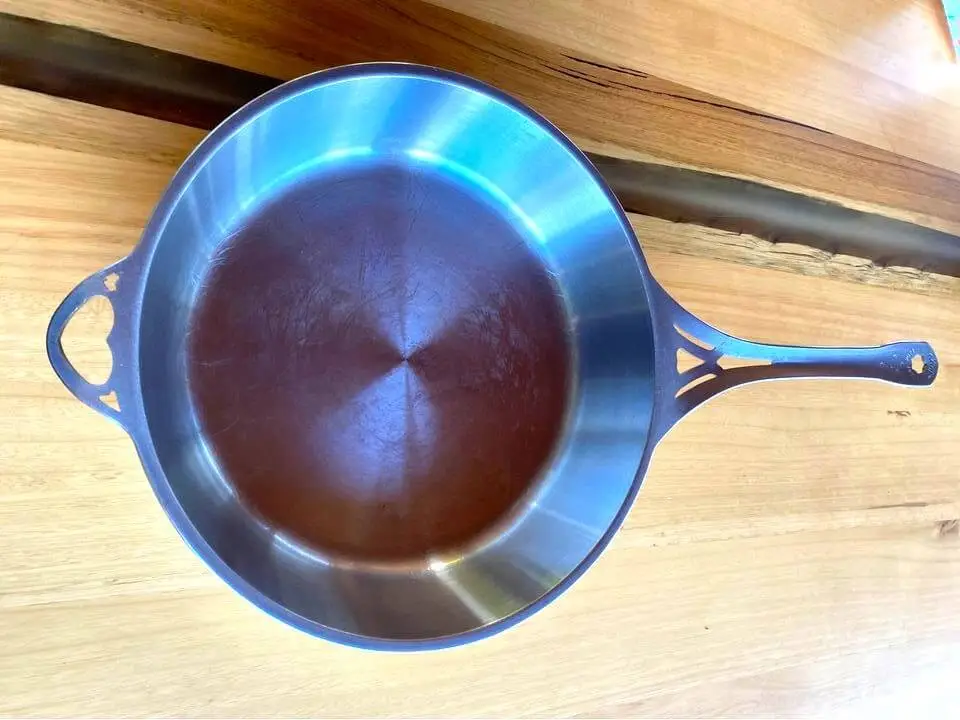 Credit: Image by I’m Plastic Free / Simona Paganetto testing the Solidteknics 31cm Noni™ Sauteuse Pan
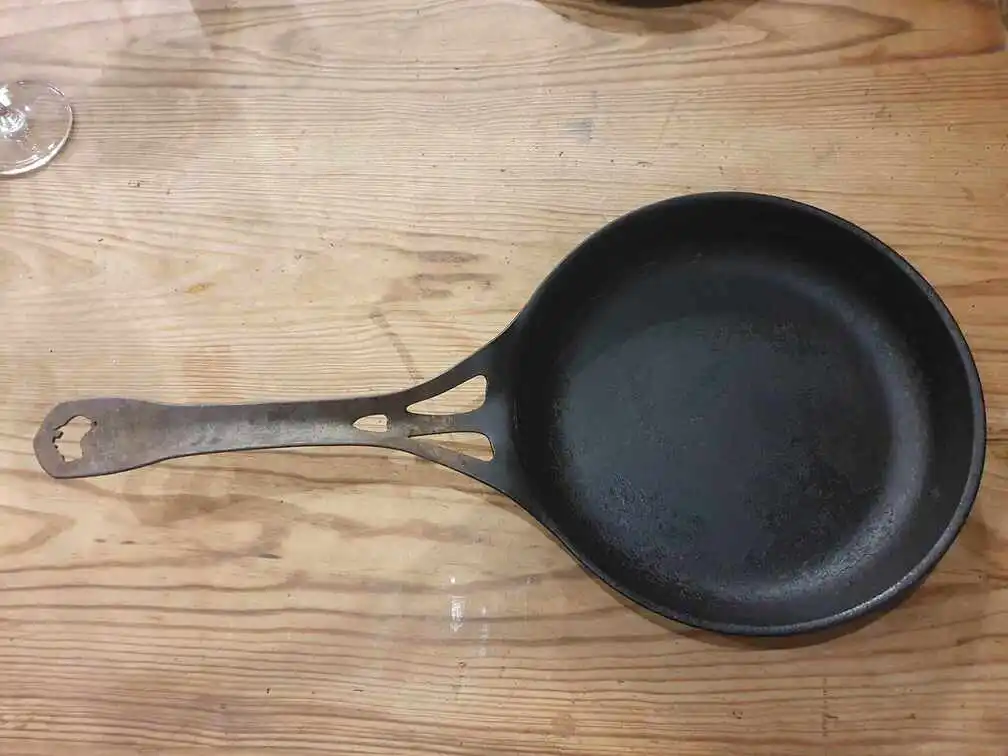
Credit: Image by I’m Plastic Free / Simona Paganetto testing the Solidteknics AUS-ION™ Frypan
Related: Plastic-free Thermomix Accessories for Non-toxic Cooking
– Best Stainless Steel Pans and Pots for Cooking
4. All-Clad Stainless Steel Pots and Pans
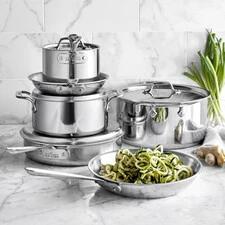

All-Clad is an American cookware company that has been around since 1971 and is best known for its fully clad cookware. The founder is a metallurgist who discovered this technique by accident, as he was trying to build a better pan, a pan built with several bonded layers, also called “plys”. If you are looking for all-cladded stainless steel pots and pans, All-Clad will satisfy your needs. They have a 3-ply, a 5-ply range with aluminum as a core, and another range with copper as a core, plus a small cast-iron product range All products are bonded, engineered, and assembled in Canonsburg, PA.
Their products are compatible with any stovetop including induction. To keep your All-Clad looking brand new, wash your cookware with soap and sponge, using non scratching utensils.
Made in: the USA
Suggested products:
- All-Clad D5 5-Ply Brushed Stainless Steel Set 10 piece
- All-Clad D3 3-Ply Stainless Steel Cookware Set 7 Piece
- All-Clad D3 3-Ply Stainless Steel Frying Pan Cookware Set
Shop All-Clad on Amazon
5. HOMICHEF Nickel-free Stainless Steel Cookware Sets


HOMICHEF has been in business since 1998 and make its products in South Korea and China. They offer stainless steel cookware sets that are nickel-free, non-allergic and are great non-toxic cookware options. Stainless steel cookware generally includes nickel because it’s more corrosion-resistant, however nickel leaches under cooking conditions and it is high up on the ATSDR list of priority toxins (14). Nickel is a known reproductive toxin and is a carcinogen in higher amounts. One of the best stainless steel for pans and pots is stainless steel (21/0), which means 21% added chromium and no nickel. This has extremely good corrosion resistance, but is characterized by high thermal conductivity and magnetism. According to the manufaturer tests show a noticeable degree (12-15%) of energy savings.
Made in: South Korea and China
Suggested products:
- HOMICHEF 3 PCS Whole Food Steamer Set – Nickel Free Stainless Steel Veggie Steamer Pot
- HOMICHEF 14 Piece Nickel-free Stainless Steel Cookware Set
- HOMICHEF 16 Quart LARGE Stock Pot with Glass Lid
Shop HOMICHEF on Amazon
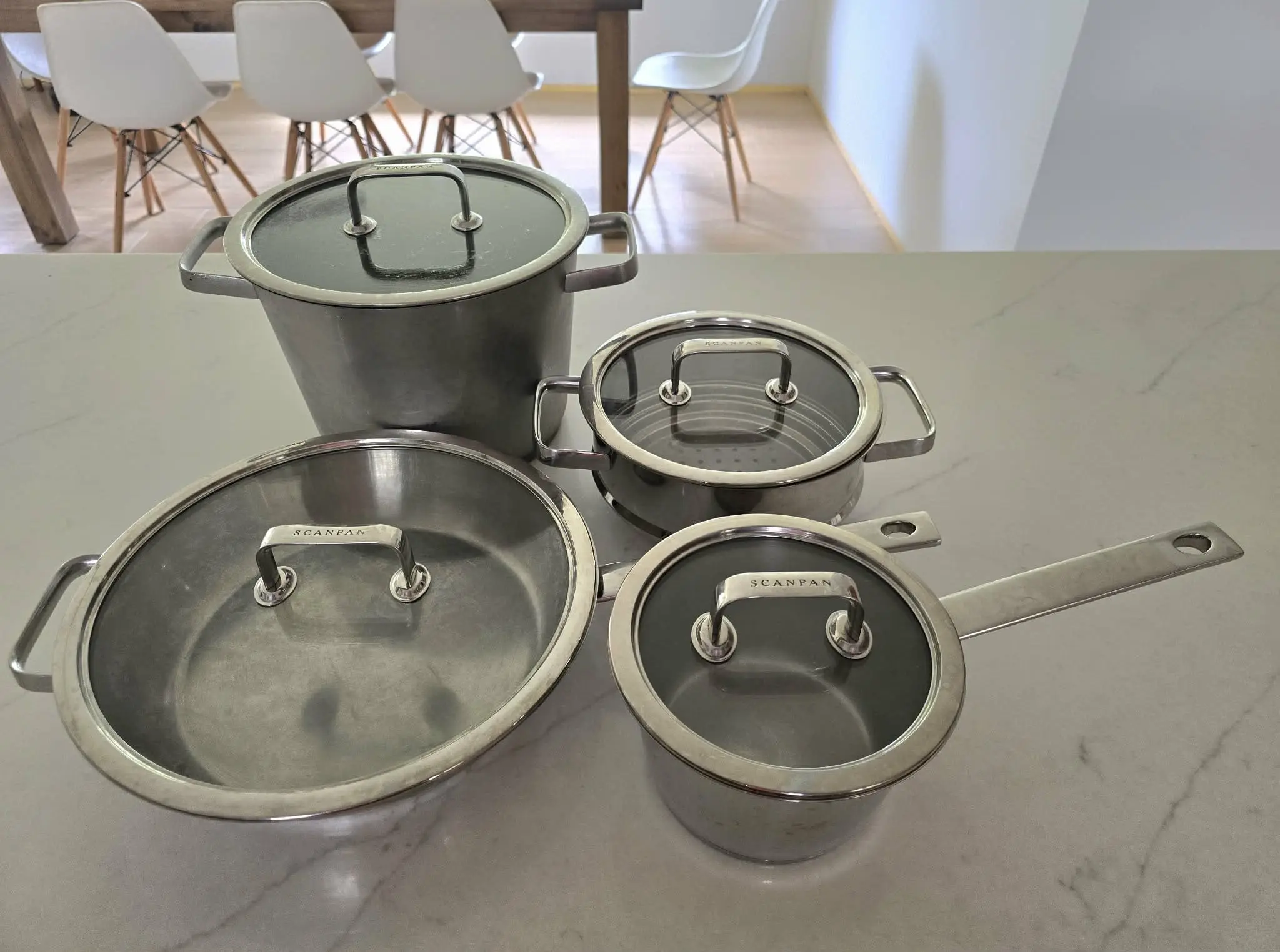
6. SCANPAN Impact Cookware Range
We included the SCANPAN Impact range because this is what we use it ourselves in our home (see our image below), and we think that their quality versus their price is fair. We love also that it is completely plastic free, also in the lid, i.e. no visible rubber or silicone between the glass, the handle, and the screw.
SCANPAN is a Danish company who has been operating for more than 60 years, so their craftsmanship is undeniable, and it’s trusted by home and professional kitchen worldwide.
The IMPACT range is made from durable 18/10 stainless steel, the pieces are induction-compatible, dishwasher safe, and oven safe up to 500°F.
Please note: we don’t recommend any of their coated cookware.
Suggested products:
Shop SCANPAN Impact on Amazon
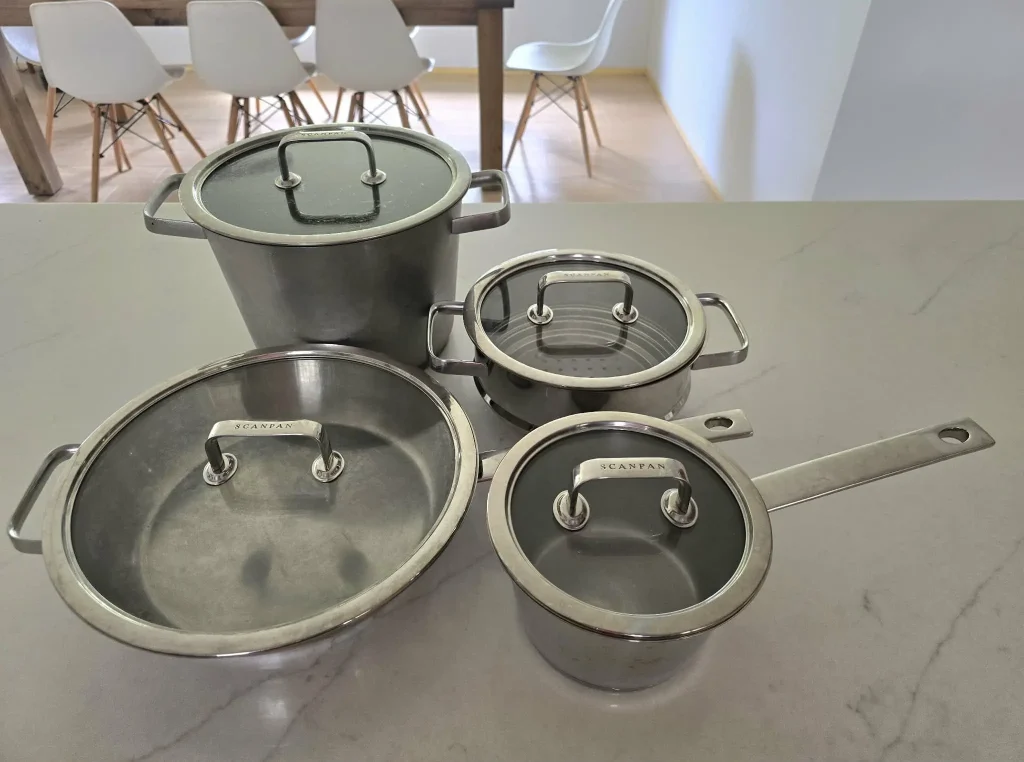
Credit: Image by I’m Plastic Free / Simona Paganetto testing the SCANPAN IMPACT cookware range.
Related: Is it Harmful to Store Food in Plastic Containers?
– Best Carbon Steel Cookware
7. De Buyer Carbon Steel Cookware Made in France
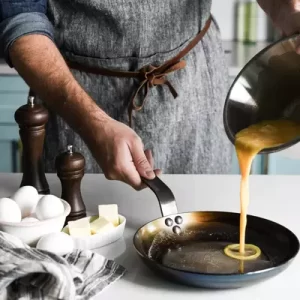

De Buyer has been making steel frying pans since 1830 in a small French village in Val d’Ajol from metals mined locally. Now they work with culinary professionals around the world to develop and produce innovative kitchen utensils. One of their iconic products is the MINERAL B steel frying pan, the essential utensil for searing, grilling, browning for healthy and tasty cooking. It is lighter than cast iron & more heat-conductive than stainless steel. It is finished with French beeswax for an all-natural protection against oxidation and to facilitate the seasoning and therefore the non-stick properties of the pan.
A part from the carbon steel line of cookware, they offer also a range of plastic free cooking utensils in stainless steel, iron, and copper.
Suggested products:
Shop DeBuyer on Amazon
8. YOSUKATA Carbon Steel Woks
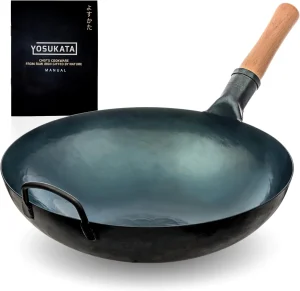
If you’re looking for a non-toxic Asian wok, don’t go past YOSUKATA. Their carbon steel woks are designed to deliver authentic Chinese and Asian flavors, retaining juices and enhancing taste across cooking styles from stir-frying to deep-frying.
They are available pre-seasoned or not, and are available with a flat or round bottom. With ongoing seasoning, over time they develop a natural, chemical-free non-stick surface. They are built from heavy-duty 15-gauge carbon steel with an ergonomic wooden handle, they are durable, heat-resistant, and crafted for traditional high-heat cooking.
We use their blue carbon steel pan (see our photo below) and we couldn’t be happier with the quality.
Made in: China
Suggested products:
Shop YOSUKATA on Amazon
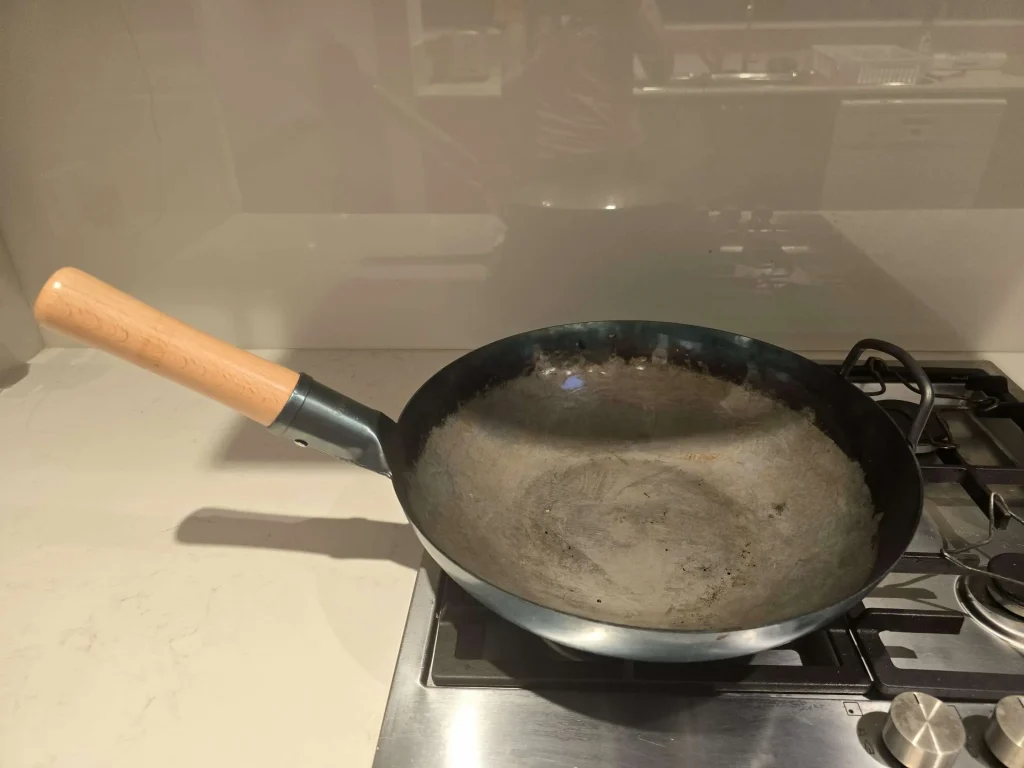
Credit: Image by I’m Plastic Free / Simona Paganetto testing the YOSUKATA wok.
Related: 17 Best Plastic Free Coffee Makers by Style for Deliciuos Non-toxic Coffee
– Best Titanium Cookware
9. TAIMA Titanium Non-stick Pans. Update: Do Not Buy!
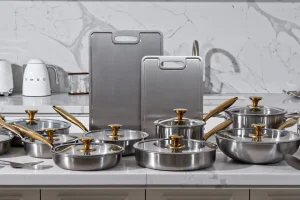
Taima has developed a range of pure, medical-grade titanium cookware and cutting boards that are toxin-free. We decided to test their Extra Large 11.8″ (30cm) pan as they also claim it’s non-stick. The pans and pots are built with a proprietary 5-ply full-clad layering as follows:
- Pure 99.86% Titanium cooking surface with a constructed enbedded SlipScale™ non-stick pattern. What does this mean? This slightly raised pattern naturally creates minimal friction with the food, minimising it from sticking to the pan surface.
- 2x high-conductivity aluminum core layers for even heat distribution
- 2x layers of durable stainless steel coatings for strength and warp resistance
The cookware is safe to be used with metal utensils, it’s compatible with all cooktops, and it comes with a lifetime warranty. Overall, we are very happy with the performance of the pan, as we fried eggs, fish in it and it’s really non-stick compared to a stainless steel pan.
Please note: the packaging is not plastic-free. We think there’s room for improvement for a more circular packaging design.
Update October 2026: we have been made aware that this company is dishonest, and has been deceiving customers. Instead of removing it straight away from the list, we’d like to warn potential customers about it.
Made in: China
Credit: Video by I’m Plastic Free / Simona Paganetto testing the TAIMA Titanium non-stick 11.8″ pan
– Best 100% Ceramic Cookware
10. Xtrema Pure Ceramic Cookware
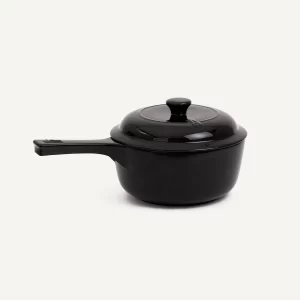
Xtrema is another brand of 100% non-toxic pure ceramic pots and pans. The products are made in China, where over seventy percent of the world’s ceramic products are cultivated and where this material has been invented first. They produce skillets, frying pans, woks, bakeware and even teaware of safe ceramic. Xtrema cookware is perfect when you’re looking for the best cooking tools that provide even heating and excellent thermal retention.
Made in: China
Related: 8 Plastic Free Blender Brands for a Truly Non-Toxic Kitchen
– Best Glass Cookware
11. Visions Glass Cookware

Image: Vintage Visions Cookware tested and reviwed by I’m Plastic Free’s Founder Simona Paganetto.
Visions is a brand of innovative glass-ceramic cookware which was originally created by French multinational Corning in the late 1970s, and later became popular also in the USA and sold worldwide by Instant Brands. Their products are made of a material that belongs to the Pyroceram family of vitroceramics (glass-ceramics). This material is transparent like glass (mostly available in an amber or cranberry tint), non-porous, and features thermal characteristics similar to Corningware, but has improved resistance to staining and the detrimental effects of acids and detergents. It is tested for heavy metals (cadmium, mercury, arsenic, etc.) and does not contain lead.
It is not to be confused with borosilicate glass, it is more resistant than that and capable of withstanding extreme thermal changes and heat of up to 1,560+ °F / 850°C, meaning that it could go from the freezer to the oven without risk of shattering. Therefore, it is dishwasher, freezer, microwave, preheated-oven, broiler and stove-top safe (gas & electric). Some new versions can be used on induction stoves, and are often identified as “IH” (Induction Heating).
For safer non-toxic cooking though, you should never use pieces that are scratched or split as these may shutter, particularly as vintage Visions products are becoming more popular. Finally, it is a very healthy choice due to its non-porous nature, Visions will never stain, harbor odors, or leach anything into your meals. We were lucky to find one at an opp shop and we are happily using it for stews and soups.
Made in: France
Shop Visions on Amazon
Related: Plastic-Free Tea Bags: Which Brands are Really Plastic-Free?
FAQs & Tips about Non-coated Cookware
– How to Achieve a Nonstick Surface with a Stainless Steel Pan like a Non-stick Skillet?
To achieve a non-stick surface with a stainless steel pan you have to create “the Leidenfrost effect”. It helps make stainless steel pans naturally non-stick. All you have to do is to heat a clean, dry metal surface to approximately 200–225°C (380–430°F), then test the temperature by dropping a small amount of water onto it.
This video shows a trick on how to achieve a non-stick surface with a conductive non-nickel stainless steel Solidteknics pan.
– How to Make Scrambled Eggs “Non Stick” in a Seasoned Cast Iron Pan?
To make scrambled eggs without them sticking to to a iron pan, the key is to keep gently scraping the cooked eggs from the outer circle of the pan to the middle at low heat, before they have a chance to dry and burn, and stick to the seasoning. The common mistake is to leave them too long at too high temperature.
– What are the Environmental Issues with Cheap Non-stick Cookware?
Cheap syntethic-coated non-stick cookware brands offer the best budget option but that’s only a short-term view as they want you to buy a new pan every year or two, right? Once scratched you have a toxic cocktail of chemicals leaching into your food and one of the safest things to do is to dispose of these.
However, one of the many problems with these non-stick pans is that they are extremely difficult to recycle as they are often made of multiple materials (steel, Teflon coating, plastic handles etc.) These products aren’t designed for disassembly and repair, so they are just piling up in landfills by the millions every year according to the principles of a linear economy (take – make – waste). Most recycling companies won’t accept them, so they simply get thrown out with the household waste destined for landfills by the millions every year. That is an environmental disaster as the PFAS coating remains in the soil for centuries.
For example, according to Kitchen Warehouse a staggering 72% of Australians toss their old cookware in general waste bins, which equates to a massive 2.7 million pieces of cookware ending up in landfill each year. That’s 7,000 pieces per day. To counteract this Kitchen Warehouse has launched The Great Exchange Pan a cookware recycling initiative.
We hope that this article has helped you find the best eco-friendly cookware picks, as most of them can be recycled at the end of their life.
Conclusion: For Your Health, Switch to Non-toxic Pans and Pots
The ultimate reality is that we pay a price for the “convenience” and that price is our health in the long run. As we wrap up our exploration of the best non-toxic pans and pots and materials, it’s essential to recap the key takeaways:
- Stainless steel, pure ceramic, cast iron, carbon steel, and glass are excellent options for non-toxic cookware. They may be a bit heavier to handle, and yes they may require some more maintenance for washing and greasing the surfaces to avoid rust stains but ultimately they won’t release toxic chemicals every time you cook.
- Choosing the right cookware set can make your cooking experience more enjoyable and efficient. Take time to do your research!
- Don’t buy budget cookware, there is a reason why it is cheap, buy either second-hand or just be ready for an investment that will last for generations.
By following the guidance in this article, you can make informed choices and create a kitchen that promotes the well-being of you and your loved ones. Remember, investing in the safest non-toxic cookware brands is an investment in your health and the delicious meals you’ll prepare in the years to come. We hope that this top non-toxic cookware guide was helpful for you to build a safe and healthy kitchen!
Do you have any questions or comments? Let us know in the comments section below.
Our Expertise:
This piece was written and updated by Simona Paganetto, I’m Plastic Free’s editor and managing director. Simona spent a decade in product management in the healthcare industry, and is, therefore, very familiar with reading scientific studies published in peer-reviewed journals. Simona is certified as a Circular Economy Specialist by the Circular Economy Alliance in conjunction with the École des Ponts Business School in Paris, France. In 2024, she completed the Executive Education for Sustainability Leadership course, from the Department of Environmental Health, Harvard T.h. Chan School of Public Health, Harvard University, thanks to a scholarship from Chief Executive Women (CEW) and the Australia and New Zealand Banking Group (ANZ). This page clarifies her work and experience.
References and Scientific Research Sources:
(1) Luo, Y., Gibson, C. T., Chuah, C., Tang, Y., Naidu, R., & Fang, C. (2022). Raman imaging for the identification of Teflon microplastics and nanoplastics released from non-stick cookware. Science of The Total Environment, 847, Article 158293.
(2) Sajid, M., & Ilyas, M. (2017). PTFE-coated non-stick cookware and toxicity concerns: A perspective. Environmental Science and Pollution Research, 24(30), 23436–23440.
(3) Consumer Reports. (2022). You can’t always trust claims on ‘non-toxic’ cookware.
(4) Ecology Center. (2020). What’s cooking? PFAS and other chemical hazards in nonstick cooking and baking pans.
(5) Tang, Y., Qin, G., Qian, N., Zeng, X., Li, R., & Lai, K. P. (2025). Bisphenol A and its replacement chemicals as endocrine disruptors and obesogens. Environmental Chemistry and Ecotoxicology.
(6) Li, S., Chen, J. C., Costello, E., Walker, D. I., Goodrich, J. A., Dara, L., Golden-Mason, L., Maretti-Mira, A. C., Bartell, S. M., Vieira, V. M., Alderete, T. L., Goran, M. I., Chen, Z., Gilliland, F. D., Baumert, B. O., Rock, S., Ducatman, A., Eckel, S. P., Conti, D. V., … Chatzi, L. (2026). Associations between per- and polyfluoroalkyl substances and metabolic dysfunction-associated steatotic liver disease in adolescents and young adults: Modifying roles of age, lifestyle factors, and PNPLA3 genotype. Environmental Research, 288(Pt. 2), Article 123320.
(7) Darrow, L. A., Groth, A. C., Winquist, A., Shin, H.-M., Bartell, S. M., & Steenland, K. (2016). Modeled perfluorooctanoic acid (PFOA) exposure and liver function in a Mid-Ohio Valley community. Environmental Health Perspectives, 124(8), 1227–1233.
(8) United States Environmental Protection Agency. (2017). Contaminants of emerging concern – PFOS and PFOA (Fact Sheet).
(9) Conley, J. M., Lambright, C. S., Evans, N., McCord, J., Strynar, M. J., Hill, D., Medlock-Kakaley, E., Wilson, V. S., & Gray, L. E., Jr. (2021). Hexafluoropropylene oxide-dimer acid (HFPO-DA or GenX) alters maternal and fetal glucose and lipid metabolism and produces neonatal mortality, low birthweight, and hepatomegaly in the Sprague-Dawley rat. Environment International, 146, Article 106204.
(10) Orion Industries (n.d.). Sol-gel coatings.
(11) Ak, A., & Çiçek, B. (2021). Synthesis and characterization of hydrophobic glass-ceramic thin film derived from colloidal silica, zirconium(IV) propoxide and methyltrimethoxysilane via sol–gel method. Journal of Sol-Gel Science and Technology, 98, 252–263.
(12) Top Class Actions. (2022). GreenPan class action says non-stick pans contain toxins.
(13) Food Packaging Forum. (n.d.). Nanoparticles released by quasi-ceramic pans.
(14) Agency for Toxic Substances and Disease Registry. (n.d.). Substances Priority List (SPL). Centers for Disease Control and Prevention.





Dee Wood
January 5, 2024 at 3:44 amHi, Great article and info. I mostly use Le Crueset cast iron, or their enameled cast iron. But, what do you do when you want to fry/scramble an egg? Do you have any recommendations for a “non-stick” pan that would not be toxic? Guessing from your article there is no such thing, but asking in case you can suggest…thanks.
I'm Plastic Free
January 5, 2024 at 3:56 pmHi Dee,
Thank you for your message and happy to hear you enjoy the content of my site!
It is a great question regarding the scrambled eggs. To be honest with you, I haven’t come across a 100% safe non-stick surface until now… so I do not own any non-stick pans any longer so the temptation to use them is gone! (Best way not to continue to use them!)
I use a stainless steel pan with a wooden spatula, the eggs do stick a bit but I put a bit of milk towards the end and that makes it easier….
Then I wait for the pan to cool off, put water and a bit of detergent, and let it soak for a few hours. When I clean it, it’s super easy then!
However, I want to buy next a cast iron skillet like this one next https://amzn.to/3vsHhpq as I read and heard from friends that it’s even easier to fry eggs than stainless steel!
I hope this helps!
Kind regards,
Simona
Cristian
February 15, 2024 at 2:36 amHi, ultimately you can learn how to season properly a carbon steel fry pan, many videos of how to do it on YouTube, it’s true its no easy task but once done you get a non stick surface that’s gonna last a life time, only thing is that you can’t cook acidic foods on it like tomatoes, lemon or wine. I bought a merten and storck 20cm fry pan to experiment with it and once seasoned properly fried eggs slide like a hockey puck around it. Cheers
I'm Plastic Free
February 22, 2024 at 4:27 pmHi Cristian,
Yes, you’re right, it’s the matter of developing the habit to season properly your pan. Thank you so much for sharing your experience.
Kind regards,
Simona
Jean
April 28, 2025 at 5:34 pmA well seasoned cast iron pan is non stick. I prefer the Finex brand. Found it on the list at NonToxU of healthy cookware. It looks interesting which fits my Bohemian and Eclectic style. Also this can be achieved with a stainless steel pan. Cooking at Pam’s Place is where I learned it. You don’t add the oil or food until drops of water dance on the surface, not just sizzle.
Mikael
March 12, 2024 at 10:58 pmHi
There is a Swedish comapny named OnePan(.se) that sells a Ceramic/SolGel coated pan that goes in a cicular system. You can order a recoat when its worn out. No pans in landfill and you can enjoy non-stick without buying new pans.
I'm Plastic Free
March 14, 2024 at 9:44 pmHi Mikael,
Thank you for this feedback! We were not aware of that Swedish brand. It’s great that they offer to re-coat your pan, so that you don’t have to throw it away. Personally, we prefer non-coated pans for the reasons outlined in the article, but it can be an option for those people that can’t live without a non-stick pan.
Thank you
Kind regards,
Simona
Babu
May 22, 2024 at 3:26 pmYou might want to remove Xtrema from your list. By now its clear that they have been blatently lying about their products, actually containing lead and other metals. Read about it on the Tamara Rubin blog.
I'm Plastic Free
May 24, 2024 at 6:52 pmHi Babu,
We contacted the manufacturer and this is what they replied:
“We want you to know that your family’s safety and health are our highest priorities at Xtrema. As a brand, we stand firm in our products and believe in the health & safety of our cookware and houseware items. We have conducted thorough testing through accredited laboratories since we opened our doors in 2007. It’s important to note – our tests are performed in third party laboratories (unbiased) in accordance with California Prop 65, the strictest standards for lead and cadmium leaching. On our website we state about products containing no extractable lead or cadmium. The materials that we use come from the earth which can contain trace amounts of heavy metals. We consistently test these materials and our products in order to ensure that they are not able to be extracted from our products and expose customers to unacceptable amounts of lead in accordance with California Prop 65. Our language reflects the third party testing that is done on our products.
The surface of our products is fired at over 2000 degrees Fahrenheit and all of the materials become permanently bonded to each other through firing. Leaching in the context of ceramics/glass is very important to understand. Glazes/glasses if well composed and fired are an amorphous solid. Glaze systems are designed because of their inherent stability. Glaze creation is fairly simple chemistry, where we convert minerals into a glass. All of the materials are contributing to the inherent chemistry of the glaze so any molecules or materials in the composition stay in the final material. When done correctly materials will not be able to escape and leach into food. This is where third party leach testing is performed to confirm that our products are being fired and manufactured correctly.
Here are the results of the tests:
– Xtrema Cookware 2022 Prop 65 Test Results-PASS
https://cdn.shopify.com/s/files/1/2996/3722/files/xtrematesting041922.pdf?v=1650421873
– California Prop 65 Testing
https://cdn.shopify.com/s/files/1/2996/3722/files/CaliforniaProp65-2017.pdf
– Xtrema Cookware BSC labs USA test results for unglazed cookware-PASS
https://cdn.shopify.com/s/files/1/2996/3722/files/unglazedxtrema050621_BSC-USA.pdf?v=1624506340
At Xtrema Cookware we stand behind our products and take true joy being fully transparent with our customers. Your health and wellness is why we are in business and allows us the opportunity to continue to innovate and grow our company”
I hope this helps.
Kind regards,
Simona
Babu
May 28, 2024 at 4:40 amYes, their dishes are glazed. And thats not pure ceramic cookware as glazes contain a lot of nasty things. See how they fraise on their site: “
Babu
May 28, 2024 at 4:46 am“No extractable lead or cadmium” Smart wording for legal purposes. Just because smth is not extractable doesnt mean its not there. Pure ceramic is never glazed (unless its with the traditional firing with milk), and this is the only real version of ceramic (pure unglazed) that truly doesnt contain any harmful chemichals. And Xtrema IS glazed.
irene
May 24, 2024 at 8:57 amhi, is there any safe wok brand options? something big enough for a family of 4? i can’t seem to find any safe alternatives.
I'm Plastic Free
May 24, 2024 at 7:29 pmHi Irene,
Thanks for your question, I love cooking with a wok, it’s so easy to make stir fries!
Lodge has a 14″ cast iron wok made in the US, however it’s heavy and it doesn’t have a long handle which I like in a wok. https://amzn.to/3WVwLT8
All-Clad also has a 14″ wok made of copper core 5-ply stainless steel https://amzn.to/3Khe19g
Otherwise, a brand that doesn’t use synthetic coatings and is specialized in woks is Yosukata, that would be my preference: https://amzn.to/3WVxnbo
I hope this helps, and happy cooking!
Kind regards,
Simona
Aubrey
May 27, 2024 at 4:17 amWhat about stoneware? Would it be considered non-toxic?
I'm Plastic Free
May 29, 2024 at 12:08 pmHi Aubrey
Thanks for the question. Yes, stoneware like clay pots, terracotta pots are fine and have been used for thousands of years for cooking. Usually, they have some glazing on top which make them non-porous on the internal side where the food goes. My mum used to cook with a terracotta pot and the sauces were delicious!
Kind regards,
Simona
Rachelle
November 13, 2024 at 12:06 pmAll Clad is out of my budget – is Essteele Stainless Steel, cooper inside pots and pans and equally safe alternative in your opinion? Thank you!
I'm Plastic Free
November 18, 2024 at 9:09 pmHi Rachelle,
Sorry about the late response. I was away, I’m Italian and based in Australia too. Yes, Essteele is a good quality budget brand, and made in Milan, Italy! I have one of their stainless pans which I purchased here https://www.amazon.com.au/stores/Essteele/page/E8C45F22-62F7-4CDF-90D7-D5CCB5051B74?&linkCode=ll2&tag=implasticfree-22&linkId=78156772acbd02232e2b8aeb9cb9e544&language=en_AU&ref_=as_li_ss_tl and I’m very happy with it. I was thinking of adding this brand to this blog article though my major audience is in North America…
Thanks for asking!
Kind regards,
Simona
Anyone know about a 100% stainless steel toaster over that has stainless Steel on the inside components
November 24, 2024 at 12:14 amWould love to find a stainless steel toaster over on the inside and on the inside components
I'm Plastic Free
December 2, 2024 at 4:12 pmHello,
Thanks for your comment! We haven’t done a thorough research yet on toaster, but at first sight, there seem to be many that are made with stainless steel inside and outside: https://amzn.to/41khxcm
Some plastic components are necessary for the tray/bottom.
Kind regards,
Simona
Adriana
November 27, 2024 at 12:42 pmHi
Do you have thoughts on the “Cooks Collective Brand” in Australia
Thank you
I'm Plastic Free
November 29, 2024 at 2:06 pmHi Adriana,
yes, we do, we do not promote non-stick cookware for the reasons highlighted above.
Kind regards,
Simona
Fatima
December 23, 2024 at 5:42 amThank you so much for your article. However, I’m still unsure which cookware would meet all my expectations. I’m looking for healthy, affordable cookware that can be used on induction cooktops, requires less oil, and can withstand high heat when cooking meals or acidic foods like tomato sauce. Do you have any suggestions?
I'm Plastic Free
January 5, 2025 at 3:30 pmHi Fatima,
Thank you for your question. It’s very hard to just suggest a brand over an other as it depends on your needs. Our only sggestion would be not to buy a complete set, but buy instead single pans and pots made of different materials suggested in the article. Over time, you’ll get a feeling for what you need and what best meets your expectations. Our suggestion is not to buy “non-stick cookware” for the reasons mentioned in the article.
I hope this helps.
Kind regards,
Simona
D
December 30, 2024 at 3:34 amWhat about Cuisinart Multiclad? I just purchased the 12 pc set and their onyx black and rose gold skillet set. Should I purchase Homichef instead? I see that Homichef does not include nickel, what about any other dangerous materials?
D Knight
December 30, 2024 at 3:35 amWhat about Cuisinart Multiclad? I just purchased the 12 pc set and their onyx black and rose gold skillet set. Should I purchase Homichef instead? I see that Homichef does not include nickel, what about any other dangerous materials?
I'm Plastic Free
January 5, 2025 at 2:57 pmHi D,
Thank you for your question, and our apologies for the late response. We have been away over the Christmas holidays. We have not reviewed that brand and product line in particular, so we are unable to comment on that. Definetely we can state that Homichef has the best affordable no-nickel pans and pots. https://amzn.to/3BV64G5
Kind regards,
Simona
Anita Vass
February 13, 2025 at 6:59 amDear Simona,
thank you for the informative article, it is super useful and educative as well! 🙂
May I ask about the Silargan cookware? I read that these pans are not 100% ceramic but the Silargan is fused to a steel body.
I was wondering if they use any nano-metals or other chemical substances while they apply the coating? I red that not just the coating, but how they apply the coating also matters, because sometimes during this process the coating becomes toxic..
I would love to try 100% ceramic cookware, but unfortunetly ordering Xtrema to Europe is very expensive. 🙁 Therefore I decided to go for Silit Siligran from your list, I was just wondering if it is as safe as a 100% ceramic cookware?
thank you ahead for your kind answer! 🙂
I'm Plastic Free
February 15, 2025 at 5:17 pmDear Anita,
Thank you so much for your kind words. We are very passionate about this project! You’re asking some very valid questions there, and unfortunately, despite researching about Silargan and how it is manufactured and applied, we couldn’t find anything more than what we wrote… probably because it is proprietary information. Maybe something we would suggest is to ask the manufacturer for test results about their cookware and material? Please send these to us too if they respond (info@implasticfree.com)
Kind regards,
Simona
Naomi
March 18, 2025 at 3:13 amHi there
I have just discovered you. I am so happy! Thank you for putting in all this hard work.
I see your comment on stoneware above. When you say they usually have some glazing on top, is this usually glass and is it acceptable? I am thinking about the Le Creuset stoneware. Do you think they are okay?
Many thanks,
Naomi
I'm Plastic Free
March 20, 2025 at 1:03 pmHi Naomi,
Thanks for your question. Yes Le Creuset is a great quality brand. Their body is usually cast iron, their coating is porcelain enamel. It is fired at very high temperatures, making it durable, easy to clean, and non-reactive. Fnd their range here: https://amzn.to/4kClWPg
I hope this helps.
Kind regards,
Simona
Jennifer
May 3, 2026 at 7:21 amWhat are your thoughts on Magnifique kaolin clay cookware?
I'm Plastic Free
May 3, 2026 at 5:23 pmHi Jennifer,
We never came across that brand so we can’t comment on Magnifique, but if it’s pure kaolin clay it should be non-toxic.
Kind regards,
Simona
Melanie
May 27, 2026 at 5:41 amHello! Thank you for your much-needed research! We need more people like you!
I live in the United States but grew up in Europe and therefore know to trust European brands much more. I love supporting local but Europe, Australia, and some Asian companies have much stricter regulations on toxins. Therefore, I’d much prefer a stainless steel or titanium set of pots and pans made entirely outside of the USA. With this in mind, what would you recommend? I’ve tried Taima but they were the worst company I’ve ever worked with and will not order from them again. I received the wrong size product and they refused to rectify the situation so I don’t trust them for future purchases. What other international brand would you recommend? I’m looking at Made In stainless steel but first wanted your thoughts. Thank you!
I'm Plastic Free
June 12, 2026 at 9:01 amHI Melanie,
Sorry to hear about your experience with Taima.
For non toxic cookware brands not made in the US, I’d recommend:
Le Creuset https://amzn.to/4a1mPgx
Solidteknics https://www.solidteknics.com/?cfclick=a675e229f3044789ac5c40411d2780e3
HOMICHEF https://www.solidteknics.com/?cfclick=a675e229f3044789ac5c40411d2780e3
SCANPAN https://amzn.to/4fasrbO
I hope this helps!
Kind regards,
Simona
Cindy
August 3, 2026 at 4:00 amWhat about our place?
I'm Plastic Free
August 3, 2026 at 2:58 pmHi Cindy,
We checked Our Place, but their cookware is non-stick ceramic or non-stick titanium, and we do not recommend either of them. They mention “Titanium interior with NoCo® nonstick technology” and we couldn’t find much information about it… We highlighted in this article what “non-stick ceramic coating” means and it’s not pure ceramic!
I hope this helps
Kind regards,
Simona
Add a comment