


I’ve been campaigning against plastic pollution since 2018 through I’m Plastic Free. Over the years, I came to understand the impact of microplastics and human health as these tiny plastic particles are everywhere: in our oceans, in our soil, in our water, food chain, and even in the air we breathe. But if you asked me back six years ago, I never thought I’d be testing for them inside my own body today.
That changed this year when I received the opportunity to test PlasticTox, the world’s first test for microplastics in human blood, which was first confirmed in a peer-reviewed and independently validated study (1) in 2022.
I know this may sound wild for some, but there’s growing concern over how microplastics might affect our health, from cancer, respiratory disorders, gut inflammation (2), to hormone disruptions (3), just to name a few, and I definitely would like to stay ahead of the curve in how to reduce my exposure.
This post contains affiliate links, which means we may receive a small commission, at no cost to you, if you make a purchase through a link. This helps us continue the hard work we put into researching products and solutions.
Please Note: Our health content is for informational purposes only and is not intended as professional medical advice. Consult a medical professional on questions about your health. Please read our disclaimer.
Related: How to Avoid Microplastics in Food: 10 Practical Tips for a Healthier Diet
What is an At-home Microplastics Blood Test Kit?
Imagine a tiny finger prick test that shows whether microplastics and nanoplastics, those invisible plastic shreds from everyday life, are floating in the human bloodstream.
That test now exists: it’s called PlasticTox blood test for microplastics, and it’s a research and development product by ArrowLab Solutions. To allow you to understand what your microplastic exposure levels in your blood are, it uses a method that is peer-reviewed, independently validated, and conducted in a CLIA/COLA-certified lab. PlasticTox’s analytical method dissolves all lipid cells prior to running. The Mayo Clinic, University of Manitoba, and UT Health San Antonio (UT-HSA), all use PlasticTox for ongoing research. See this peer-reviewed publication using the PlasticTox test (4).
In a specially designed, plastic free, BSL-2 (Biosafety Level 2 ) lab in the Netherlands, scientists use a specialized and proprietary dye that stains plastic particles. Advanced imaging techniques, then, detect and count particles sized between 1–70 µm, revealing not just if, but how much, along with the size and likely types of plastics, allowing for an estimated particle concentration.
My kit arrived in eco-conscious packaging with clear instructions. All I had to do was prick my fingertip with a tiny lancet, place a few drops of blood on a card, let it dry, and send it back in the prepaid envelope at my local post office. That was it.
It was the first at-home testing I have ever done, and it felt a bit strange… like I was mailing a piece of myself to science. Most recently, I also participated in the National Bowel Cancer Screening Program offered by the Australian Government, and I’m becoming more familiar with such screening tests. I think that they will become an integral part of our long-term health in the future.
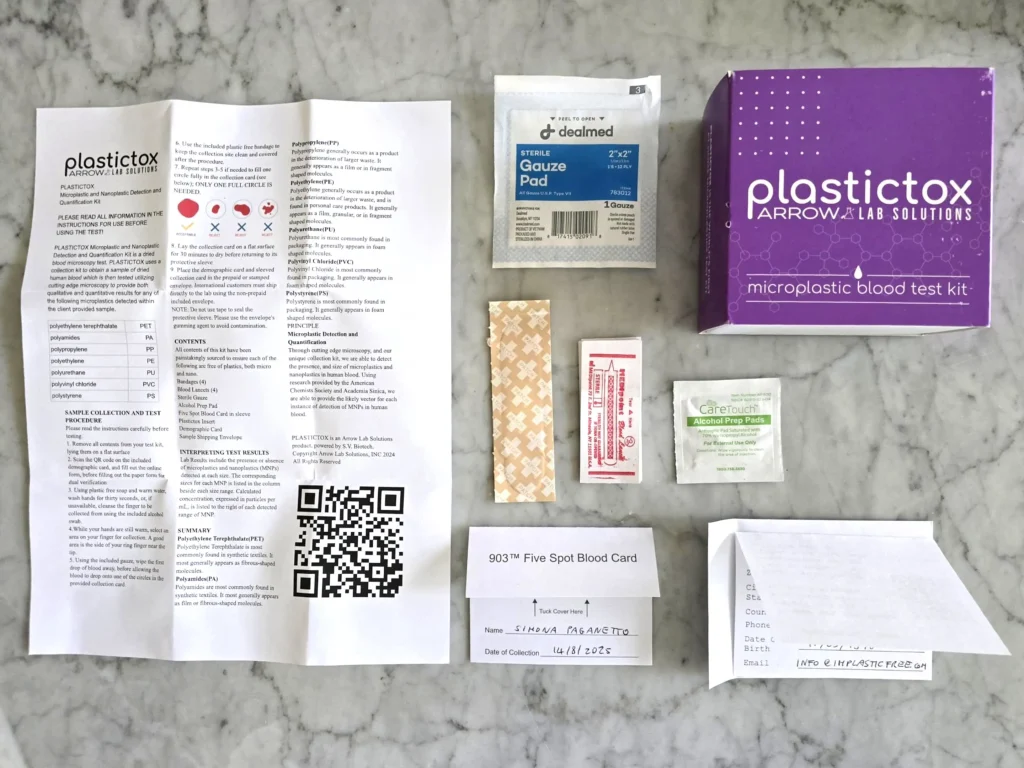
Image Credit: I’m Plastic Free – Simona Paganetto showing all the components of the the PlastixTox Microplastic Blood Test Kit
Related: Plastic Free Water Filters: Can We Find Water Purifiers without Plastic?
What Types of Microplastics and Nanoplastics are Detected and Quantified in the Microplastics Test Kit?
PlasticTox uses a collection kit to obtain a sample of dried human blood, tested by utilizing cutting-edge microscopy to detect any of the following microplastics and nanoplastics in your blood:
- Polyethylene terephthalate (PET)
- Polyamides (PA)
- Polypropylene (PP)
- Polyethylene (PE)
- Polyurethane (PU)
- Polyvinyl chloride (PVC)
- Polystyrene (PS)
They also developed a world-first microplastic oral fluid test kit. This will show all detectable microplastic polymers present in your saliva. Each self collected sample is tested for each known polymer. Results include number of contaminants, sizes of detected plastic particles, and calculated concentration of plastic particles in your saliva.
Check out the PlasticTox at-home microplastics testing kits.
Video credit: I’m Plastic Free – Simona Paganetto testing the PlasticTox Mircoplastic Blood Test Kit
The Microplastic Blood Test Results
As I have been dealing with the health effects of plastic for a while now, I thought I was ready for anything. But as I waited for my results, I couldn’t help but feel a bit anxious. After all, if microplastics are inside me, what does that mean for my long-term health?
Within a month, the results arrived via email in a PDF. The report broke down exactly how many particles were found, their size, and concentration. To me, it was confronting.
There were 41 microplastic particles in my blood droplets, and my results were pretty right in the middle, from a range that went between 0 on one end, and 96+ on the other:
- 29 particles were detected in the size category <10 µm
- 12 particles were detected in the size category 10-30 µm
- 0 particles were detected in the size category 30 -70 µm
The calculated concentration, based upon an assumed collection of a 100 µm sample, was 410 P/ml. Seeing the proof on paper (well, in digital form in this case), made something I’d talked about at least for the past seven years suddenly very real. Plastic isn’t just polluting the planet; it’s polluting me.
Related: The Hidden Ingredient in Salt. 3 Microplastic Free Salt Brands You Can Trust
What is the Meaning Behind the Results?
I read further to better understand the results:
- The smallest particle sizes (<10 µm) are linked mainly to inhalation as the entry point. These are the most concerning, since they can bypass the body’s finest protective barriers, including the blood-brain barrier.
- Medium-sized particles (10-30 µm) are too large to cross the blood-air barrier but can move through the blood-gut barrier, meaning they likely enter the body through ingestion, aka through food and drinks.
- The largest particles (30 -70 µm) are considered too big to pass through either pathway. Current research suggests that they may enter the bloodstream directly, possibly through blood transfusions, intravenous medications, or due to issues with sample collection.
The results also made me aware that plastics in the body tend to accumulate over time, leading to a gradual buildup. They immediately raised tough questions:
- I haven’t used single-use plastics in the past ten years, apart from food packaging… So, where were these particles coming from?
- Could they be linked to food packaging, synthetic clothing, or even the water I drink?
- Or would they be related to the fact that my father was a chain smoker and I spent the first 19 years of my life (I’m 47 now) in the same house as a heavy passive smoker? Studies (5) confirm that cigarette smoke may be a previously underestimated source of respiratory microplastic exposure.
- Most importantly, what are they doing to my health in the long run?
I’m not a doctor, I’m not even a scientist, and even science doesn’t have all the answers yet. But knowing my own results gave me power. It motivated me to double down on choices I was already making: avoiding single-use plastic, filtering my water, swapping plastic for other materials, and choosing natural fibers whenever possible.
Related: Microplastics in Food. The Latest Research
What Steps Am I taking Next?
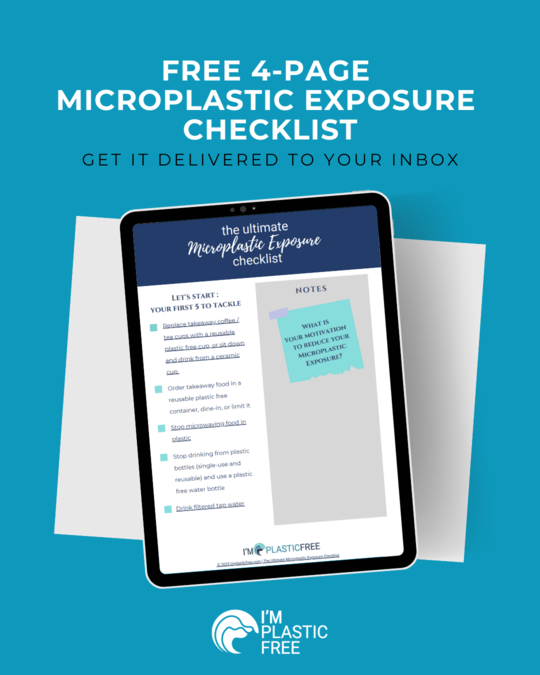
I didn’t do this test just for myself, I did it because I believe awareness leads to action. If more of us test, measure, and see the reality inside our own bodies, we can’t ignore the problem any longer. Plastic pollution isn’t “out there” anymore. It’s in us. Once you see the results, you’ll never look at plastic the same way again. For me it was already like this before taking the test, but now, I decided that I’ll do my best even further to help everyone who wants to reduce their exposure with the I’m Plastic Free platform, by offering a free checklist to my audience as a start.
Related: Free Microplastics Exposure Checklist
FAQ
Who Should Test Their Levels of Microplastics The Most?
Of course everyone who is interested in microplastic pollution or at least in health and wellness can do the screening, as I did. However, according to PlasticTox, these are the categories that should think most about testing based on people’s profession, location, or their lifestyle:
- Currently or formerly a firefighter
- Employed or previously employed in manufacturing
- Reside or have resided near a manufacturing site
- Rely on municipal tap water
- Currently or formerly employed in the carpet or cleaning sector
- Currently or formerly worked with textiles or clothing
- Frequently eat takeout or fast food
- Wear water- or stain-repellent apparel, uniforms, or footwear
- Currently or formerly employed in construction or food packaging
- Use or have used e-cigarettes or vape products
What is in a At-home Microplastic Blood Test Kit Itself?
You might think that the contents of the kit might contaminate the test results, right? Well, instead, PlastixTox has painstakingly selected each component to be free of both micro- and nanoplastics. It included:
- Bandages
- Blood lancets
- Sterile gauze
- Alcohol prep pad
- Five spot blood card in sleeve
- Test insert
- Demographic card
- Sample shipping envelope
Related: Plastic-free Tea Bags. Which Brands are Really Plastic-free?
Final Notes
Knowing what’s in your bloodstream might be the first step toward meaningful change. Whether you are a first-time tester like me, or those tracking their progress, this tool supports ongoing health monitoring and informed lifestyle changes, especially in the growing interest towards longevity.
However, it’s important to note that PlastixTox is not a diagnostic tool; it’s a research and development tool, and at-home microplastic testing and its implications are still emerging. Further research is required to determine the direct health risks of detected particles.
Would you take a test to find out how many microplastic particles are in your blood?
Let us know in the comments below.
For more information, check out the PlasticTox Screening Kits
References & Scientific Literature Resources
(1) Leslie, H. A., van Velzen, M. J. M., Brandsma, S. H., Vethaak, A. D., Garcia-Vallejo, J. J., & Lamoree, M. H. (2022). Discovery and quantification of plastic particle pollution in human blood. Environment International, 163, 107199.
(2) Winiarska, E., Jutel, M., & Zemelka-Wiacek, M. (2024). The potential impact of nano- and microplastics on human health: Understanding human health risks. Environmental Research, 251, 118535.
(3) Ullah, S., Ahmad, S., Guo, X., Ullah, S., Ullah, S., Nabi, G., & Wanghe, K. (2023). A review of the endocrine disrupting effects of micro and nano plastic and their associated chemicals in mammals. Frontiers in Endocrinology, 13, 1084236.
(4) Helgeson, S. A., Alaws, H., Ibrahim, M. I., Lee, A. S., Vlecken, D. H. W., & Baig, H. Z. (2026). The association of microplastics in peripheral blood and pulmonary disease: A pilot study. Journal of Xenobiotics, 16(3), 72.
(5) Özçelik, N. (2025). Tobacco-related microplastic exposure: An overlooked respiratory health risk. Tobacco Use Insights, 18, 1179173X251366004.






Jolie
October 17, 2025 at 12:28 amThank you so much for sharing this. I am a big fan of cutting-edge diagnostics. I will seriously consider taking this test. As someone who avoids using plastic, but probably not as scrupulously as you, I am curious what my results would be. I have high risk factors for Alzheimer’s so the BBB and plastics are of interest to me.
I'm Plastic Free
October 17, 2025 at 7:01 pmHi Jolie,
Thank you for your comment. Yes, I was very shocked when I received the results and I’m planning to redo the test in one year time, or two, to see if there’s any difference. It’s a real eye-opener…
Kind regards,
Simona
mike
October 21, 2025 at 7:14 pmI did the test today. Pricked my finger 3 times before the penny dropped. Drank 2 large glasses of (filtered) water. Waited 20 minutes then only 1 prick required.
I’ve been looking at all the tips. Great website Simona
I'm Plastic Free
October 21, 2025 at 9:24 pmHi Mike,
Oh wonderful that you took that step! I think it’s an important one. It’s a baseline from where to start making conscious steps to reduce our daily exposure to microplastics… I’ll keep my fingers crossed for your results!
… and thank you for your kind words about my project!
Kind regards,
Simona
Noelle
January 9, 2026 at 10:53 pmGreat article. I did this test recently and got back the results. I’ve been trying to raise awareness on this as I think it will increasingly become an issue considering that we are polluting ourselves (along with our environment and other species). thanks!
I'm Plastic Free
January 13, 2026 at 8:17 amHi Noelle,
Thank you for your kind words, and I fully agree! Great that you also tried the microplastic blood test! It’s a great baseline and gives motivation to reduce our exposure to microplastics!
Kind regards,
Simona
Luane Osborne
April 17, 2026 at 10:39 amDo you give any information re: detox meds or home made remedies?
I'm Plastic Free
April 19, 2026 at 7:05 pmHi Luane,
No we are not a medical provider and our disclaimers state this. In the future though, we might list on our directory companies that sell supplements that help detox from microplastics.
Kind regards,
Simona
Jay
May 5, 2026 at 10:03 pmI’ve been told that once microplastics get in your system, that there is no way to get rid of them, is that a true statement or not.
Thank you
I'm Plastic Free
May 15, 2026 at 11:42 amHi Jay,
We are not a doctor and can’t provide medical advice, however there is evidence that toxins from plastic-associated chemicals (PACs) like phtahalates and bisphenols, not the physical particles, can be expelled through sweat as in the sauna https://link.springer.com/article/10.1007/s00244-010-9611-5. Regarding the physical particles some supplements like one based on “chetin” have been shown some clinal evidence to interact with microplastics during digestion, supporting your body’s natural elimination and “bind-and-pass” excretion processes. https://www.implasticfree.com/listing/sifts/
Kind regards,
Simona
Add a comment