

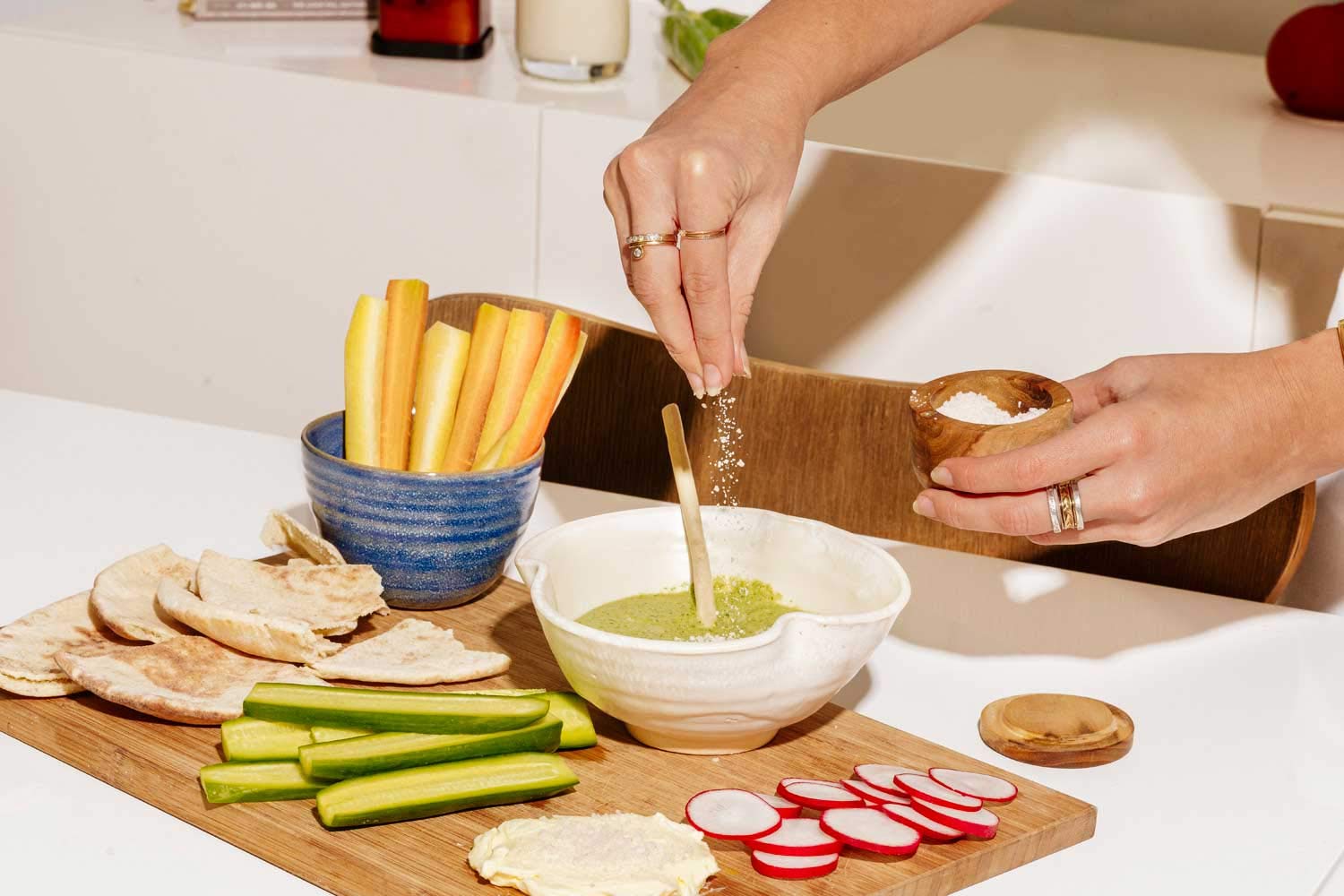
Salt is a staple in nearly every kitchen around the globe, seasoning our food and enhancing flavors. But have you ever stopped to think about what else might be in your table salt?
Since it comes mostly from our oceans and by now we should be all aware about plastic pollution, you can imagine what to expect in salt: microplastics.
Which Type of Salt Has the Most Microplastics?
Sea salt sea from around the world is one of the most contaminated salt types by microplastic particles as confirmed by studies (1). In fact, a 2018 study (2), published in the Journal of Environmental Science & Technology, concluded that that sea salt can be a good indicator of the magnitude of microplastic pollution in the surrounding marine environment with some areas in Asia showing the highest contamination.
A more recent study from 2023 (3), published in the Journal of Ecotoxicology and Environmental Safety, revealed that while microplastics in European sea salts are expected, a notable fraction is introduced during production rather than being inherent to the raw material. This highlights a critical and often overlooked contamination pathway, suggesting that improving manufacturing and processing controls could significantly reduce microplastic exposure through edible products.
Is Table Salt Contaminated by Microplastics?
Yes, most table salts are contaminated by microplastics. A 2019 study (4), published in the Journal Scientific Reports, reviewed microplastic contamination in table salts and found that 94% of globally tested salt products contained microplastics. The most prevalent types were polyethylene terephthalate (PET), polypropylene (PP), and polyethylene (PE), all of which are some of the most commonly used plastic polymers. These tiny plastic particles, often invisible to the naked eye, are finding their way into our salt and, consequently, into our bodies.
Microplastics Contamination Level By Salt Type
A review article (5), published in 2025 in Applied Food Research, analyzed four years of studies of microplastics in three foods: salt, seafood, and freshwater fish. Researchers found that sea salt tended to be worse than rock or lake salt in microplastic concentrations because it’s made by evaporating plastic polluted seawater in open ponds. On top of that, airborne particles settling on the ponds, and a few from packaging, also ends up in the product.
- Sea Salt (Highest Contamination – Depending on region)
- Lake Salt (Moderate Contamination)
- Rock Salt and Mined Salt (Lowest Contamination)
Microplastics were found in salt from almost every country surveyed, but the amounts varied enormously. The lowest figures were a few dozen particles per kilogram (Nigeria, Turkey, Australia). The highest was about 6,850 particles/kg in Bangladeshi table salt.
Related: Plastic Free Tea Bags: Which Brands Are Really Microplastic Free in 2026?
Our Testing Criteria When Choosing Microplastic-Free Salt Brands
1. Source Matters
When searching for brands of pure salt, we looked for brands that harvest salt from cleaner, remote, or less polluted environments. Some deep-mined salts in pristine areas are often lower in or have no microplastic contamination due to their terrestrial origins and sources away from civilization.
2. Independent / Third Party Testing
Third party testing is an essential element in our research. All brands provided 3rd party lab testing or studies published in peer-reviewed journals that showed no microplastic contamination. Some brands like Vera Salt, are very transparent about their sourcing and testing processes and published on their website.
Related: How to Avoid Microplastics: The Ultimate Guide & Checklist
4 Best Plastic Free Salt Brands to Help You Reduce Your Microplastic Exposure Risks
Here is a selection of salt brands that are free of microplastics. If you’re looking for a container where to store your salt we found this elegant salt box.
This post contains affiliate links, which means we may receive a small commission, at no cost to you, if you make a purchase through a link. This helps us continue the hard work we put into researching products and solutions to plastic/ microplastic pollution.
Please Note: Our health content is for informational purposes only and is not intended as professional medical advice. Consult a medical professional on questions about your health. Please read our disclaimer.
1. Vera Salt Pure Natural Spring Salt Microplastic Free
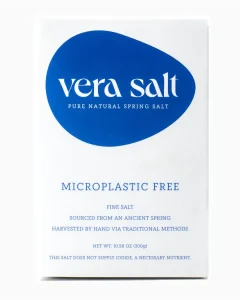
Vera Salt is sourced from an ancient spring on the foothills of Spain at over 2,000 feet above sea level. The pristine location is far from human activity and pollution and hosts an underground aquifer that feeds a brine spring, rich in natural minerals like calcium, potassium, and magnesium. The salt is harvested by hand via traditional methods. It is rust-free and additive-free.
In 2026 Vera Salt launched three new flavors:
Product Packaging: Within the values of fighting plastic waste pollution, this company made an effort to offer also plastic-free packaging with cardboard on the outside of the product and a biodegradable, compostable inner bag made of potato starch, or a glass jar for the flake salt.
Lab Testing: The salt is third-party lab-tested for microplastics, heavy metals, and other additives. You can find the results on their website.
Our Personal Testing: We personally tested the fine spring salt, the flake salt, and the fleur de sel, as you can see from the image and video below. The flavor of all these three products is great, we cannot fault them at all.
Shop from Vera Salt – Use code IMPLASTICFREE for a 10% discount at check out.
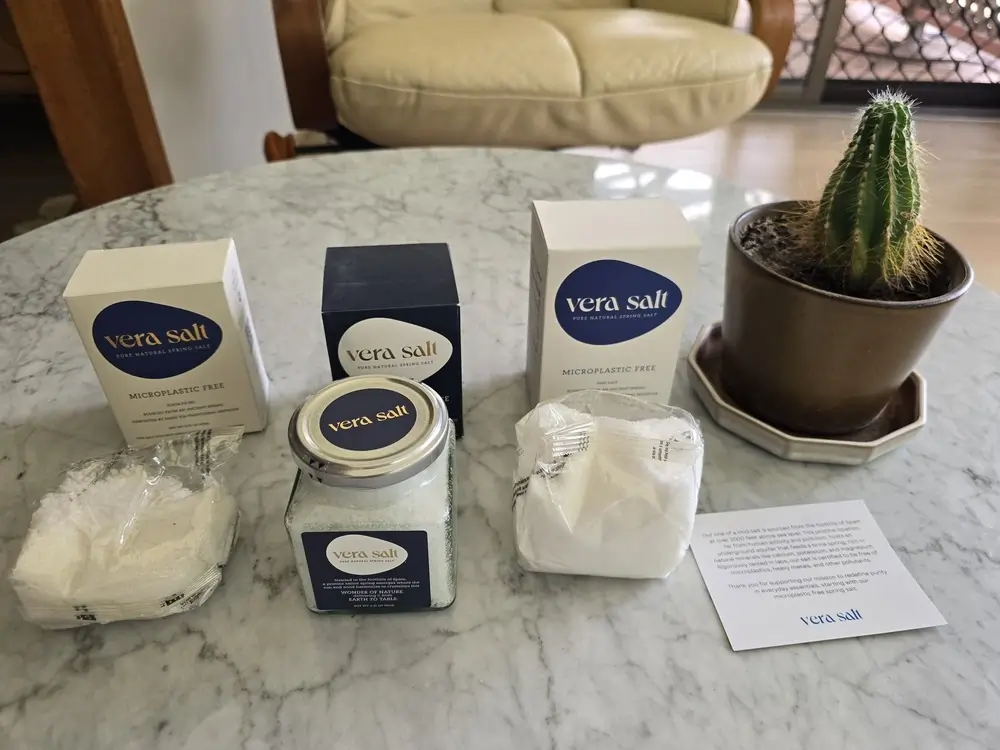
Image Credit: I’m Plastic Free testing Vera Salt products.
Related: Plastic Free Tea Bags: Which Brands Are Really Plastic Free?
2. Only Plastic-Free Spring Salt
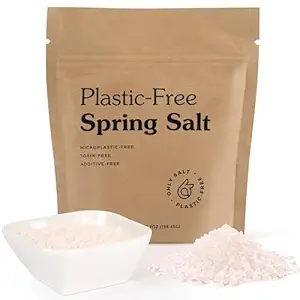
Unrefined and free from harmful additives, this spring salt flows from a natural aquifer 10,000 feet high in the Andes mountains that is untouched by plastic pollutants. This salt has no preservatives, uses no anti-caking agents, no aluminum, and no bleaching. It is just pure flavor in every pinch!
in 2026 Only Salt introduced microplastic free spring salt in bulk bags (24 oz/1.5 lb).
Product Packaging: made of Kraft paper with a fully plant-based biodegradable lining. It is recyclable with your paper waste stream recycling.
Lab Testing: The company performed an optical analysis of the salt with a 3rd party lab to test for microplastics and shared the test with us. (Please contact the brand if you’d like a copy).
Related: Plastic Free Chewing Gum. Do They Exist?
3. Mayi Delice Fine Natural Spring Salt
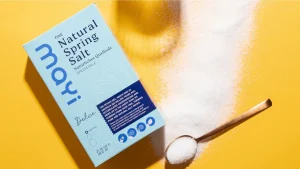
The source of the Mayi Delice Natural Spring Salt is safely protected underground, free from heavy metals and microplastics. Due to this geo-strategic location of 600 m above sea level and far from any industrial establishments, this table salt still preserves its purity, which emerged 200 million years ago through the Thesis Sea. It is naturally enriched with 82 essential minerals from the richest soils of Anatolia, and it is low in sodium. It’s organic, unrefined, and rich in potassium, magnesium, and calcium, perfect for baking, gourmet meals, and as a natural salt substitute.
Product Packaging: depending on the selected product, the packaging will be either glass or plastic. The company used to use cardboard but the product would no arrive to consumers safely… They are lookng for alternatives.
Lab Testing: The company shared their microplastic analysis report with us (Please contact the brand if you’d like a copy), as well as a scientific study (6) published in the Journal of Food Science and Technology about a microplastic analysis conducted on their product.
Related: Microplastic in Food: The Latest Research
4. Murray River Gourmet Salt Flakes (Naturally Pink)
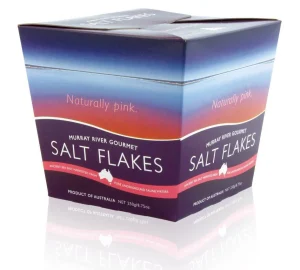
Murray River Salt is Australia’s only naturally pink salt, and it is loved by Michelin star chefs for its unique flavor! The flakes are produced using the pristine mineralised brines from ancient saline aquifers of the Murray Darling basin. We enquired directly with the manufacturer about the “microplastic free claim” and their Production Manager explained that this is due to their underground brines being thousands of years old. Plus, their quality systems and HACCP program, directly at the source, are aimed to keep the salt 100% natural, without additives, preservatives, herbicides, pesticides, or other contamination.
Product Packaging: The outer cardboard is packaging, but unfortunately the inner packaging is plastic.
Lab Testing: Their Production Manager / QA sent us the 3rd party lab test results, which showed to be free of microplastic particles.
Our Personal Testing: As we are based in Australia, we personally tested and regularly consume the pink salt flakes as you can see from the image below. The salt tastes great but the inner packaging is made of plastic.
Shop on Amazon USA – Australia
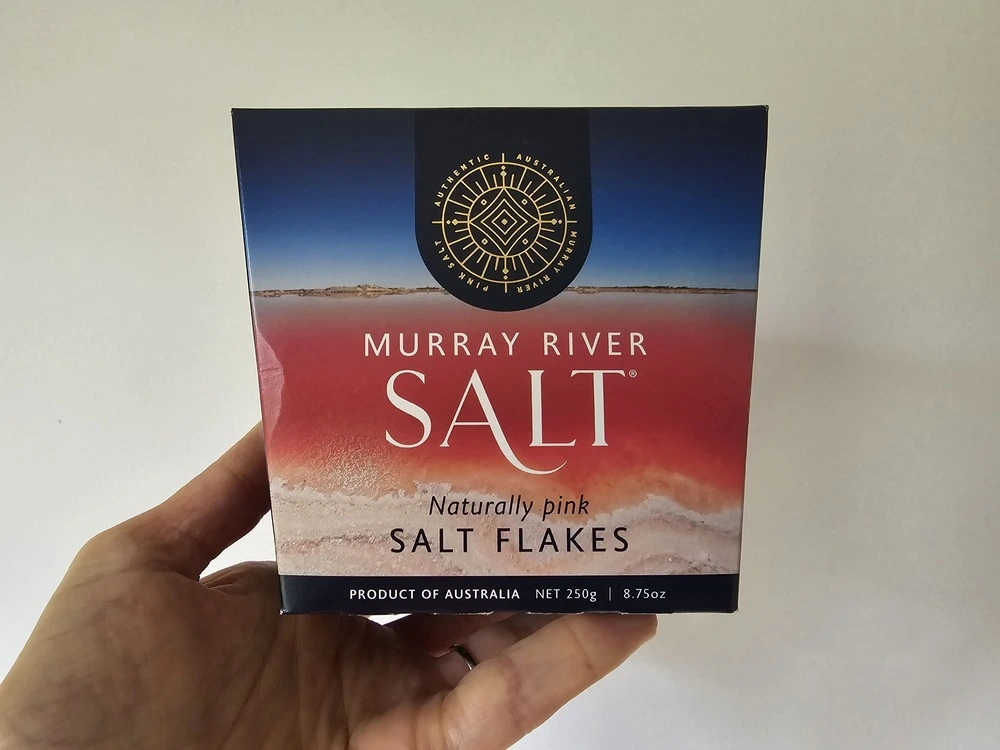
Image credit: I’m Plastic Free’s Editor Simona Paganetto testing the Murray River Naturally Pink Salt Flakes
Related: Is Microplastics Leaching into Your Coffee?
Which Salt Grinders Shed Microplastics?
Many cheap, pre-filled salt and pepper grinders are designed to be used once and thrown away rather than refilled. Their griding mechanism contain plastic parts. So, every time you grind fresh salt in your dish, you also grind some plastics. What to do then?
If you want to avoid disposable grinders, there are a few easy swaps:
-
Go back to a salt shaker
Pre-ground salt in a reusable shaker is simple and means you don’t need a grinder at all. Example: try this plastic-free salt and pepper shaker set.
-
Choose a quality reusable grinder
Look for one made from durable wood, glass or ceramic. Don’t forget to check what the grinding mechanism itself is made from. Example: the Luven Salt Grinder with Ceramic Burr or the combined Luven Salt & Pepper Grinder Set, which have a ceramic and a stainless steel grinding mechamism respectively.
-
Try a salt cellar
If freshly ground salt isn’t important to you, a simple reusable salt cellar or crock makes it easy to grab a pinch when cooking or at the table. Example: try this elegant salt cellar.
-
Buy in bulk and refill
Rather than replacing a grinder every time it runs empty, invest in one durable container and refill it with your favourite salt. Example: the Only Salt’s bulk bags (24 oz/1.5 lb).
FAQs
– What Are Microplastics?
Microplastics are small fragments of plastic, typically less than 5 millimeters in size. There are two types:
- Primary microplastics: they are manufactured as tiny particles for products like microbeads in cosmetics.
- Secondary microplastics: they result from the breakdown of larger plastic items.
They are pervasive in the environment, polluting oceans, rivers, and even the air we breathe. Because salt is often harvested from marine and coastal regions, it’s particularly susceptible to microplastic contamination.
– Why Should We Care About Microplastics in Food?
While the long-term effects of ingesting microplastics are still being studied, early findings suggest potential health risks. Microplastics in food can carry harmful chemicals and toxins, and their accumulation in the body may contribute to inflammation and other health concerns. Avoiding microplastics in your diet and try to buy groceries plastic free as much as you can is a proactive step toward better health.
Related: How to Avoid Microplastic in Food. 10 Practical Tips for a Healthy Diet
– Is Natural Salt Healthy? Which Salts have the Lowest Heavy Metals?
Natural doesn’t necessarily mean “healthy” on product packaging. Ocean salt comes from microplastics and chemicals contaminated waters. Heavily processed table salt is bleached and it’s completely stripped of its natural minerals. To extract mountain salt, on the other hand, mining operations use explosives that can leave behind gunpowder residue, which can increase some high level metal levels in the product, as confirmed by independent lab testing. Vera Salt compared common natural salt types for aluminum, arsenic, cadmium, copper, iron, lead, mercury, and microplastics, and found up to 500 ppm of aluminum, up to 300 ppm of iron in Celtic Sea Salt and Real Salt. See the comparison table here below.
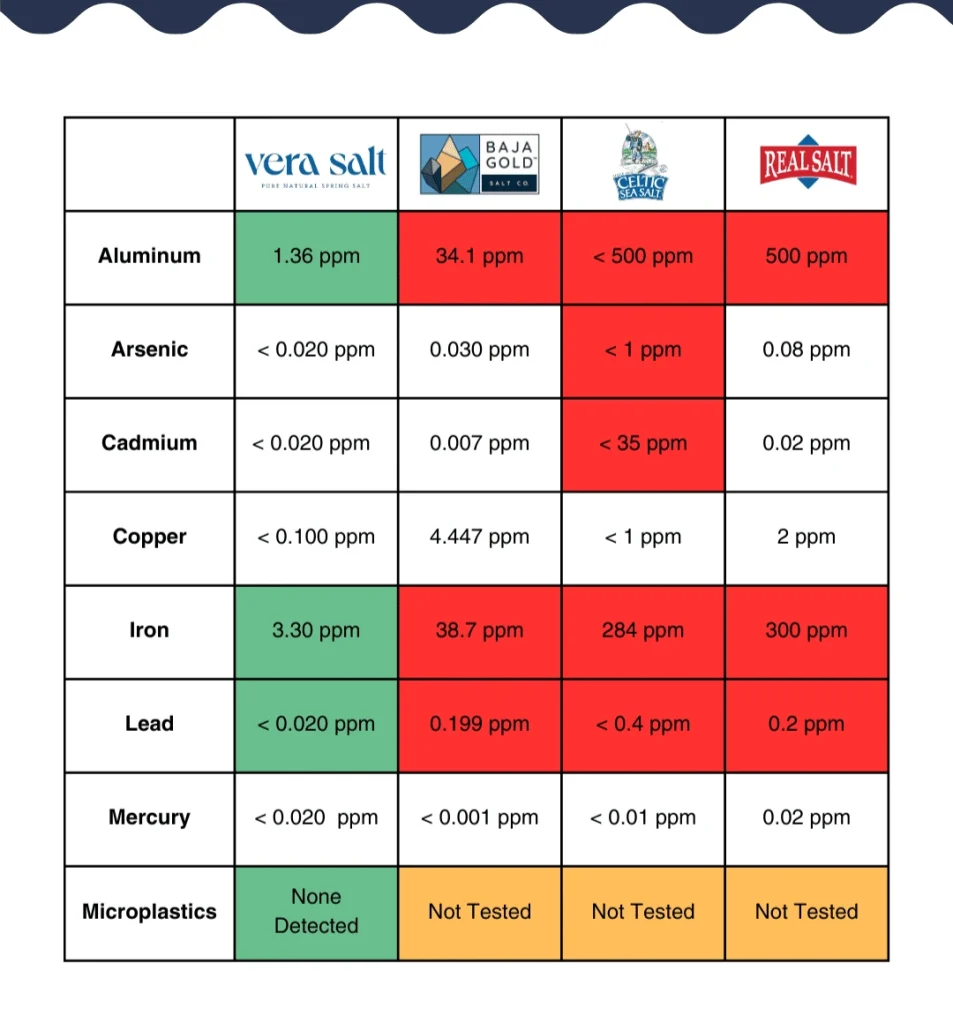
Image Credit: Vera Salt
Related: Plastic-free Thermomix Accessories for Non-toxic Cooking
– How Much Microplastics do we Consume from Salt?
The 2018 study (2) published in the journal Environmental Science & Technology, we mentioned in this article, estimated that as an average an adult ingests approximately 2,000 microplastics per year through salt, mostly due to the high presence of microplastics in the world’s oceans and waterways.
– Does Himalayan Salt Have Microplastics?
A study (7) published in the Journal of Environmental Science & Pollution in July 2022, analyzed 7 common Australian commercial salts (table salt, black salt, sea salt, iodised salt, rock salt, fine Himalayan pink salt, and coarse Himalayan pink salt) found in supermarkets. Surprisingly, microplastic contamination was found to be higher in terrestrial salts, such as black salt and Himalayan pink salt, compared to marine salts, with the highest content coming from Himalayan salt. The study suggests that the contamination in mined salts might have originated from manufacturing, packaging, atmosphere, or storage processes. Notably, studies with larger sample sizes are needed, to provide more robust results.
– How to Advocate for Microplastic Free Food?
The presence of microplastics in salt is part of a broader environmental issue tied to using a lot of plastic in food production and manufacturing processes. The closest the food is processed at the source, the less chances to have microplastics. Reducing your plastic consumption, by avoiding as much plastic as possible and supporting organizations working to tackle this crisis can help mitigate the problem. One other way, is to contact food manufacturers and let them know your concerns. This is why we founded I’m Plastic Free.
Simple steps into plastic free living, like avoiding plastic in the kitchen, and supporting bans on plastic and microplastics in personal care products in your jurisdiction, can make a significant difference.
Final Thoughts: The Healthiest Salt is Free of Microplastics and Heavy Metals
Salt is an essential ingredient in our lives, but it shouldn’t come with hidden contaminants or heavy metals. By choosing microplastic free salt and advocating for a cleaner environment, you can protect your health and the planet. Next time you reach for the salt shaker, think about what’s inside – and make the cleaner, healthier choice!
Do you have any questions or comments? Let us know in the comments section below.
References and Scientific Literature Sources:
(1) Di Fiore, C., Sammartino, M. P., Giannattasio, C., Avino, P., & Visco, G. (2023). Microplastic contamination in commercial salt: An issue for their sampling and quantification. Food Chemistry, 404, 134682.
(2) Kim, J.-S., Lee, H.-J., Kim, S.-K., & Kim, H.-J. (2018). Global pattern of microplastics (MPs) in commercial food-grade salts: Sea salt as an indicator of seawater MP pollution. Environmental Science & Technology, 52(21), 12819–12828.
(3) Thiele, C. J., Grange, L. J., Haggett, E., Hudson, M. D., Hudson, P., Russell, A. E., & Zapata-Restrepo, L. M. (2023). Microplastics in European sea salts – An example of exposure through consumer choice and of interstudy methodological discrepancies. Ecotoxicology and Environmental Safety, 255, 114782.
(4) Lee, H., Kunz, A., Shim, W. J., & Walther, B. A. (2019). Microplastic contamination of table salts from Taiwan, including a global review. Scientific Reports, 9, 10145.
(5) Rahman, S., Saha, W., Maysha, T. I., Sarker, P., Datta, T. R., Rahman, S., Hossain, M. A., & Chacrabati, R. (2025). Microplastics in the human food chain: A review of prevalence, contamination pathways, and mitigation strategies in salt, seafood, and freshwater fish. Applied Food Research, 5(2), Article 101355.
(6) Bozkaya, O., & Aluç, Y. (2024). Physico-chemical characterization of food grade natural spring salt from the Central Anatolia region of Turkey and investigation of its microplastic content. Journal of Food Science and Technology, 61(9), 1711–1721.
(7) Kuttykattil, A., Raju, S., Vanka, K. S., Bhagwat, G., Carbery, M., Vincent, S. G. T., Raja, S., & Palanisami, T. (2023). Consuming microplastics? Investigation of commercial salts as a source of microplastics (MPs) in diet. Environmental Science and Pollution Research, 30(1), 930–942.
—
Want to learn more about non-toxic plastic alternatives?
Explore innovative solutions with I’m Plastic Free and reduce your daily exposure to microplastics.




Jon Michalek
January 7, 2025 at 9:38 amOnly Vera provided 3rd party lab test results. Salt produced from water source is usually very contaminated and without in-process quality testing the claims of the companies in this report and elsewhere are bogus.
I'm Plastic Free
January 12, 2025 at 7:37 pmHi Jon,
Thanks for your comment. We’ve asked the product manufacturers about their testing and we’ll update the article if they respond.
Kind regards,
Simona
David
March 10, 2025 at 7:16 amI agree with Jon and it has been 2 months. Where are lab test results?
Thanks,
David
I'm Plastic Free
March 10, 2025 at 2:59 pmHi David,
We have updated the article as all 3 brands we featured have provided their third party lab results. If you can’t find the public link, please contact those brands directly and ask to receive the test.
Kind regards,
Simona
Perry Washington
June 5, 2025 at 9:16 pmPlease keep me updated!
alicia
July 31, 2025 at 7:17 amI am looking for microplatic free salt for a commercial kitchen – so want to purchase wholesale any suggestions for brands/companies?
I'm Plastic Free
July 31, 2025 at 11:20 amHi Alicia,
Thanks for your message. I’ll enquire with a few manufacturers and will let you know via e-mail.
Kind regards,
Simona
Angela
February 24, 2025 at 8:20 amHere’s another salt to potentially add to the list. Gathering Place Trading Ltd. sells their “Antarctic Pure Sea Salt”, which is labeled as microplastic-free.
I'm Plastic Free
March 10, 2025 at 3:36 pmHi Angela,
Thank you for your recommendation. Do you have any 3rd party lab testing for that brand? If yes, could you please send it to info@implasticfree.com ?
Many thanks for your help.
Kind regards,
Simona
Dan Olmsted
January 15, 2026 at 10:04 amI am also looking for 3rd party test results from that brand.
djolmsted94@gmail.com
I'm Plastic Free
January 19, 2026 at 10:42 amHi Dan,
Thanks for the reminder. Angela, do you have an update?
Kind regards,
Simona
I'm Plastic Free
January 19, 2026 at 10:43 amHi Angela, do you have an update? Have you been able to obtain the 3rd party lab test results for the “Antarctic Pure Sea Salt”?
Kind regards,
Simona
WS
May 14, 2025 at 10:42 pmVera Salt HAS toxic heavy metals. See the test results.
https://cdn.shopify.com/s/files/1/0750/7345/4393/files/Vera_Salt_Heavy_Metal_Test_Results_2025.pdf?v=1745042631&ref=IMPLASTICFREE&sub_id=
Mayi HAS toxic heavy metals. See the test results.
https://pmc.ncbi.nlm.nih.gov/articles/PMC11263517/#Sec12
Arsenic (As) < 0.0142 mg/kg
Cadmium (Cd) < 0.038 mg/kg
Mercury (Hg) < 0.0019 mg/kg
Lead (Pb) < 0.018 mg/kg
I'm Plastic Free
May 23, 2025 at 2:05 pmHello,
we’ve received an answer from one of the salt manufacturers you mentioned, Vera Salt, and we’re happy to provide some context. We’d like to clarify: all unrefined salts (meaning salts that haven’t been chemically washed or processed) will contain trace minerals — both beneficial ones and naturally occurring elements like lead, which is found in the earth’s crust. The key factor is how much is present.
In their most recent lab test (which has been linked below), Vera Salt’s lead level came back as <20 ppb (parts per billion). That means it’s somewhere below 20, but the lab’s equipment isn’t able to quantify anything lower than that. For context, even Lead Safe Mama (who is known for being extremely strict about lead) categorizes salts with less than 50 ppb as “100% acceptable” and lists that range as her top recommendation.
So by that standard, Vera Salt falls well within the safest category and is among the lowest lead levels we've seen in unrefined salts.
Refined salts like Morton’s table salt, Diamond Crystal, picking salt, or other refined salts are processed in a brine or chemical wash, which strips everything including both the heavy metals and the naturally occurring minerals. What you’re left with is nearly pure sodium chloride.
We can’t speak for the Mayi brand (we'll update here if we receive a response), but it looks pretty similar. If someone is looking for a salt that is only sodium chloride and free of any trace minerals (good or bad), then a refined salt is the better option.
We ope that helps clarify things!
Angelil
May 16, 2025 at 1:34 pmJacobsen Salt is also a Safe Salt. It not only passed the leadsafemama website and tests, it is what the web owner uses and the only one clean enough for me to use, as well. It is made on the coast in Oregon and they purify their water. I also received an email response from Vera Salt today, as I requested COAs that were current-er than 2023 back in February, updating me on the new lab results. That they followed up with a response and labs is a huge testament to the integrity of the company. None of the others have even barely responded. I just ordered another couple pounds from Jacobsen (Oregon salt only!) but look forward to trying Vera Salt. You can also add Jacobsen to your Safe Salt list; their labs are on the website.
I'm Plastic Free
May 23, 2025 at 5:22 pmHi Angelil,
Thank you for your comment and product recommendation. We’ll check Jacobsen Salt!
Kind regards,
Simona
Add a comment