

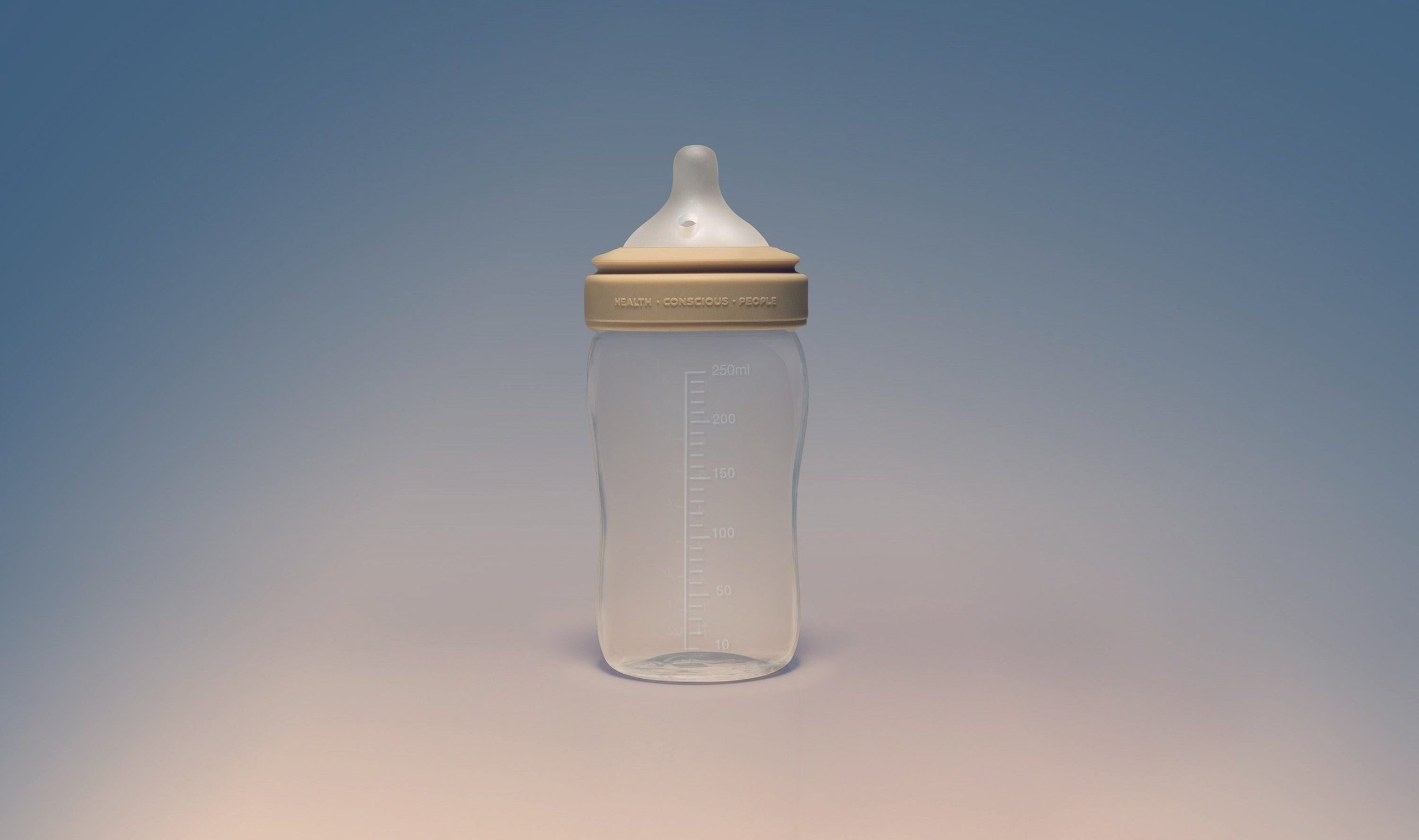
Image Credit: Health Conscious People
As a mom of two children, I fully understand your concern. You want to find non-toxic baby bottles that are safe to sterilize and non-toxic for your newborn. I wish I had this information, when I had my children… We did the research for you!
Do Baby Bottles Have Microplastics?
Yes, they do. A 2020 study (1), from Trinity College Dublin, published in the Journal of Nature Food tested 10 polypropylene (PP) plastic baby bottles with no brand names.
When the researchers prepared the bottles the normal way, first sterilizing them in hot water and then filling them with 70°C water as the World Health Organization (2) recommends for making formula, each liter of water from the plastic bottles contained between about 1.3 million and 16.2 million tiny plastic particles, depending on which bottle was used.
In a related test, microwaving water in a polypropylene container released up to 10 times more particles than pouring hot water in, so never microwave formula in plastic bottles. Using formula or tap water instead of lab water made no significant difference.
On average, the researchers estimated that bottle-fed babies swallow about 1.6 million microplastic particles a day during their first year (3). Exposure was highest in Oceania (including Australia), North America and Europe, at roughly 2.1 million, 2.3 million and 2.6 million particles a day respectively, mainly because bottle-feeding is more common in these regions.
Related: 13 Non Toxic, Plastic Free Electric Kettles for a Healthy Cup
Do Silicone Nipples Release Microplastics?
Yes, when they are heated repeatedly. A 2021 study (4) by The University of Massachusetts Amherst (UMass Amherst) and Nanjing University, published in the Journal Nature Nanotechnology, found that steam-sterilizing silicone baby bottle nipples causes the silicone to break down over time, releasing tiny micro- and nanoplastic particles. The researchers estimated a baby could swallow more than 660,000 of these particles by their first birthday. The health effects aren’t known yet, and other heated silicone products like bakeware may shed particles too. The study looked at the nipple, not the bottle, so even glass or stainless bottles usually come with a silicone nipple.
Please note: the teats tested were made of platinum-cured silicone, the higher-quality type usually sold as food-grade, which suggests that even good silicone can shed particles after repeated steam sterilization. The main alternative to silicone nipples currently on the market is natural rubber latex, but no material is perfect.
Do Latex Baby Nipples Shed Microplastics?
Yes, maybe. A 2023 Swedish study (5), published in PLOS ONE, broke down silicone and latex pacifiers (not bottle nipples!) with a kitchen blender to mimic environmental wear, and both released tiny nanoplastic particles. Boiling alone released no detectable particles, but boiled silicone shed about twice as many particles when blended afterwards. The silicone particles stayed chemically stable and didn’t harm water fleas, while the latex particles changed chemically and killed significantly more of them.
Please note: Although latex particles harmed water fleas in a 2023 Swedish environmental test where pacifiers were broken down in a blender, this doesn’t reflect how babies use latex nipples, pacifiers or teethers, and more research is needed to know whether they pose any risk in real use cases.
Related: Plastic Free Toys: Do Eco-friendly Alternatives to Plastic Toys Exist?
Our Selection and Testing Criteria
Before we went ahead to scout non-toxic baby bottles, we decided what materials we’d accept when vetting the brands individually, and which materials we’d reject. Simona, I’m Plastic Free’s editor, scrutinized many brands before deciding which ones to select. Please see here below our approach.
Check Your Baby’s Formula Bottle. What are Baby Bottles Usually Made of?
Most baby bottles on the market are made from these types of plastic:
- Polypropylene (PP): the most common plastic used for baby bottles. It is lightweight, cloudy or translucent, and free of BPA, but it can scratch and cloud over time.
- Polyphenylsulfone (PPSU): a high-performance, medical-grade plastic with a naturally honey or amber tint. It offers excellent durability, impact resistance, and heat resistance up to 356°F (180°C).
- Polycarbonate (PC): a rigid plastic that was once widely used in baby bottles. Older versions may contain BPA (bisphenol A), an endocrine disrupting chemical that has since been phased out or restricted in many infant products.
- Tritan: A proprietary copolyester from Eastman known for glass-like clarity, high scratch resistance, and durability
What are Baby Bottle Nipples Made of?
– 100% Food- or Medical-grade Silicone (Synthetic Rubber)
Silicone is commonly used in baby bottles and nipples. It is free from BPA and phthalates and can be an alternative to conventional plastics exposed to heat. However, not all silicone material is created equally. Cheap silicone is made with fillers, so it’s important to choose high-quality products made with certified and tested materials. Please note: we do not recommend baby bottles made entirely of silicone. See the research below.
– 100% Latex (Natural Rubber)
Baby bottle nipples made from natural rubber latex tapped from the Hevea brasiliensis tree offer a soft, flexible, skin-like feel that mimics breastfeeding, but they come with specific safety, durability, and allergy considerations. They are free from BPA, BPS, PVC, and phthalates but only if you buy high-quality products made with certified and tested materials.
What is the Safest Material for Baby Bottles?
Safer material alternatives to plastic baby bottles are borosilicate glass, or stainless steel for the bottle body and silicone or natural rubber for the baby bottle nipples.
– Borosilicate Glass
Borosilicate glass is a high-grade, heat-resistant glass made from silica and boron trioxide. It is very stable and doesn’t leach chemicals into milk under normal use, which makes it a popular and safe material for baby bottles.
– Stainless Steel
Stainless steel baby bottles are a safe, durable, and plastic-free alternative to traditional plastic or glass bottles, commonly made from food-grade 18/8 (304) or medical-grade (316) stainless steel.
Related: 7 Best Plastic-Free Wet Wipes (100% Biodegradable, No Microplastics)
3 Best Non-toxic Baby Bottles with Little or No Plastic
There are a lot of baby bottles on the market that claim to be non-toxic but most of them have plastic parts. We scouted the baby milk bottles that have the least contact to with plastic.
This post contains affiliate links, which means we may receive a small commission, at no cost to you, if you make a purchase through a link. This helps us continue the hard work we put into researching products and solutions.
Please Note: Our health content is for informational purposes only and is not intended as professional medical advice. Consult a medical professional on questions about your health. Please read our disclaimer.
1. Health Conscious People Premium Wide Neck Glass Baby Bottle – Plastic-free Baby Bottle
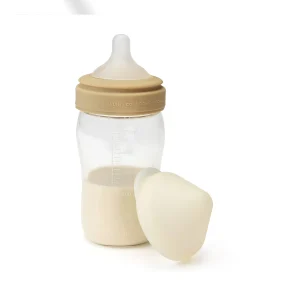
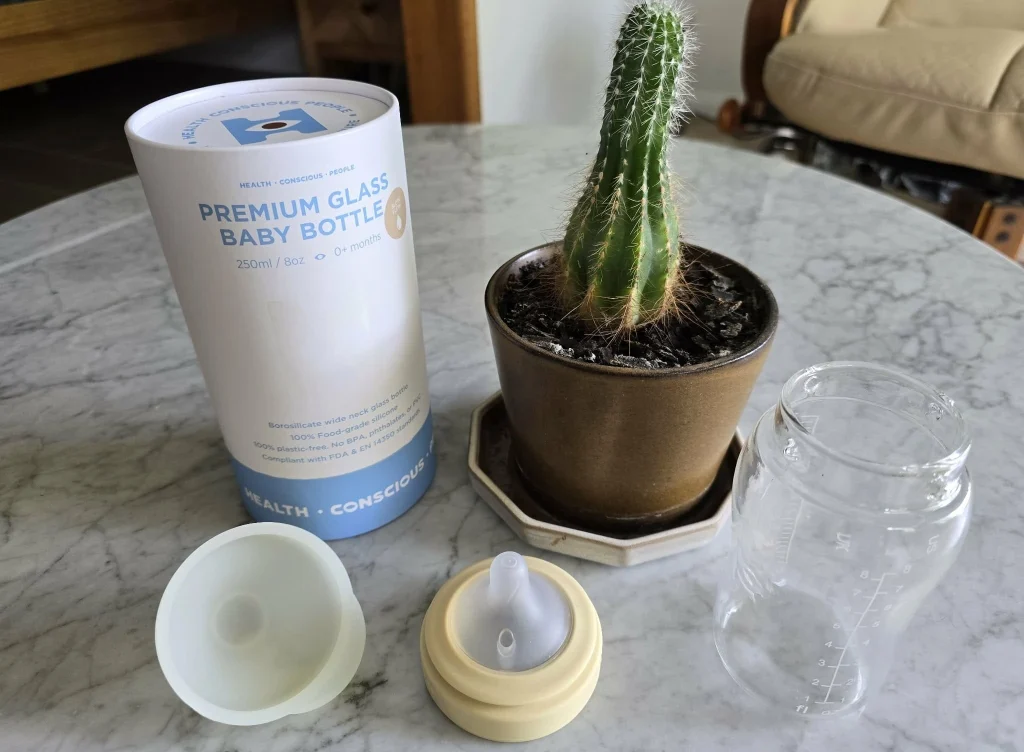
Health Conscious People have developed a baby bottle that comes into an innovative two-piece patent pending design and only two materials. It has been designed with no polypropylene screw rings, internal plastic venting tubes, or hidden plastic parts. The anti-colic venting is built directly into the silicone top without requiring separate tiny valves or complicated pieces to clean. Nipples are also sold separately and available in three flow rates: slow, medium, fast.
Parts & Materials:
- Bottle: high-purity borosilicate glass with lead-free, fade resistant laser-etched measurement markings
- Integrated nipple and collar: food-grade/medical-grade German LFGB compliant silicone
- Cap: food-grade/medical-grade German LFGB compliant silicone
Capacity: 8 fl oz / 250 ml
Product Packaging: a cardboard tube, but with a rigid plastic foam insert to protect the bottle from breaking during transport. We hope that the manufacturer will find an alternative material in the future.
Our Personal Testing: We personally tested the “0+ months” baby bottle. We can confirm that it is very well made. The design is very ergonomic. The bottle is easy to hold. We love how the collar connects to the glass bottle thanks to four interlocking glass knobs. It’s very easy to open, close and clean it.
Third Party Testing: We required the manufacturer to send us an independent testing lab report which tested the product against US and European baby-product safety rules. At the lab’s detection limits, no harmful chemicals were detected in the silicone: BPA, phthalates, nitrosamines (cancer-linked chemicals sometimes found in rubber teats), formaldehyde, PAHs, organotins and rubber additives. Microplastics were not part of the test.
Shop from Health Conscious People
Related: Plastic Free Toys: Do Eco-Friendly Alternatives to Plastic Toys Exist?
2. Pura Kiki Stainless Steel Infant Bottle with Sleeve, Anti-Colic, 100% Plastic-Free
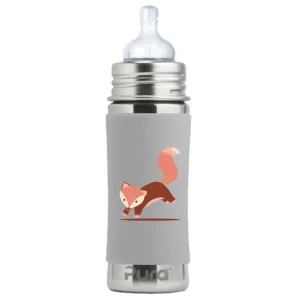
Pura have designed the first and only line of plastic-free juvenile bottles that has achieved the MADE SAFE Certified rating. Their design eliminates plastic components, and also provides much-improved functionality. Pura focuses on safety, durability, ease of use. This bottle has a medium flow nipple with anti-colic vent tube.
We like the circular principles of their designs: this non toxic stainless steel baby bottle transforms into a sippy bottle, a straw bottle, or sport/water bottle by simply swapping the nipple out for another Pura silicone lid, once the baby is growing into a toddler.
Parts & Materials:
- Bottle: 304, 18/8 stainless steel
- Screw thread: 304, 18/8 stainless steel
- Nipple: high-purity, medical-grade silicone
- Cap: high-purity, medical-grade silicone (soft travel cover)
Capacity: 9 fl oz / 275 ml
Product Packaging: 100% plastic-free product packaging for all their children’s items, in line with their philosophy to fight plastic pollution and eliminate microplastics.
Shop from Amazon
Shop from Biome Australia
Related: Embracing Motherhood Sustainably with a Plastic-free Pregnancy Test
3. Hevea Standard Neck Glass Baby Bottle with Natural Rubber Nipples, Minimal Plastic
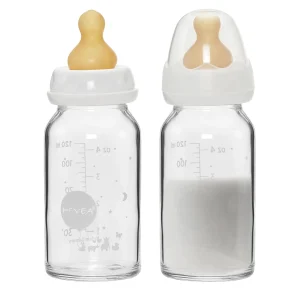
Hevea is a female-run, family-owned Danish company that has specialized in natural rubber alternatives to plastic and silicone. Natural rubber is compostable and will biodegrade when no longer in use, unlike silicone. Their anti-colic glass baby bottles are free of BPA, BPS, PVC, and Phthalates, and other harmful materials that can leach from plastic bottles. However, they are not completely plastic free!
The nipples have been designed to ensure a proper latch and make the transition to bottle-feeding (or supplementation of breastfeeding) your baby a breeze.
Parts & Materials:
- Bottle: shock and thermo-resistant borosilicate glass with laser-etched measurement markings
- Screw thread and dust cap: high-quality polypropylene (PP)
- Cherry-shaped Nipple: 100% natural rubber
- Cap: high-quality polypropylene (PP)
Capacity: 4 fl oz / 120 ml
Product Packaging: a FSC certified cardboard box with an Earth First home-compostable window, made from plants.
Shop from Amazon
Shop from ZeroWasteStore (ZWS)
Related: Are Glass Baby Bottles Safe? Pros, Cons and Tips
Tips to Reduce Microplastics in your Baby Bottles
We are not here to alarm anyone, the numbers in the cited studies are the results of different methodologies and more research is urgently needed. Here are tips on how to reduce your newborn’s microplastic exposure:
- Use boiled cool water in a non-plastic container to rinse the plastic baby bottle three times AFTER sterilization with hot water.
- Mix formula in a glass or stainless steel container. Use water at 158°F ( 70°C) or hotter to kill bacteria, as the WHO recommends, then cool it quickly and pour it into the bottle. Test the temperature on your wrist before feeding.
- If you have plastic baby bottles already, don’t keep them for a very long time, the study shows that the release of microplastics is also due to the degradation of the polypropylene (PP) material.
- The safest option with infants is to use glass baby bottles. Once the baby is able to drink milk by him/herself switch to a stainless steel baby bottle to avoid possible glass breakage and injuries.
- If you are on a budget. Some people find glass baby bottles very expensive and opt for special mason jar glass bottles with plastic attachments and the silicone nipples of your choice.
FAQ about Plastic-free Baby Bottles
– Does a 100% Plastic-free Baby Bottle Exist?
Almost. If you don’t consider silicone a plastic, the only plastic-free baby bottles currently available on the market are:
- The Health Conscious People Wide Neck Baby Bottle, which is made of only two materials: borosilicate glass and silicone.
- The Pura Kiki Stainless Steel Infant Bottle with Sleeve, which is made also of two materials: stainless steel and silicone.
– Are There Microplastics in Human Breast Milk?
Yes, this 2022 Italian study (6), published in the Journal Polymers, found microplastics in human breast milk for the first time. Researchers tested milk from 34 healthy mothers and found tiny plastic particles in 26 of them, mostly common plastics like polyethylene, PVC and polypropylene. The particles were very small, between 2 and 12 micrometres, and each sample had only a few of them. The amount wasn’t linked to what the mothers ate or drank or the products they used, which suggests microplastics are so widespread that everyone is exposed. It was a small study that didn’t look at health effects, and the researchers still consider breast milk the best food for babies.
– Are Half-glass, Half-plastic Baby Bottles Safe? (They are also called Hybrid Baby Bottles)
Hybrid options, such as the Chicco Duo, combine a thin layer of medical-grade glass bonded to an outer plastic shell, aiming to balance the benefits and drawbacks of all-glass (breakage) and all-plastic bottles (microplastics). However, since the Trinity College study found that plastic sheds more particles when exposed to heat, the plastic exterior may release some microplastics during sterilization, although this hasn’t been tested on hybrid bottles specifically. Most hybrid bottles also have plastic collars that do come into contact with milk.
– Are Baby Bottles in the US still Made with BPA?
No. In 2012, the FDA banned polycarbonate resins containing BPA from baby bottles and sippy cups. Manufacturers had already stopped using it, so the rule mainly confirmed that BPA-containing polycarbonate bottles are no longer sold in the US. “BPA-free” doesn’t mean plastic-free, though: most bottles are now made of polypropylene, which can shed microplastics when heated.
– What Water Temperature Should I use to Make Baby Formula?
For most babies, follow the instructions on the formula container. If your baby is under 2 months old, was born prematurely, or has a weakened immune system, the CDC and FDA recommend preparing powdered formula with water at least 158°F (70°C) to kill Cronobacter, a rare but dangerous bacterium. To limit microplastics, mix the formula in a glass or stainless steel container, cool it quickly, and test it on your wrist before feeding.
What Safety Rules do Baby Bottles have to Meet in the US?
Baby bottles sold in the US are children’s products, so they must meet Consumer Product Safety Commission (CPSC) rules, including limits on lead and certain phthalates and permanent tracking labels. Materials that touch milk must also comply with FDA food-contact regulations. None of these rules currently require testing for microplastics, so ask brands for independent lab reports.
References and Scientific Literature Sources:
(1) Li, D., Shi, Y., Yang, L., Xiao, L., Kehoe, D. K., Gun’ko, Y. K., Boland, J. J., & Wang, J. J. (2020). Microplastic release from the degradation of polypropylene feeding bottles during infant formula preparation. Nature Food, 1(11), 746–754.
(2) World Health Organization & Food and Agriculture Organization of the United Nations. (2007). Safe preparation, storage and handling of powdered infant formula: Guidelines.
(3) Trinity College Dublin. (2020, October 19). High levels of microplastics released from infant feeding bottles during formula prep [Press release].
(4) Su, Y., Hu, X., Tang, H., Lu, K., Li, H., Liu, S., Xing, B., & Ji, R. (2022). Steam disinfection releases micro(nano)plastics from silicone-rubber baby teats as examined by optical photothermal infrared microspectroscopy. Nature Nanotechnology, 17(1), 76–85.
(5) Ekvall, M. T., Gimskog, I., Kelpsiene, E., Mellring, A., Månsson, A., Lundqvist, M., & Cedervall, T. (2023). Nanoplastics released from daily used silicone and latex products during mechanical breakdown. PLOS ONE, 18(9), e0289377. https://doi.org/10.1371/journal.pone.0289377
(6) Ragusa, A., Notarstefano, V., Svelato, A., Belloni, A., Gioacchini, G., Blondeel, C., Zucchelli, E., De Luca, C., D’Avino, S., Gulotta, A., Carnevali, O., & Giorgini, E. (2022). Raman microspectroscopy detection and characterisation of microplastics in human breastmilk. Polymers, 14(13), Article 2700.
—
Browse the I’m Plastic Free platform to discover more plastic-free baby products.




Add a comment