

When it comes to creating a cozy, healthy, and eco-friendly home, a “hygge”-home like they say in Scandinavia, choosing organic and non toxic blankets, quilts, bed sheets, mattresses, and bedding in general, is an excellent step. In this article, we highlight the reasons why chosing a high quality cozy blanket is better for you, the planet, and ultimately your wallet.
What are Synthetic Blankets Made of?
These days most blankets are made of cheap virgin fossil-fuel-based fibers like polyester, acrylic, and nylon. Please note: don’t be fooled by product descriptions on packaging like:
- Microfiber
- Microplush
- Microdenier
- Microsuede
- Flannel
- Fleece
- Faux Fur
- Chenille
- I’m Comfy!
- Soft Touch
- Cloud Like
- Warm and Cosy
Manufacturers use these descriptions and misleading “marketing words” in order to avoid the word “synthetic”. In the video here below we highlight how brands disguise synthetics in textiles by showing examples.
What are the Environmental Issues with Synthetic Blankets?
Synthetics materials are petroleum based and cheap to produce, but their environmental impact is visible through out their life cycle: extraction, production, transportation, and end-of-life. They are easy to care for but shed microplastics with every wash. According to the International Union for Conservation of Nature, 35% of microplastics in the world’s oceans come from washing synthetic textiles (1).
What are the Health Issues with Synthetic Blankets?
One of the most immediate health concerns associated with polyester is how unpleasant this fabric is on the skin, causing skin irritation, and allergies according to several studies published in peer-reviewed journals (2). The synthetic fibers can cause friction against the skin, the largest organ in our body, leading to redness, itching, and rashes, particularly in individuals with sensitive skin or pre-existing dermatological conditions.
Are Stain- or Water-resistant Blankets Healthy?
No, they aren’t. Beware of blankets and comforters labeled as stain- or water-resistant. They most probably contains PFAS, following a 2022 research report (3) by the not-for-profit organization Toxic Free Future.
Are Synthetic Blankets Fire Resistant?
No, they arent. Synthetic blankets, hoodied blankets, and jumpers made from polyester, nylon, acrylic or fleece are not inherently fire-resistant, and can pose a significant hazard next to fire. Who doesn’t love a good bonfire on a chilly evening? Well, a cozy camping night by the fire can transform into a tragedy, like it happened to an Australian girl, who suffered severe burns to 13% of her body, including her face, right arm, and the right side of her chest (4). The wind carried sparks onto her jumper, causing it to ignite instantly. The product was later recalled by Temu upon pressure by the ACCC (5) for not having a Warning Label saying; “High Fire Danger – Keep Away from Heat and Flame”. Would the label have prevented this? Of course not, and this is exactly the point, stay away from such products! Buy once, but buy better!
Related: 9 Organic, Truly Non-Toxic Bedding Brands That Use Only Natural Fibers
Our Selection and Testing Criteria
We selected these following blankets according to these criteria:
- They are crafted from natural fibers content like organic cotton, wool, linen etc.
- They are free from toxic chemicals, dyes and finishes, including toxic PFAS, making them safe for your skin and the environment.
- They all carry third party certifcations like GOTS
- Hands-on testing whereever possible.
5 Organic Non-toxic Soft Blankets & Throws that are Free of Synthetics
Below are five standout options that combine sustainability, comfort, and style.
This post contains affiliate links, which means we may receive a small commission, at no cost to you, if you make a purchase through a link. This helps us continue the hard work we put into researching products and solutions.
Please Note: Our health content is for informational purposes only and is not intended as professional medical advice. Consult a medical professional on questions about your health. Please read our disclaimer.
1. AIZOME 100% Regenerative Organic Cotton Knitted Blanket
We personally tested this regenerative blanket made from 100% organic and undyed cotton and… you can’t imagine how super soft this breathable fabric feels at the touch. It’s perfect for sensitive skin, as it’s hypo-allergenic, i.e. free of any synthetic softeners, allergens, and irritants, as it’s bio-enzyme processed instead.
The design of the blanket is stunning, as it features a minimalist, luxury knit and has a natural beige hue. The knit is so stylish that it could be perfect also as a cardigan! No wonder that it comes with a lifetime warranty. It is a timeless piece to hand over from generation to generation.
Aizome is the best choice for toxin-free bedding. All of their products are plant-dyed and made without petrochemicals. Their fabrics have been tested under the control of a dermatologist through HRIPT (Human Repeat Insult Patch Test), the most common screening for skin safety, which consists of a patch test that assesses the skin’s potential reaction to products applied to the skin (We read the whole study report). Even their wastewater is so clean that it was certified as skincare (WASTECARE). Feel the difference for yourself!
Material: 100% Organic Cotton
Certifications: GOTS, Oeko-tex Standard 100, QTEC (Japanese Textile Assessment)
Made mindfully in: India
Shop Aizome – 10% off with code IMPLASTICFREE
VIP Sale: October 19 to November 1. 25% off bedding, towels, and artisan line if you join this list.

Credit: Image and video by I’m Plastic Free / Simona Paganetto testing the Aizome Regenerative Organic Cotton Knitted Blanket
Related: Plastic-free Underwear: 10 Best Non-Toxic & Compostable Brands for Better Health
2. Pact Organic Cotton Quilt

Pact’s premium organic quilt is inspired by the classics, but reimagined to feel modern, sleek, and comfortable with a medium weight. It’s perfect as a standalone cover during the summer months, and as a layer in winter.
This quilt is made with premium organic yarn superior to conventional yarns used in high thread-count sheets.
Materials: 100% organic cotton sateen and 100% organic cotton fill
Certifications: GOTS, Fair Trade certified factory
Made mindfully in: India
Related: JulieMay Rosie Silk & Organic Cotton Lace Lingerie Set Review
3. Avocado Luxury Natural Throw Blankets

Avocado has created a range of luxurious comforters and throws, sustainably woven or knit from the finest fabrics, like merino wool, cashmere, organic cotton, and recycled cotton. The natural colors have no added dyes and all other colors are set with natural dyes and metallic salts to have the lowest environmental impact possible, while still giving a warm touch to any room in your home.
Material: merino wool, cashmere, organic cotton, and recycled cotton.
Certifications: GOTS, GOLS, USDA Organic, USDA Certified Biobased
Made mindfully in: USA and Mongolia.
Related: The Very Good Bra: 100% Organic Cotton Padded Bra Review
4. Coyuchi Sequoia Organic Throw / Washable Blanket

Coyuchi has also created a beautiful product range of organic cotton blankets mixed with soft wool etc. with a process that is free of chemicals and toxins that endanger the health of humans, animals, and the ecosystem. This soft, cottony feel blanket is paired with the warmth of wool. The fabric is brushed for extra softness and finished with a double-needle stitched edge.
Materials: 70% organic cotton grown in Turkey, and 30% organic wool from Argentina.
Certifications: GOTS, FairTrade, MadeSafe, GOLS , 1% for the Planet
Made mindfully in: Germany.
Related: 4 Reasons to Choose Plastic Free, All Natural Fibers Over Synthetic Fibers
5. Bearaby Organic Cotton Hand-Knit Weighted Blanket for Adults – Chunky Knit Blanket
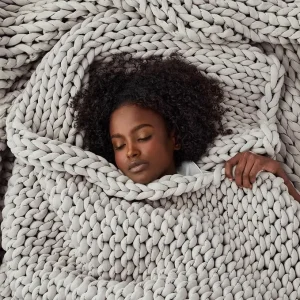
Bearaby has been designing and manufacturing blankets since 2017. This blanket is called “The Napper” and it’s made of a soft, breathable cotton fabric, perfect for all seasons, providing a comfortable sleeping experience no matter the weather. The patented hand-knit design (U.S. 10,835,708; U.S. 11,260,200), allows this cooling weighted blanket to help you rest comfortably and avoid artificial fillers, making it more sustainable option than traditional weighted blankets with plastic filling.
It’s best to choose a weighted blanket that’s around 10% of your overall body weight, depending on your individual snuggle preference! The heavier the bklanket, the more you’ll experience the full benefits of Deep Touch Pressure (DTP).
Material: 100% cotton
Certifications: OEKO-TEX Standard 100 certified
Made mindfully in: The USA
Related: 4 Reasons to Choose Plastic-free, All Natural Fibers Over Synthetic Fibers
FAQ about PFAS-free and Polyester-free Blankets
– How to find non-toxic weighted blankets?
Non-toxic weighted blankets for kids or adults exist. They are made of organic cotton and are OEKO-TEX Standard 100 certified:
- Weighted Blanket for Kids: 100% Cotton with Non-Toxic Glass Beads
- Bearaby Hand-knit Weighted Blanket for Adults Made of Cotton
Don’t buy polyester weighted blankets with plastic poly pellets (microplastics) as a filling!
– Why choose blankets made of natural fibers?
Blankets made of natural fibers like cotton, linen, or wool can help with the following health benefits:
- Less Chemical Exposure
- Less Allergic Reactions
- Improved Sleep Quality
- Lighter Footprint on the Environment (if they’re a one-off purchase)
- Ultimately, more comfort (and health to the family)
Natural fibers breathe, which helps you regulate your body temperature during sleep (they are so called “thermo-regulating”) and if you do sweat at night, they are more absorbent, so you don’t feel damp!
– Are blankets made from recycled plastic bottles healthy?
No, they aren’t. Claims like “made from plastic bottles recovered from the ocean” or “ocean bound” mean that the blanket is made with recycled PET (rPET, aka PolyEthylene Terephthalate). It’s still plastic but it is spun into a fiber and still releases microplastics in your bedroom, living room, or lounge.
– Is a recycled polyester (rPET) blanket safer than regular polyester?
Not really. Recycled polyester keeps plastic bottles out of landfill for one more use, but chemically it’s the same material as new polyester. It still sheds microplastics, is rarely recycled again, and can contain antimony, a residue from PET production. It’s a slightly better environmental choice, not a healthier one for your skin.
– What are Lola blankets Made Of?
Lola blankets are made of 95% high-density polyester, which they refer to as “faux fur” and 5% spandex. The blankets are, therefore, made of synthetic petroleum-based plastics.
– Are Lola blankets Healthy?
Lola Blankets are primarily made from synthetic petroleum-based plastics (virgin polyester) rather than natural materials. For this reason, they shed microplastics in your bedroom, living room or lounge, as well as with every wash.
-Are fleece blankets toxic?
Fleece blankets aren’t poisonous, but they’re made of polyester, which is plastic spun into fiber. They shed microplastics with every wash and may be treated with chemical finishes such as flame retardants or stain repellents. For lower chemical exposure, choose organic cotton or wool blankets with GOTS, GOLS or OEKO-TEX certification.
– Are hooded blankets safe? Are Oodies made of plastic?
Yes, most Oodies and similar hooded or wearable blankets are made of 100% polyester fleece, so they are plastic, including “recycled” versions. Always check the label or the material description online. They shed microplastics and can catch fire or melt quickly near fire pits, candles or heaters. If you love the style an oversized hooded sweatshirt with an oversized “kangaroo pocket”, look for wearable blankets in organic cotton or wool.
– How do I know if a blanket has PFAS?
You usually can’t tell by looking or touching. Warning signs are labels such as “stain-resistant,” “water-repellent,” “wrinkle-free” or “performance finish.” Look for GOTS certification, which bans PFAS, or OEKO-TEX Standard 100, which tests for them. Or ask the brand for a written PFAS-free statement. Lab testing for total fluorine is the only definitive check.
– What is the healthiest material for a blanket?
Certified organic natural fibers are the healthiest choice:
- Organic cotton is soft, breathable and easy to wash.
- Wool regulates temperature, wicks moisture and is naturally flame-resistant.
- Linen and hemp suit hot sleepers.
Look for GOTS, GOLS or OEKO-TEX certification, undyed or plant-dyed fabric, and no stain-, water- or wrinkle-resistant finishes.
– Are wool blankets good for sensitive skin or eczema?
Often yes, if it’s the right wool. Coarse wool can feel itchy. However, studies by Australia’s Murdoch Children’s Research Institute found superfine merino worn next to the skin didn’t worsen eczema, and may improve it, compared with cotton. Choose superfine merino (18.5 microns or finer) or organic cotton, and test on a small patch of skin first.
– What’s the best non-toxic blanket for babies?
For sleep, the safest blanket is no loose blanket at all. The American Academy of Pediatrics advises keeping soft bedding out of the crib for babies under 12 months. Use a wearable sleep sack in GOTS-certified organic cotton or merino instead. Save organic cotton muslin or knit blankets for supervised awake time, the stroller and tummy time.
– What is Flannel?
Flannel is a soft woven fabric made from cotton, wool or synthetic fibres, with one or both sides brushed to create a soft, fuzzy texture through a process that in the textile industry is known as napping. Be careful: if a brand cites “flannel” as the material the product is made of, they are still not telling you what fiber they used in it!
Conclusion: Switch to Sustainable Blankets That Will Last a Lifetime!
Investing in one of these non toxic blankets is a significant step towards creating a healthier home. By opting for natural and organic materials, you can reduce your exposure to harmful chemicals, improve your sleep quality, and contribute to a more sustainable environment.
Whether you prefer the softness of cotton or the warmth of wool, these options offer something for everyone seeking comfort without compromise!
References and Scientific Literature Sources:
(1) https://portals.iucn.org/library/sites/library/files/documents/2017-002-En.pdf
(2) https://pubmed.ncbi.nlm.nih.gov/23022822/
(3) https://toxicfreefuture.org/research/pfas-in-stain-water-resistant-products-study/results/
(4) https://www.abc.net.au/news/2025-01-07/temu-recall-flammable-glow-in-dark-jumper-australia-consumer-law/104787390
(5) https://www.productsafety.gov.au/search-consumer-product-recalls/glow-in-the-dark-hooded-jumper-sold-on-temu
–
Browse our I’m Plastic Free platform for non-toxic plastic-free alternatives.




Michelle
July 21, 2025 at 2:31 pmLooking for pillow inserts with hypoallergenic materials.
I'm Plastic Free
July 21, 2025 at 7:22 pmHi Michelle,
Thanks for your question. I’d strongly recommend AVOCADO if you are looking for an organic hypoallergenic pillow insert, made with natural materials: https://amzn.to/4lC5Ox8 If you need a pillow case too, I’d opt for AIZOME because all of their products are dyed naturally with plants and without petrochemicals or microplastics. They are very gentle on sensitive skin, eczema-prone skin, and suitable for allergy sufferers: https://aizome-textiles.com/products/organic-pillowcase?ref=IMPLASTICFREE&utm_source=goaffpro&variant=40196856512592
I hope this helps!
Kind regards,
Simona
Add a comment