

I had never heard of kapok until a few years ago. While we were living in Australia’s Northern Territory, my son showed me the fluffy content of the pod of this plant. He was 9 years old at the time, and had the business idea of collecting it and selling it as pillow filling… until he realized it was a lot of work and needed a lot of material to make some money!
Circadian Kapok Pillow Review by I’m Plastic Free
This post contains affiliate links, which means we may receive a small commission, at no cost to you, if you make a purchase through a link. This helps us continue the hard work we put into researching products and solutions.
Little did I know that only 3-4 years later, after removing plastic from my bedding sheets, I’d sleep on a non-toxic kapok filled pillow. after removing plast I’ve been sleeping on a Circadian Kapok Pillow for several months, and I’ll share my experience here in the form of questions and answers about what I’ve learnt over the past months. I love that it has the perfect equilibrium between softness and firmness. The material is exceptionally lightweight and feels cool against the skin, helping you stay comfortable without excessive sweating.
It is the first plastic-free pillow I own. The fill is 100% kapok with no polyester blended in, which matters to anyone keeping plastic away from their face. Each pillow is filled and sewn by hand in New Jersey, because kapok is so light that a machine easily puts in too much or too little. It opens at the side so each sleeper can remove fill to set their own height.
The Pillow at a Glance:
Company: Circadian
Price: From $114
Sizes: Standard, Travel, Queen, King
Pillow Cover: GOTS-certified organic cotton (license GOTS-10229, issued by Oregon Tilth). 300 Thread Count Sateen Weave
Firmness: Soft
Made in: The USA
Trial period: 60 nights sleep trial
Shipping: free with no minimum order value required in the USA.
Shop the Circadian Kapok Pillow
What Is Kapok? A Vegan Down Alternative.
Kapok is a natural, silky-soft, exceptionally lightweight plant fiber obtained from the seed pods of the tropical kapok tree (Ceiba pentandra). As a fully plant-based product coming from a tree, it’s also considered a vegan down alternative.
Where does Circadian’s Kapok Fill Come From?
Circadian’s kapok comes from Java, in Indonesia, the grade of kapok the world has long paid extra for. It grows in seed pods on Ceiba pentandra trees. The pods ripen, split and fall, and people gather them by hand. The tree is never cut down for it, and a mature one keeps fruiting for decades, a few hundred pods every season. Bats pollinate its flowers. Because it is gathered wild, Circadian’s kapok carries no organic certification. The kapok goes from the pod directly into the pillow without a chemical processing step, and it is never bleached.
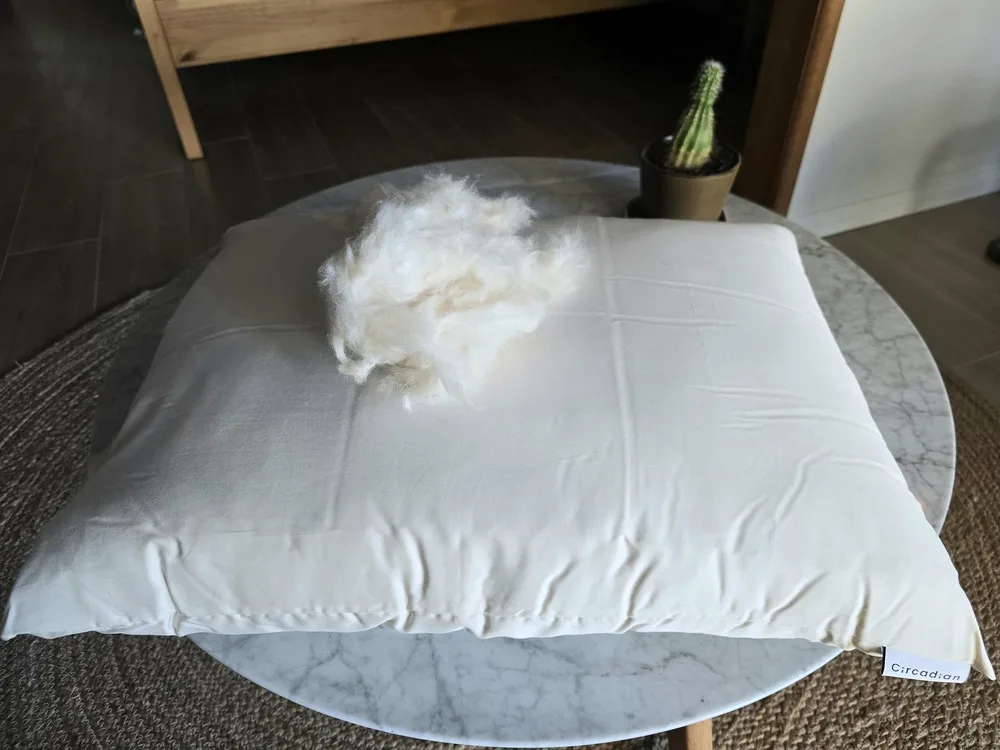
Image Credit: I’m Plastic Free’s editor, Simona Paganetto, testing the Circadian Wild-Harvested Kapok Pillow.
Why is a Kapok Pillow so Light?
A Kapok pillow is so light because Kapok is one of the lightest natural fibers, much lighter than cotton! Each strand is hollow and mostly air inside, so the pillow puffs up soft instead of packing flat. Air moves through it too, so it stays cool and it is ideal for hot sleepers.
Why Does Kapok Fiber Naturally Repel Water and Resist Dampness?
Kapok fiber naturally repels water and helps resist moisture thanks to its waxy outer layer and hollow, air-filled structure. It also stays fresh for years. The natural wax on the fiber makes water bead off it. A 2018 study (1), published in the Journal of the Korean Wood Science and Technology, measured that bead at 120.7 degrees, well past the point where a surface counts as water-repellent. Its water-resistant surface may make it less hospitable to mold and dust mites than damp synthetic fills.
Related: 5 Organic Non-toxic Blankets and Throws in Super Soft Natural Fibers
Who Is a Kapok Pillow Best For?
A kapok pillow is best for sleepers who want a soft, light, natural pillow they can adjust. Because you can add or remove fill through the zipper, one pillow can work for most sleeping positions.
- A side sleeper: keep the pillow fuller to fill the gap between your shoulder and neck. Kapok holds its loft well when it’s generously filled.
- A back sleeper: remove some fill for a medium height that supports your neck without pushing your head forward.
- A stomach sleeper: take out more fill for a low, soft pillow that keeps your neck in a more natural position.
- A hot sleeper: kapok’s hollow fibers let air move through the pillow, so it stays cooler than foam or polyester.
- A vegan, or a person avoiding down: kapok gives you a soft, fluffy feel with no animal products.
Keeping plastic away from your face: the fill is 100% plant fiber, with no polyester blended in. - A person with chemical sensitivities: the fiber comes off wild Ceiba pentandra pods, therefore no chemical treatment is needed about the pillow, and it is soft like down.
Related: Plastic-Free Underwear: 10 Best Non-Toxic & Compostable Brands for Better Health
Circadian Kapok Pillow: Pros and Cons
| Pros | Cons |
|---|---|
| 100% plastic-free: kapok fill with no polyester, foam or synthetics of any kind. | Fibers escape when you remove fill: kapok is so light it floats and escape everywhere, so adjust the fill outdoors. |
| Lightweight and cool: the hollow fibers let air move through, which suits hot sleepers. | The fill can’t be washed: only the cotton cover goes in the machine; kapok clumps when wet. |
| Adjustable height: a side zipper lets you remove fill until the loft feels right. | Needs daily fluffing: a quick shake each morning keeps it lofty. |
| Naturally water-repellent: the waxy coating on kapok fibers helps it resist moisture. | May smell earthy at first: unprocessed natural fiber can have a mild scent that fades with airing. |
| Vegan down alternative: soft and fluffy like down, with no animal products. | Softer than latex: not ideal if you want firm, springy support. |
| Organic cover: GOTS-certified organic cotton, handmade in New Jersey. | Extra care in the tropics: in hot, humid climates, air the pillow often and put it in the sun as much as you can. |
| Unbleached fill: according to Circadian, the kapok goes from pod to pillow with no chemical processing. | No organic certification on the fill: the kapok is wild-harvested, so it isn’t certified organic (the cover is). |
Personal Tips:
- Give the natural fiber pillow a quick shake each morning. This can help it last three to five years.
- Always use the pillow with an extra cotton cover on it, which you can change and wash often.
- If you live in a tropical climate, air the pillow regularly, and place it in the sun when you can!
FAQs About Kapok Filled Pillows
– Can a Kapok Pillow be Washed?
Only the pillow cover can be washed after removing the fill first, because kapok clumps when wet.
– How to Wash a Kapok Pillow?
To clean a kapok pillow, unzip it and remove the filling before washing the cotton cover in the machine on a gentle cycle with cold or warm water and mild (plastic-free) laundry detergent. Allow the cover to dry completely before returning the filling, then fluff the pillow to restore its shape.
Please Note: Never machine-wash the kapok filling itself, as it can clump when wet and take a long time to dry thoroughly. Instead, air it outdoors monthly and spot-clean it if spills occur.
– Is a Kapok Pillow Good for Hot Sleepers?
Yes, a kapok pillow is perfect for a hot sleaper because it’s light and very breathable, contrary to dense synthetic fills or memory foam pillows.
Conclusion
I finally found a completely natural pillow that doesn’t contains any foam or polyester, so there’s no synthetic material to shed microplastics or off-gas. We rest our faces on a pillow for hours every night, so I strongly recommend switching to a Circadian kapok pillow.
Shop the Circadian Kapok Pillow
References and Scientific Literature Sources
(1) Purnawati, R., Febrianto, F., Wistara, I. N. J., Nikmatin, S., Hidayat, W., Lee, S. H., & Kim, N. H. (2018). Physical and chemical properties of kapok (Ceiba pentandra) and balsa (Ochroma pyramidale) fibers. Journal of the Korean Wood Science and Technology, 46(4), 393–401.
—
Do you have any questions or comments? Let us know in the comments section below.
Browse our I’m Plastic Free platform for plastic-free alternatives, and discover plastic-free bedding brands.







Add a comment