


This article explores why you should switch to organic, non-toxic pillows. We rest our face on a pillow for about eight hours every night. We sweat in them, and we breathe in the chemicals and the microfibers that these pillows are made of.
So, we believe pillows should be made from things grown in a field or on a sheep, not produced in a petrochemical plant. Why then is the majority of pillows on the market filled with 100% synthetic material?
Non-toxic bedding, and blankets, matter, but don’t forget the pillow!
Are Synthetic Pillows Safe? What are the Chemicals to Avoid in Synthetic Pillows?
Pillows that are fully made of petrochemicals come with the following chemicals to avoid.
1. Volatile Organic Compounds (VOCs)
Volatile Organic Compounds (VOCs) are carbon-based chemicals that easily evaporate into the air at room temperature. Because conventional pillows are made using petroleum-derived chemicals, plastics, and synthetic treatments, they act as primary sources of indoor VOC emissions. When a pillow releases these trapped gases into your room, it is a process known as “off-gassing”. They are responsible for that strong “new pillow smell.”
The American Lung Association (1) advises reducing VOC sources at home and choosing low-VOC products.
- Formaldehyde: The simplest aldehyde; a highly volatile gas.
- Toluene: A common solvent used in polyurethane foam production.
- Xylene: A chemical solvent frequently found in synthetic foam manufacturing.
- Benzene: A highly volatile hydrocarbon used in chemical synthesis.
- Acetone: A fast-evaporating solvent used in manufacturing processes.
- Chloromethane: A volatile gas detected in emissions from new memory foam.
- Tetradecane: A heavier hydrocarbon compound that still evaporates into indoor air.
2. Semi-Volatile Organic Compounds (SVOCs)
These compounds have a higher molecular weight than VOCs. Instead of evaporating completely into a gas all at once, they release very slowly over months or years. They tend to attach themselves to household dust particles or get absorbed directly through skin contact.
- Flame Retardants: like polybrominated diphenyl ethers (PBDEs) or organophosphates added to foam pillows to slow the spread of fire (2). As you compress the pillow every night by resting your head on it, microscopic particles of these chemicals can migrate into household dust. You then breathe in this toxic dust or absorb it through your skin.
- Phthalates (Plasticizers): Chemicals used to make synthetic fabric casing softer, or to create flexible, waterproof vinyl backings on pillow protectors (often used for kids’ beds or allergy barriers). Over time, these chemicals leach out of the waterproof lining and rub off directly onto your pillowcases and sheets.
A 2017 review (3), published in the journal Building and Enviroment, found that our bedding exposes us to more pollution than we might expect. We spend about a third of our lives asleep with our face just inches from the mattress and pillow, so anything they release reaches us more easily. This can include dust, allergens, microbes, and chemicals such as phthalates and flame retardants. Body heat can carry these pollutants up toward the nose and mouth, and tossing and turning stirs dust back into the air. The authors concluded that exposure during sleep deserves more attention.
Do Pillows Shed Microplastics?
Yes, synthetic pillows release microfibers into the immediate breathing zone of the pillow. A 2022 study (4), published in the journal Polymers, examined how different textile structures shed microfibers, finding that mechanical friction and fabric deterioration can substantially increase microplastic release. Loosely constructed and heavily worn fabrics may release more fibers over time, suggesting that aging synthetic pillow fillings and covers could shed more microfibers over time.
What are Pillows Made of?
Pillows are usually made with two main parts: an outer fabric casing and the filling inside it.
The filling may be made of natural materials or synthetic ones. Cheap pillows in large department stores are usually made with synthetic fillings of polyester, polyurethane (PU) foam, or viscoelastic polyurethane foam, which is a type of plastic polymer engineered to react to body heat and pressure.
The outer fabric casing can be made of synthetic materials like polyester, or natural fibers like cotton.
What are Safer, Natural Pillow Fills Without Microplastics?
Safer, natural pillow fills that do not shed microplastics are made of the following materials:
- Organic cotton: provides a dense, familiar support that holds its shape for years. Make sure that the cotton is certified under the Global Organic Textile Standard (GOTS), fill and cover.
- Organic Kapok: best for chemical-sensitive sleepers. The fiber comes off the pods of the tropical Kapok tree (Ceiba pentandra) and needs no chemical treatment.
- Organic Wool: best for hot sleepers. Wool absorbs up to 30% of its weight in moisture while the surface stays dry. Again, make sure that the wool is certified under the Global Organic Textile Standard (GOTS).
- Buckwheat: provides firm cervical support that stays where you put it, with air moving between the hulls all night.
- Buckwool Hybrid: a hybrid filling that combines natural buckwheat hulls and pure wool to balance firm, ergonomic support with plush, cushioned comfort.
- Tree-Tapped Latex: is made from milky sap harvested from rubber trees (Hevea brasiliensis). It’s best for people who like memory foam pillows.
- Pure down, pure feather, or hybrid feather-and-down blends: pure down offers quill-free, cloud-like softness, pure feather provides a firmer, flatter structure with support from quills, and hybrid blends combine both by wrapping a supportive feather core in a plush down outer layer.
Our Selection and Testing Criteria
Before we went ahead to scout organic, non-toxic pillows, we decided what materials we’d accept when vetting the brands individually, and which materials we’d reject. Simona, I’m Plastic Free’s editor, scrutinized many brands before deciding which ones to select. Please see here below our approach:
- The pillowcase / pillow cover must be made of GOTS-certified fabric
- The filling must be made of organic, natural materials
- Third-party lab reports or recognized safety certifications by independent organization must be available, i.e:
- Hands-on testing by our editor for our top pick
3 Plastic-free Pillows that are Made with Natural Materials
There are a lot of pillows on the market that claim to be non-toxic but most of them have plastic fibers or fillings. We scouted the pillows that have no plastic.
This post contains affiliate links, which means we may receive a small commission, at no cost to you, if you make a purchase through a link. This helps us continue the hard work we put into researching products and solutions.
Please Note: Our health content is for informational purposes only and is not intended as professional medical advice. Consult a medical professional on questions about your health. Please read our disclaimer.
1. Circadian All-natural 100% Plastic-free Pillows
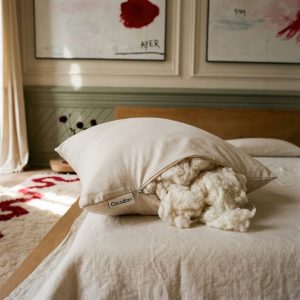
Every Circadian pillow is completely plastic-free and handmade in their New Jersey workshop in the US, and wrapped in a GOTS-certified organic cotton cover.
Organic Fill Materials: 6 fills available, GOTS-certified organic cotton, wool, wild-harvested kapok, buckwheat, buckwool, tree-tapped Dunlop latex.
Cover Material: GOTS-certified organic cotton
Firmness Available: different firmness levels depending on the specific model and fill material. A zipper lets you add or remove fill until the firmness feels right to you.
Weight: Every pillow uses completely natural, uncompressed raw materials rather than uniform synthetic foam, so the weight varies dramatically depending on the chosen fill material.
Personal Testing: We love that it’s all natural inside and outside: no polyester, no memory foam, no synthetics of any kind. We have been sleeping on the wild-harvested kapok pillow (see the image below) for weeks, and we love that it has the perfect equilibrium between softness and firmness. The material feels incredibly light, and it is also cool on the skin as it doesn’t let you perspire easily. Last but not least, we love that they stock the largest range of certified, natural pillows we could find.
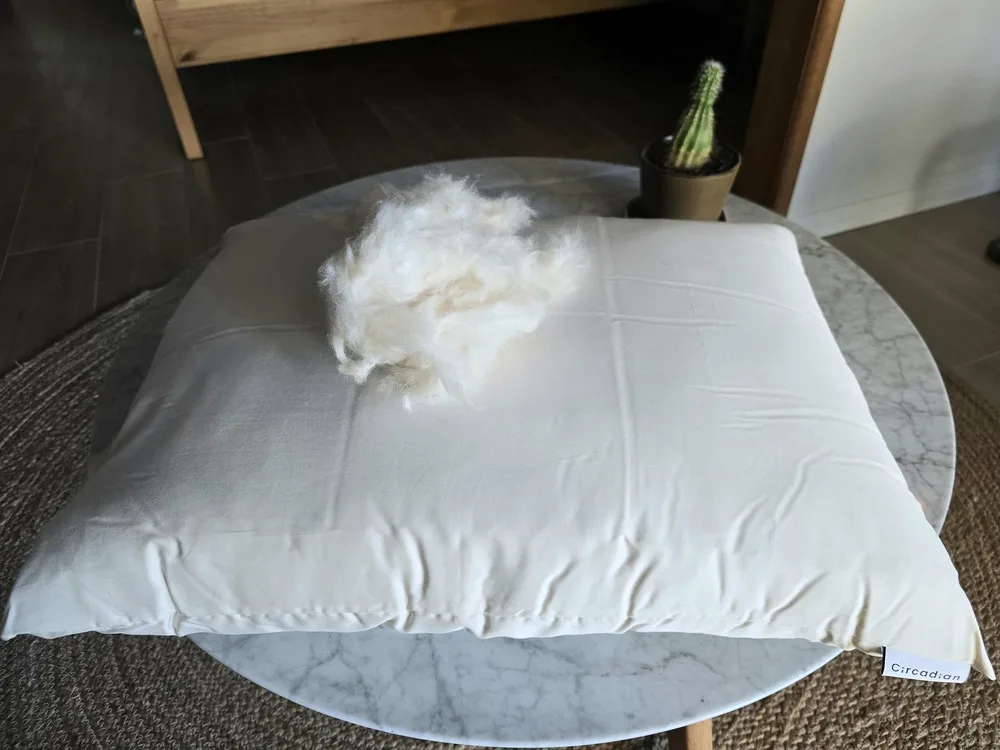
Image Credit: I’m Plastic Free’s editor, Simona Paganetto, testing the Circadian Wild-Harvested Kapok Pillow.
2. Avocado Organic Green Pillows & Other Options
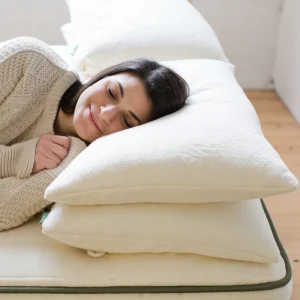
Avocado makes a range of organic pillows. The lineup includes the adjustable Green Pillow we feature here, as well as a solid molded latex pillow, Talalay latex options, and a down pillow, plus kids, travel and wedge versions. All are made without polyurethane foam, memory foam, polyester fill, PLA bioplastic or chemical flame retardants.
Organic Fill Materials: GOLS-certified organic latex and natural kapok tree fiber in a 70/30 ratio by weight for the Green Pillows. They also offer alternative pillow fills like RDS-certified down, pure Talalay latex, and charcoal-infused Dunlop latex. You can also purchase pillow refills separately.
Cover Material: GOTS-certified organic cotton
Firmness Available: different firmness levels depending on the specific model and fill material.
Weight: It depends on the material of the pillow. They have different shapes too like for side sleepers.
3. Coyuchi Natural Pillows
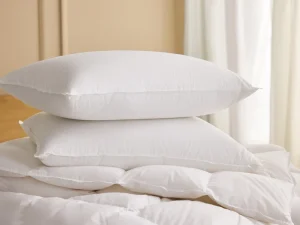
Coyuchi is a California brand that has made organic bedding for more than 30 years. Its pillows use natural fills, such as responsibly sourced down and feather from a US duck farm, inside covers of certified organic cotton. The down pillows are made in the USA, and the brand avoids pesticides and toxic chemicals in its textiles.
Organic Fill Materials: Down, down feathers, and GOLS-certified organic Dunlop latex.
Cover Material: GOTS-certified organic cotton
Firmness Available: soft for down, more structural for feather and down, and firm for the latex option.
Weight: It depends on the material of the pillow.
Personal Tips if You are on a Budget
- If you just bought a new synthetic pillow, let it off-gas for 1-2 weeks outside or in a well-ventilated area before using it.
- Buy a GOTS-certified organic cotton cover for your current “synthetic plastic pillow”. It won’t eliminate microplastic exposure, but it might reduce it. The pillow will still off-gas, though.
- Wash your cotton pillow cover regularly with a fragrance-free, plastic-free laundry detergent.
- If you’re buying an organic synthetic-free pillow, place an organic cotton cover on top. It’ll make your pillow last longer.
FAQ About Microplastic-free Pillows
– What is the safest material for a pillow?
The safest pillow materials are made of organic, natural materials like cotton, wool, Kapok, buckwheat, buckwool, latex, or feathers and downs.
– Can I just put an organic cover on my synthetic pillow?
Yes, you can. A GOTS-certified organic cotton cover will help prevent surface shedding of microfibers, but it will not eliminate your exposure. The internal synthetic filling will continue to break down over time, and will continue to release fibers, so it’s an improvement, but not a long-term solution.
– What is a buckwool pillow?
Buckwool stands for buckwheat and wool. A buckwool pillow combines buckwheat hulls, which provide firm, adjustable support and a cooling effect, with a layer of natural wool that adds surface softness and helps regulate temperature.
Conclusion: Choose Pillows Made of Natural Fillings and Fibers
We spend about a third of our lives with our face pressed against a pillow, so what it’s made of matters. Synthetic pillows can shed microplastic fibers through friction and wear, and some contain flame retardants linked to health concerns. Research (5) also shows that bedroom air during sleep already carries a high load of airborne chemicals, so cutting out avoidable sources makes sense. Non-toxic pillows made from 100% natural fills and an organic cotton cover are a simple way to keep synthetics out of the space you breathe in every night.
References and Scientific Literature Sources
(1) American Lung Association. (2023, November 29). Volatile organic compounds in the home: The surprising places you might find them. https://www.lung.org/blog/volatile-organic-compounds-at-home
(2) National Institute of Environmental Health Sciences. (n.d.). Flame retardants. Retrieved October 21, 2026, from https://www.niehs.nih.gov/health/topics/agents/flame_retardants
(3) Boor, B. E., Spilak, M. P., Laverge, J., Novoselac, A., & Xu, Y. (2017). Human exposure to indoor air pollutants in sleep microenvironments: A literature review. Building and Environment, 125, 528–555. https://doi.org/10.1016/j.buildenv.2017.08.050
(4) Cui, H., & Xu, C. (2022). Study on the relationship between textile microplastics shedding and fabric structure. Polymers, 14(23), Article 5309. https://doi.org/10.3390/polym14235309
(5) Molinier, B., Arata, C., Katz, E. F., Lunderberg, D. M., Ofodile, J., Singer, B. C., Nazaroff, W. W., & Goldstein, A. H. (2024). Bedroom concentrations and emissions of volatile organic compounds during sleep. Environmental Science & Technology, 58(18), 7958–7967. https://doi.org/10.1021/acs.est.3c10841
—
Do you have any question or comments? Let us know in the comments section below.
Browse our I’m Plastic Free platform for non-toxic plastic-free alternatives, to discover plastic-free beddings brands.






Add a comment