Electric kettles are regarded as an essential appliance in the kitchen for the quick boiling of water for tea or coffee. Plastic kettles or tea kettles containing plastic fill indicators, plastic spout filters, and plastic lids are harmful to health for many reasons.
Plastic Associated Chemicals (PACs) in plastic tea kettles can cause health problems by interfering with the human endocrine (hormone) system. Consumers are becoming aware of these health hazards of plastics in the kitchen, as summarised in a 2024 study by Liu et all., published in the Environment International Journal (1) and are beginning to demand products that are free of plastic components, like stainless steel tea kettles for example.
Are Plastic Tea Kettles Safe?
No, they aren’t. Plastic starts breaking down when exposed to heat. A kettle made entirely of plastic can generate tiny cracks and imperfections on long use, increasing the risk of unwanted chemicals leaching into the hot water. A 2020 study by the Medical University of Vienna (2) has shown that electric plastic kettles have a higher tendency to provide about 4-29 million microplastics per liter at boiling temperature.
New research by the University of Queensland published in npj Emerging Contaminants (3) found that the first boil in a new kettle released almost 12 million nanoparticles per millilitre, equating to almost 3 billion particles in an average 250ml cup of tea. After 150 boils, there were still 820,000 nanoparticles detected per millilitre, or 205 million per 250ml cup.
Aren’t these reasons enough to stop boiling water in plastic and choose a non toxic tea kettle?
When you consider that tea bags may also release microplastics into your cup or teapot, then this becomes a reason to be alert about your health. If you want to use a tea bag in your cup or teapot, choose one from an organic tea brand that uses 100% plant-based folded and stitched sachets.
Related: Plastic-free Tea Bags. Which Brands Are Really Microplastic Free?
The Effect of Plastic Kettles on Our Health
You would not want to taste water contaminated with plastic associated chemicals (PACs). Bisphenol A (BPA) is one of the most hazardous chemicals often detected in foods and drinks stored or heated in plastic containers. Research shows that BPA is a known endocrine disruptor, and individuals using plastic kettles for boiling water are exposed to the harmful effects of this chemical. If this is done daily, we are under strong exposure to bisphenols linked to many health issues.
Is BPA Free Plastic Still Toxic?
A lot of plastic products, including tea kettles, are now advertised as “BPA free”, however, please don’t be fooled by the marketing language. It is not just Bisphenol A the issue; there are many other bisphenols (that have replaced BPA, like BPS, BPF, BPAF etc.), phthalates etc. that are endocrine disrupting chemicals as proven by studies (4).
It is no wonder that companies selling non-toxic tea kettles are experiencing a rising demand for their plastic-free electric kettles, i.e. that are free from toxic materials. Some plastic-free kettles use aluminum, copper, or coloured glazed material, which also negatively impacts health, as the hot water causes some metal components and colour pigments to infiltrate into the water, which is harmful to health. It is, therefore, highly recommended to use safer materials to reduce the poisoning of our bodies with the nasty chemicals.
What are the Safest Materials for Electric Kettles?
Most of the products in the plastic-free range are made of materials that do not produce any toxic effects in contact with boiled water. The best non-plastic electric kettles are free of plastic or have minimal plastic parts, but these do not come into contact with hot water. The safest materials for plastic-free, non toxic tea kettles are stainless steel, borosilicate glass and ceramic.
Stainless Steel
A stainless steel kettle is recommended because it is safe and does not expose the user to dangerous chemicals. It also avoids rust and is suitable for long use without side effects. Stainless steel electric kettles are easy to clean and don’t affect water with any scent or flavor. However, all grades of stainless steel are not equally effective. You should look for kettles made with 18/8 or 18/10 grade stainless steel.
Borosilicate Glass
Borosilicate glass is also a safe material as it is chemical resistant and does not release any metals or toxins. Glass kettles also have better temperature control and don’t do not release any colur or odor in the water. Unfortunately, however, most borosilicate glass kettles are made with a plastic lid which defeats the purpose of not wanting the water to boil in contact with plastic.
Ceramic
Fully ceramic electric kettles do exist and are another safe alternative to plastic kettles.
Related: Why Plastic Microwave Covers Aren’t Safe (And 5 Non-toxic Alternatives)
13 Best Non Toxic Kettles on the Market
The best plastic-free and chemical-resistant electric kettles are designed innovatively to eliminate plastic parts or avoid contact with plastic elements in hot water.
This post contains affiliate links, which means we may receive a small commission, at no cost to you, if you make a purchase through a link. This helps us continue the hard work we put into researching products and solutions.
Important Disclaimer: While we make our best efforts to scout plastic-free products around the world, we are also aware that electrical appliances that are 100% plastic-free do not exist. In this article, we are presenting the best versions of what is available on the market where the interior kettle materials are not made with plastic, according to our values.
1. SAKI Luna All Stainless Steel Electric Kettle (Cordless)
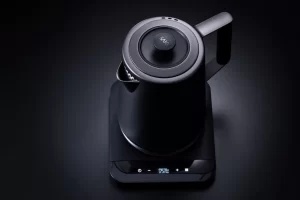
We finally found an all stainless steel electric kettle that is crafted meticulously with a 100% plastic-free 304 stainless steel interior. This is the only electric kettle with variable temperature control that literally has no plastic and no silicone in its interior.
The SAKI Luna cordless kettle comes with manual temperature control and 7 presets for Black, Green, White, Oolong, Herbal Tea, and French Press coffee. It also includes a 60-minute keep-warm feature and an elegant LED light ring indicator that allows you to see real-time updates on the water heating progress.
Update July 2026: The manufacturer has updated the kettle design to further enhance its material integrity (SAKI’s CEO is a Medical Doctor). The new version now incorporates aluminum and glass on top of the plastic base structure to minimize residual odor and improve thermal stability. The base’s inner structural frame remains plastic, which is needed for insulation and mechanical support.
Furthermore, the silicone seal in the lid designed for a smooth-closing mechanism has been completely removed. The lid now has entirely metal-to-metal contact!
Capacity: 1.75L
Wattage: 1,500W
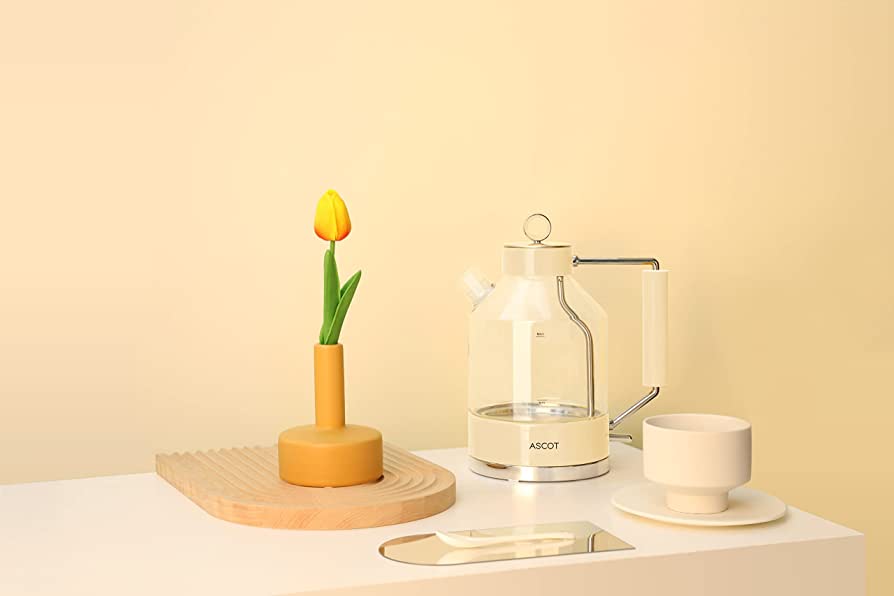
2. ASCOT Stainless Steel Electric Tea Kettle
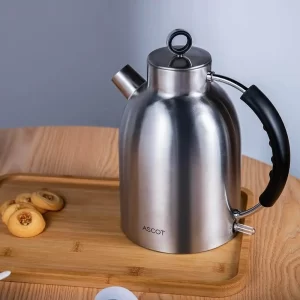

Similar in design to the borosilicate kettle, however, this one is a food-grade 304 stainless steel kettle, including the lid and the spout, and no plastic is in contact with water hot or cold according to the manufacturer. It’s available in matte or polished stainless steel with no coating for more longevity, if wished. If you’re searching for the best electric kettle, this one is definitely to be highly considered.
Capacity: 1.7L
Wattage: 1,500W
Related: The Best Non-Toxic Small Kitchen Appliances That Don’t Shed Microplastics
3. ASCOT Glass Electric Kettle


This borosilicate glass kettle is designed in Denmark and made of the finest quality borosilicate glass, which resists scratching and scuffing. Being a full glass kettle ensures that no plastics touch the boiling water inside, including the lid. The round spout filter is made of stainless steel and food-grade silicone under strict quality standards. Please note: the circumference at the bottom has a silicone interior encased in the glass.
Capacity: 1.7L
Wattage: 3,000W
Related: Why is a Plastic-Free Blender Better For Your Health
4. Hazel Quinn Retro Electric Kettle with 304 Stainless Steel Interior

We added this kettle because it has a cool vintage design and is crafted with food-grade 304 stainless steel in its interior, lid, and filter. We have it in our home, so we tried this first-hand; it has no plastic in contact with the water, providing you and your family with microplastic-free healthy drinking. We LOVE that it is a powerful kettle that can boil 1.7L of water within 4-5 min (though not perfectly silently). The retro thermometer dial is cute and allows you to check the desired temperature.
The manufacturer provides a 2-year warranty for customers worldwide from the date of delivery, which is great as most brands offer only a 1-year warranty.
Our Testing Takeaway: We tested this kettle extensively and are currently using it. The only drawback is that we wish they’d make a sleek pure stainless steel version with no plastic paint in the exterior. Also, it doesn’t have a limescale filter, aka the mesh filter in the spout of the kettle, but as we use filtered water this is not a main issue. Lat but not least, the exterior is hot to the touch, so be careful while handling it!
Capacity: 1.7L
Wattage: 1,200W
Shop at Amazon USA – UK – Australia

Image and Video Credit: I’m Plastic Free testing the Hazel Quinn electric kettle and showing no plastic under the lid and in the interior.
Related: 12 Truly Non-Toxic Cookware Brands for a Healthy Kitchen
5. Cosori Electric Gooseneck Pour Over Stainless Steel Kettle
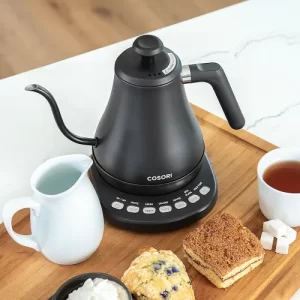

This electric gooseneck kettle always gives you the right temperature, while the gooseneck spout pours water precisely and easily. The kettle interior, the lid, and the spout are made of food-grade 304 stainless steel, with no Teflon or chemical lining. The heated water inside the kettle, therefore, doesn’t touch any plastic. It has 5 one-touch presets and keeps the water temperature in the kettle warm for up to 1 hour, making it perfect for your morning cup.
Capacity: 0.8L
Wattage: 1,200W
Shop at Amazon USA – Canada – UK – Australia
6. COSORI Glass Electric Kettle with Wide Mouth For Easy Cleaning

This is our personal tip if you have a Low Budget: the same brand COSORI offers an affordable glass kettle model with a wide opening for easy cleaning and descaling, where the boiling water doesn’t come in contact with plastic.
Alternatively, if you don’t want glass, go for the COSORI Stainless Steel Double Wall Electric Kettle.
Capacity: 1,7L
Wattage: 1,500W
Shop at Amazon USA – Canada – UK – Australia
7. Chantal Mia eKettle – Electric Water Kettle With No Plastic Interior
Chantal is a US cookware brand offering a stylish electric water kettle with no plastic interior made of brushed stainless steel (and available in other colors) called Mia eKettle. It has a unique gooseneck slow pour spout for handcrafted coffee or tea perfection. The spout cools boiling water to the ideal brewing temperature of 205° F when pouring. This no plastic electric kettle even has an interior water gauge made entirely of stainless steel!
Our Personal Tip: Don’t buy the colored versions with paint on them; it’ll peel off over time, buy the steel version for longevity and safety.
Update July 2026: the latest model has no plastic also in the lid and in the handle.
Capacity: 2 pounds
Wattage: 1,000W
8. Fellow Stag Stainless Steel Electric Gooseneck Kettle


This plastic-free electric kettle has a gooseneck that pours as good as it looks though with a minimalist base to save space on the kitchen bench. It offers easy temperature control to the degree and keeps your water warm for up to 60 minutes. It is made with a high-quality 304 stainless steel body and a wooden handle, so it avoids any contamination from plastic. The spot pours water gently, so It is perfect for tea lovers who want their oolong tea.
Please Note: a small soft plastic/silicone O-ring (less than 1/4 inch in diameter) around the temperature sensor comes in contact with the water.
Our Testing Takeaway: We tested this kettle (image by I’m Plastic Free), and it wasn’t big enough for our family, plus we prefer a standard spout.
Capacity: 0.9 L
Wattage: 1,200 W
Shop at Amazon USA – Canada – UK – Australia
Related: 3 Stylish Types of Plastic-free Reusable Coffee Cups You Can Take Anywhere
9. Willow & Everett Gooseneck Electric Kettle
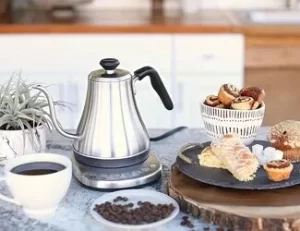
This plastic-free tea kettle is designed so that water only touches rust-proof 18/8 stainless steel. The ergonomically designed handle is lined with BPA-free plastic but doesn’t touch the boiling water. The kettle body is made of 100% food-grade stainless steel with no chemical linings and therefore no plastic. It also has a “keep warm” function that remembers and holds the previous preset temperature.
Capacity: 1L
Wattage: 1,000W
10. LongSeed Electric Ceramic Tea Kettle

Capacity: 1 Quarts
Wattage: 1,200
Related: Plastic Free Thermomix Accessories for Non-toxic Cooking
Plastic Free Stovetop Kettles
For completeness, we’d also like to suggest some stainless steel kettles that can be directly placed on your stovetop and don’t require an electric connection to heat the water but do require external heat. These non toxic tea kettles are light, unlike a cast iron kettle that is better for a campfire but heavy to handle in the kitchen. Copper kettles are also not recommended as they can be dangerous when used to heat water daily. For all these reasons, we prefer to recommend stainless steel options because they are durable, crack- and rust-resistant. There are many tea kettles that heat water efficiently from your stove, we’ve selected a few of the best 100% stainless steel kettles on the market.
11. Gipfel International Whistling Tea Kettle Pot
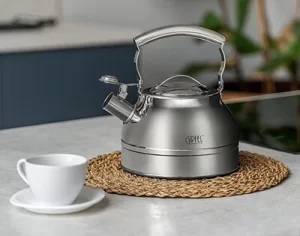
This non toxic tea kettle is very efficient as it takes only a very short time to boil water due to the high thermal conductivity, the energy-efficient design, and the multilayer bottom technology (tri-ply capture bottom). The 2.2L capacity is perfect for a family or for surprise visitors. This stovetop kettle is 100% plastic free, dishwasher safe and designed in Germany.
Capacity: 2.2 liters
12. All-Clad Specialty All Stainless Steel Tea Kettle

This All-Clad Tea Kettle boils water quickly and efficiently, on on all cooktops including gas, electric, ceramic, and induction. It’s made from durable, high quality 18/10 stainless steel with a high-polished surface for easy cleaning and it’s dishwasher safe. The stainless steel whistle alerts when the water is boiling, and the hinged cap flips open for easy pouring.
The manufacturer is so confident in this product that they provide a Limited Lifetime Warranty.
What we love: it has a visible fill line to prevent overfilling! It’s bonded engineered and assembled in the USA.
Capacity: 2-Quart
13. Alessi Tea Kettle – Il Conico 90017
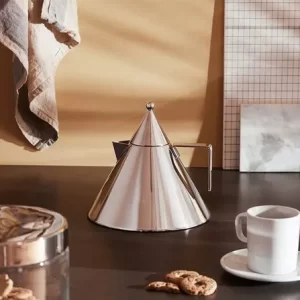
This designer Alessi tea kettle can be used on a gas or induction stovetop. It is a tea kettle that uses only high-quality 18/10 stainless steel, even in the outside handle. This whistling tea kettle has been designed by Aldo Rossi and is made in Italy. Considering the price point, we wouldn’t label it as dishwasher-safe.
Capacity: 2 liters, 7 cups.
Shop at Amazon USA – UK – Australia
Related: Plastic Free Water Filters: Can We Find Water Purifiers without Plastic?
FAQ about Kettles that don’t Shed Microplastics
– Electric Kettles vs. Stovetop Kettles. What is More Energy Efficient?
Tea kettles account for around 35% of energy used when cooking, so it’s important to make a decision also considering their carbon footprint.
In fact, from a sustainability standpoint, in terms of energy used, it’s worth noting that stovetop or hob kettles are capable of heating the water way above the boiling point, therefore using more energy than required. The heating element of electric tea kettles is immersed in the water, so there’s very little heat loss. The same is true for a tea kettle used on an electric induction hob. Whereas with a kettle on the gas stove, energy is wasted heating up the body of the kettle first, so it’s less energy efficient.
So, at the point of use, and particularly if your home is running on renewable energy, an electric kettle or an electric hob kettle is more energy efficient than a gas hob kettle.
Personal Tip 1: Check the Underside of the Lid and the Spout Filters Before Buying (Many Are Plastic!)
With the recommendations in this article, we have gone the extra mile and have analyzed many features of non-toxic tea kettles, including the underside of the lids and the filters, to make sure there is no contact of plastic with the boiling water.
Please note: a lot of glass and stainless steel kettles on the market that claim to be plastic-free still show that the underside of the lid and part of the mechanism that opens the lid is plastic. They also have a (mostly) removable plastic filter on the spout. These parts defeat the purpose of buying non-toxic tea kettles because of the hot steam in contact with the plastic lid or the boiling water flowing through the plastic filter when pouring it.
Personal Tip 2: What To Do Before the Product’s First Use
Wash the inside and the outside of the tea kettle with hot soapy water, rinse, and dry. This step will make sure that any leftover residues from the production process are gone.
Conclusion: Choose a Glass, Ceramic, or Stainless Steel Electric Kettle
It is best to have non toxic tea kettles that are made of high-quality stainless steel, borosilicate glass or ceramic and do not use any plastic components, at least in the interior. An electric kettle with no plastic components is highly desirable for consumers looking for non-toxic small kitchen appliances. Plastic free tea kettles can help improve your long-term health, plus you will also experience enhanced flavor in the drinks.
Do you have any questions or comments? Let us know in the comments section below.
Our Expertise:
This piece was written and updated by Simona Paganetto, I’m Plastic Free’s editor and managing director. Simona spent a decade in product management in the healthcare industry, and is, therefore, familiar with reading scientific studies published in peer-reviewed journals. Simona is certified as a Circular Economy Specialist by the Circular Economy Alliance in conjunction with the École des Ponts Business School in Paris, France. In 2024, she completed the Executive Education for Sustainability Leadership course, from the Department of Environmental Health, Harvard T.h. Chan School of Public Health, Harvard University, thanks to a scholarship from Chief Executive Women (CEW) and the Australia and New Zealand Banking Group (ANZ). Find out more about her work and experience.
Scientific Literature Sources
(1) Gallo, F., Fossi, M. C., & Aliani, S. (2024). Plastic additives and microplastics in the marine environment: A review of potential risks to human health via seafood consumption. Environment International, 189, 108826. https://www.sciencedirect.com/science/article/pii/S016041202400326X
(2) Li, D., Shi, Y., Yang, L., Xiao, L., Kehoe, D. K., Gun’ko, Y. K., Boland, J. J., & Wang, J. J. (2020). Microplastic release from the use of polypropylene feeding bottles during infant formula preparation. Nature Food, 1(11), 746–754. https://www.researchgate.net/publication/347172664_Microplastics_in_hot_water
(3) Zhu, X., Song, Y., Wang, Y., & Zhang, C. (2025). Temperature-dependent release of microplastics and nanoplastics from commercial food-contact plastic materials. Nature Chemical Engineering, 2(1), 45–56. https://www.nature.com/articles/s44454-025-00018-w
(4) Kumar, R., Verma, A., & Singh, S. (2025). Assessing the migration of microplastics and chemical additives from reusable plastic water bottles under varied thermal conditions. Materials Today: Proceedings, 112, 102–111. https://www.sciencedirect.com/science/article/pii/S2590182625000372
—
Browse the I’m Plastic Free platform to discover more non-toxic appliances for your kitchen or read our blogs in the plastic-free kitchen category.