

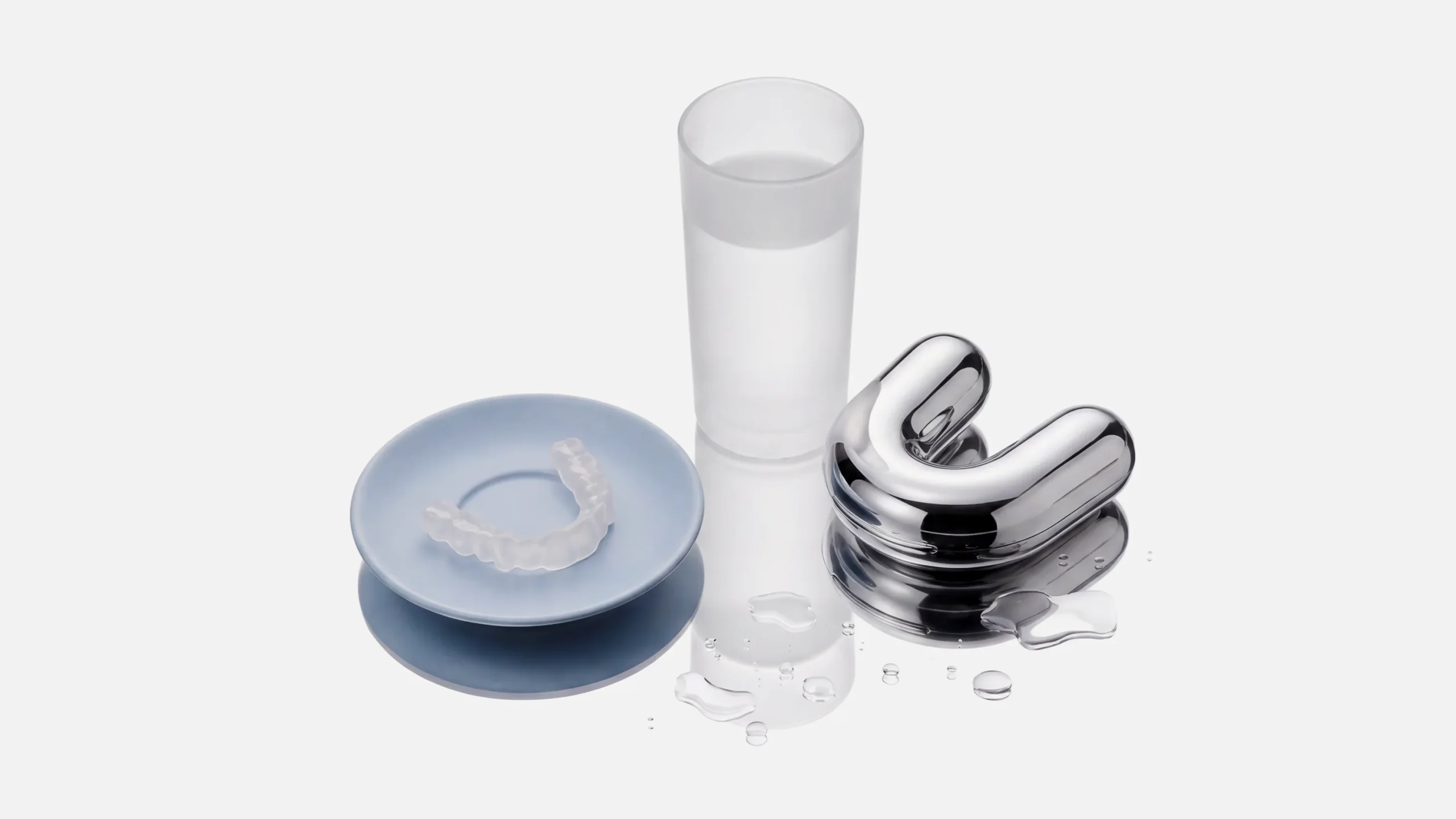
Image credit: Unplastic Retainer by moses
If you’ve had braces or clear aligners, your orthodontist probably told you to wear a retainer every night, often for life. That’s a lot of hours with plastic pressed against your teeth. I’ve had a plastic retainer for years, which I was using only during the night, and always felt guilty for years knowing that I’d ingest microplastics.
We’ve spent years researching plastic-free oral care, from microplastic-free toothbrushes to PFAS-free dental floss. Here is what the research says about plastic retainers, what they are made of, and the plastic-free retainers on the market today.
Do Dental Retainers Shed Microplastics?
Yes. Every lab study that has tested clear retainers so far has found that they release plastic particles. The amount depends on the material, how hard you bite or grind, and how long you wear them.
A 2026 pilot study (2) published in Applied Sciences tested five appliances in artificial saliva at body temperature for 14 days: a PETG Essix A+ retainer, an acrylic Hawley retainer, an acrylic night guard and two polyurethane aligners. The retainers were stirred to simulate 8 hours of night wear a day. Using laser infrared imaging, the team counted 16 particles per 1 mL sample from both the Essix and Hawley retainers, and 11 from the night guard, compared with 1 in plain saliva. The polymers they identified included PET, PMMA (acrylic) and polyurethane.
Please note: This was a pilot study with one appliance of each type, and it could not detect particles smaller than about 20 µm.
Retainer company Moses ran its own test in 2026 (3). PETG retainers made from Great Lakes Biocryl were put in a chewing simulator at the University at Buffalo School of Dental Medicine for 58,240 cycles at 37°C (98.6°F), which the authors equate to about six months of nightly wear. Each upper and lower pair lost an average of 3.35 mg of plastic and released an estimated 59,100 detectable particles, averaging 52 µm across. Extrapolated, that is about 118,000 particles a year.
Please note: This is a company white paper, not a study published in a peer-reviewed journal. It tested four retainer pairs in purified water instead of saliva, counted only particles 15 µm and larger.
Do Clear Aligners Release Microplastics?
Yes. Clear aligners are made of the same kinds of plastic as clear retainers and are worn up to 22 hours a day, so they have been studied more.
A 2023 study (6) from Italy, published in Science of the Total Environment, was the first to show it. Researchers stirred aligners from seven brands in artificial saliva for seven days to mimic friction against the teeth. All of them released particles, mostly 5 to 20 µm in size. Five brands were made of PET-type plastic and two of polyurethane. In the 2026 Applied Sciences study, aligners stirred to simulate 20 hours of wear a day released far more than retainers: 341 particles per mL for Invisalign SmartTrack and 1,382 for Zendura FLX (2).
A 2026 University at Buffalo study (1) tested six devices from different manufacturers, including clear aligners, retainers and appliances for jaw (TMD) disorders, in artificial saliva for one week. Three were thermoformed (heated plastic sheets pressed over a model) and three were 3D printed. All six released micro- and nanoplastics, and the 3D-printed resins released the most. When the researchers added the particles to immune cells, the cells readily took them up, and particles from urethane-based printed resins pushed them toward an inflammatory state.
Please note: All of these are lab studies over days or weeks, not studies in patients. The University at Buffalo authors call their results preliminary and say clinical studies are needed.
Are Microplastics from Retainers Harmful?
We don’t know yet. Researchers have shown that orthodontic plastics shed particles and that immune cells take them up, but no study has followed retainer wearers to look for health effects.
A 2025 review (4) in Progress in Orthodontics looked at 11 studies on microplastics from aligners, adhesives, elastics and oral care products. It found that most were short lab tests with inconsistent methods, that saliva enzymes and real chewing were not modeled, and that there are no regulatory limits for microplastic exposure. A 2024 review (7) in the Journal of the World Federation of Orthodontists, by Nearchos Panayi, Theodore Eliades and colleagues, argued that aligners are non-biodegradable, release microplastics, are classed as medical waste and can’t be recycled, and called on the profession to address the issue.
Please note: Both are narrative reviews, which means the authors chose which studies to include. They raise valid concerns but do not prove harm.
Retainers may matter more over time than aligners, because many orthodontists now recommend wearing one at night indefinitely. A 2025 study (8) in PLoS ONE loaded passive aligners, the type used as retainers, 22,500 times in a testing machine. All three cracked or chipped, and the PETG Essix ACE shed fragments mostly 30 to 65 µm long.
What Are Dental Retainers Usually Made Of?
Almost all removable retainers are made of fossil-based plastic. Clear retainers are thermoformed from a plastic sheet, while Hawley retainers combine acrylic and metal wire. Here are the materials you are most likely to be given, and where each one comes from.
| # | Material | What It Really Is | Where You’ll Find It |
|---|---|---|---|
| 1 | PETG (polyethylene terephthalate glycol) | A copolyester, the same plastic family as water bottles (PET), with glycol added to make it easier to mold | The most common clear retainer: Essix ACE and A+, Duran, Biocryl (2)(3)(9) |
| 2 | Polyurethane (PU, TPU) | A flexible, tough plastic made from fossil-based isocyanates and polyols | Vivera retainers, Zendura, Invisalign SmartTrack aligners (2)(9) |
| 3 | Polypropylene and copolymers | Polypropylene, often blended or layered with other polymers (copolymers) to balance flexibility and strength | Essix C+ retainers (9); multilayer aligner sheets |
| 4 | 3D-printing resins | Light-cured liquid resins, often urethane-based methacrylates, printed layer by layer | Direct-printed retainers and aligners; they shed the most particles in lab tests (1) |
| 5 | PMMA acrylic plus steel wire | Hawley retainer: a pink or clear acrylic plate (polymethyl methacrylate) with a stainless steel wire | Traditional removable retainers; acrylic still shed particles in lab tests (2) |
| 6 | Stainless steel wire plus resin composite | Bonded, fixed or “permanent” retainer: a thin wire glued behind the teeth with dental composite | The lowest-plastic option; the composite is plastic-based and can release small amounts of BPA when first placed (10) |
Brands rarely say “plastic”. Terms such as “medical-grade polymer”, “copolyester”, “thermoplastic” or “BPA-free” all describe plastics. In a 2024 study (9) in Clinical Oral Investigations, the polypropylene Essix C+ absorbed about 15% of its weight in artificial saliva and was the only retainer material that showed chemical signs of degrading.
If you have a bonded retainer, a 2011 study (10) in the American Journal of Orthodontics and Dentofacial Orthopedics measured BPA in the saliva and urine of 22 people after their wire was glued on. Salivary BPA rose only right after placement, up to 20.9 ng/mL, and was back to normal by the next day. The authors judged the risk negligible but recommended rinsing and polishing after placement to keep it low.
Please note: This study is older and small. It looked at BPA, not microplastics.
What Plastic Alternatives Are on the Market for Dental Retainers?
A few companies now make retainers from bio-based materials. Honestly, none of them is plastic-free in the strictest sense: they are still polymers, and they still shed particles. The difference is what the particles are made of and whether they biodegrade.
| # | Material | What It Is | Product | Status |
|---|---|---|---|---|
| 1 | PHA (polyhydroxyalkanoates) | A bio-polymer that bacteria make inside their cells as an energy store, by feeding on sugars or plant oils. It biodegrades in soil, water and compost (11) | Unplastic Retainer by moses | Available in the US |
| 2 | “100% Plant-based” Undisclosed material | A patent-pending blend the maker describes as “100% plant-based, bio-based, and other naturally-occurring components”. The exact polymer isn’t disclosed | Good Fit / GT Smiles | Retainers available through dentists |
| 3 | Undisclosed “bio-derived” materials | Plant-based or bio-derived polymers whose chemistry isn’t published | bio. (UK), EcoAligners (India) | UK retainers; aligners only in India |
| 4 | PLA (polylactic acid) | A bioplastic made from fermented corn or sugarcane starch that needs industrial composting | None found for retainers | Suggested by researchers (12) |
| 5 | Silk fibroin | The protein that makes silk, engineered into a flexible, antimicrobial, recyclable film | None | Lab and animal testing only (13) |
| 6 | Stainless steel wire | A fixed wire bonded behind the front teeth | Ask your orthodontist | Widely available; glued with resin composite |
Please note: A 2026 scoping review (12) in Frontiers in Oral Health concluded that no biodegradable material has yet been proven fit for clear aligner treatment in clinical trials. Retainers hold teeth in place rather than move them, so they ask less of a material, but no clinical trial has tested a bio-based retainer either yet.
What Is PHA, and Is It Plastic?
PHA is a natural polyester (natural biopolymer) made by microorganisms, so it is a bioplastic, but not a petrochemical one. According to a 2025 review (11) in Frontiers in Microbiology, many microorganisms can break PHA down with their own enzymes, in soil, seawater and compost. How fast depends on the type of PHA, its thickness and the conditions. In seawater, for example, 58% of PHB films degraded after 160 days.
This is the key difference from PETG and polyurethane. Those plastics also shed particles, but the particles can persist for decades. The University at Buffalo researchers noted that conventional orthodontic particles may linger inside immune cells because they don’t biodegrade (1).
How Did We Choose These Plastic-Free Retainers?
We looked for retainers with no petrochemical plastic in the part that sits in your mouth, a named material we can check, third-party testing for contaminants such as bisphenols, phthalates and PFAS, evidence on what happens to the particles it sheds, and availability in the United States. Only Moses met all of these, so we have also included the low-plastic option your orthodontist can already offer.
| # | Retainer | Material | Price | Availability |
|---|---|---|---|---|
| 1 | Unplastic Retainer by moses | 100% PHA | From US$245 | US only, direct to you |
| 2 | Bonded stainless steel retainer | Stainless steel wire and resin composite | Varies by orthodontist | Ask your orthodontist |
| 3 | GT Flex Green retainer | Undisclosed plant-based blend | Not listed | Through dentists |
Prices checked in October 2026 and may change.
This post contains affiliate links, which means we may receive a small commission, at no cost to you, if you make a purchase through a link. This helps us continue the hard work we put into researching products and solutions.
1. Unplastic Retainer by moses: Best Petrochemical-Free Retainer
Unplastic Retainer is the first PHA retainer we have found on the market. According to this oral case brand, the retainer is made with 100% pure medical-grade PHA with no additives, plasticizers, colorants, or stabilizers. PHA, as mentioned, is a polymer grown by microbes, as an alternative to PETG. You order your custom clear retainer online, and Moses requests your existing dental scan from your dentist or orthodontist or arranges a scanning appointment. Retainers ship within five business days of receiving your scan. Each batch is tested by Light Labs for bisphenols, phthalates, PFAS, heavy metals and solvents, with reports published online.
The retainer is an FDA-registered medical device. It has passed biocompatibility, cytotoxicity, irritation, and sensitization testing.
Parts & Materials:
- Retainer: 100% medical-grade PHA, no additives, plasticizers, colorants or stabilizers
- Case: stainless steel travel case with the first subscription order
What’s included: one upper and lower pair, scan retrieval, and a 30-day fit and money-back guarantee. Subscribers get a new pair every six months and unlimited lost or broken replacements.
Care: Don’t soak it in water for more than six hours, and keep it away from very hot water.
Good to know: PHA is designed to last about six months, so you will replace it more often than a PETG retainer.
Image credit: moses
2. Bonded Stainless Steel Retainer: Best Low-Plastic Option from Your Orthodontist
A bonded, or “permanent”, retainer is a thin stainless steel wire glued to the back of your front teeth. There is no plastic tray to wear, wash or replace, so there is no tray to shed particles. The catch is the small amount of resin composite used to glue it on, which is plastic-based. It also needs careful flossing.
Parts & Materials: stainless steel wire; resin composite adhesive.
Good to know: Ask your orthodontist whether you are a good candidate, and whether they can use a BPA-free composite and polish the surface after placement.
3. GT Flex Green: Plant-Based Option Through Dentists
GT Flex Green is the plant-based, petroleum-free retainer material described above, fitted by dentists through GT Smiles. It ranks third because the material isn’t disclosed, no price is published and you can’t order it directly.
How Can You Reduce Microplastics from Your Retainer?
Keep wearing it. Teeth can move back after braces, and retainers are what keep them in place. These simple habits can cut wear and tear on the plastic you already have, and most of them cost nothing:
- Clean it gently. Use cool water and a soft brush, with a little unscented soap if needed. Toothpaste is abrasive and scratches the surface.
- Avoid heat. Hot water and hot drinks can soften and warp thermoformed plastic. Take it out before a hot coffee or tea.
- Don’t chew on it. Remove it to eat, and don’t click it in and out with your teeth. Lab tests show repeated biting causes cracks and fragments (8).
- Replace it when it’s worn. A cracked, cloudy or rough retainer is shedding more. In the Italian loading study, all three appliances cracked or chipped under repeated loading (8).
- Use a stainless steel case. It protects your retainer without adding more plastic.
- Budget tip: You don’t need to throw away a retainer that fits well. Switch to a lower-plastic option when it’s due to be replaced, and ask your orthodontist whether a bonded retainer suits you.
What Happens to Plastic Retainers When You Throw Them Away?
Most used retainers and aligners go to landfill. They are classed as medical waste by manufacturers, because they are class IIa medical devices, which makes recycling difficult (7). One thesis summarized in the 2026 Frontiers in Oral Health review estimated that aligner plastics take roughly 25 to 39 years to degrade outdoors (12).
Compostable materials don’t solve this on their own. The same review points out that used aligners count as contaminated waste, so they can’t easily go to an industrial composting facility (12). However, with PHA being a fully biodegadable and compostable material, a PHA-based retainer can be home-composted.
FAQ About Plastic-Free Retainers
– Do retainers shed microplastics?
Yes. Lab studies show that clear PETG retainers, acrylic Hawley retainers and polyurethane aligners all release plastic particles into artificial saliva, especially under chewing forces. One company-run chewing test estimated about 59,000 detectable particles per PETG retainer pair over six months of simulated night wear. No study has yet measured how much people actually swallow.
– Do clear aligners release microplastics?
Yes. Every lab study so far has found that clear aligners release microplastics, mostly 5 to 20 micrometers in size. 3D-printed aligners released more particles than thermoformed ones in a 2026 University at Buffalo study, and the particles were readily taken up by immune cells in the lab.
– Are plastic retainers toxic?
There is no evidence that plastic retainers cause harm, but there is also little research on long-term wear. They shed microplastics, and the health effects of swallowing microplastics are still being studied. If you want to reduce your exposure, look at a PHA retainer or a bonded stainless steel retainer.
– What is the safest retainer material?
From a plastic point of view, a bonded stainless steel wire has the least plastic, though it is glued on with resin composite. For a removable retainer, PHA avoids petrochemical plastic and is biodegradable. Your orthodontist can tell you which type suits your teeth.
– Is a PHA retainer plastic?
PHA is a bioplastic: a natural polyester made by microorganisms, not a petrochemical plastic. It still sheds particles as you wear it, but PHA can be broken down by microbial enzymes, unlike PETG or polyurethane.
– Are permanent retainers plastic-free?
Almost. A permanent, or bonded, retainer is a stainless steel wire, but it is glued to your teeth with a small amount of plastic-based resin composite. Studies show salivary BPA rises briefly after placement and returns to normal within a day.
– Do Hawley retainers contain plastic?
Yes. Hawley retainers have a stainless steel wire, but the plate that sits against the roof of your mouth is acrylic (PMMA), a plastic. In a 2026 pilot study, a Hawley retainer shed as many particles as a clear PETG retainer.
– How often should you replace a retainer?
Replace a clear retainer when it cracks, gets cloudy or no longer fits snugly, since worn plastic sheds more. Moses PHA retainers are designed to last about six months. Follow your orthodontist’s advice for your own retainer.
Conclusion: Should You Switch to a Plastic-Free Retainer?
If you want to cut your microplastic exposure at the source, it’s worth considering. Conventional retainers are made of fossil-based plastic, you wear them for years, and every lab study so far shows they shed particles. The health effects are still unknown, so there is no need to panic or stop wearing your retainer.
When your current retainer needs replacing, ask your orthodontist about a bonded stainless steel retainer, or try the Moses Unplastic Retainer, the first PHA retainer we have found. Find more swaps in our guides to microplastic-free toothbrushes and PFAS-free dental floss.
Please Note: Our health content is for informational purposes only and is not intended as professional medical advice. Consult your orthodontist or dentist before changing your retainer. Please read our disclaimer.
References and Scientific Literature Sources:
(1) Warunek, J., Warunek, S., Calderon, M., Franks, J., Watkins, S., Turnquist, H., & Al-Jewair, T. (2026). Orthodontic derived microplastics impact macrophage differentiation and homeostasis. Progress in Orthodontics, 27, 3.
(2) Dobrowski, D., Akyalcin, S., Hartsfield, J., Nadeau, K. C., Johnson, M. M., Cheong, A., Ross, E., & Weissheimer, A. (2026). Microplastic particle recovery from orthodontic appliances: An in vitro pilot study using laser-directed infrared spectroscopy. Applied Sciences, 16(15), 7715.
(3) Westlie, A. H. (2026). Microplastic release from orthodontic retainers during simulated wear [White paper, not peer reviewed].
(4) Umrai Shariff, K., Le, A., Goodwin-Loughton, E., Chung, M., Ali, A., Farella, M., & Venugopal, A. (2025). Microplastics and nanoplastics in clinical dentistry and orthodontics: Leaching, health implications, and future directions: A narrative review. Progress in Orthodontics, 26, 49.
(5) RespirTek, Inc. (2026). OECD 311 anaerobic biodegradability test for samples after in vitro digestion in accordance with the INFOGEST protocol (Project UNP-3532)
(6) Quinzi, V., Orilisi, G., Vitiello, F., Notarstefano, V., Marzo, G., & Orsini, G. (2023). A spectroscopic study on orthodontic aligners: First evidence of secondary microplastic detachment after seven days of artificial saliva exposure. Science of the Total Environment, 866, 161356.
(7) Panayi, N., Papageorgiou, S. N., Eliades, G., & Eliades, T. (2024). Microplastics and orthodontic aligners: The concerns arising from the modernization of practice through polymers and plastics. Journal of the World Federation of Orthodontists, 13(6), 259–264.
(8) Barile, C., Cianci, C., Paramsamy Kannan, V., Pappalettera, G., Pappalettere, C., Casavola, C., Laurenziello, M., & Ciavarella, D. (2025). Experimental assessment of damage and microplastic release during cyclic loading of clear aligners. PLoS ONE, 20(2), e0318207.
(9) Alfadil, L., Patel, M., Pandis, N., & Fleming, P. S. (2024). Assessment of wear characteristics, longevity and stiffness of Essix-type retainers. Clinical Oral Investigations, 28, 185.
(10) Kang, Y. G., Kim, J. Y., Kim, J., Won, P. J., & Nam, J. H. (2011). Release of bisphenol A from resin composite used to bond orthodontic lingual retainers. American Journal of Orthodontics and Dentofacial Orthopedics, 140(6), 779–789.
(11) Paloyan, A., Tadevosyan, M., Ghevondyan, D., Khoyetsyan, L., Karapetyan, M., Margaryan, A., Antranikian, G., & Panosyan, H. (2025). Biodegradation of polyhydroxyalkanoates: Current state and future prospects. Frontiers in Microbiology, 16, 1542468.
(12) Taymour, N., Abdelrahman, H. H., Hassan, D. G., Khalifa, A. R., Abdelaziz, A. A., Ellabban, M., El Zayat, M., & Hassan, M. G. (2026). Sustainable clear aligner practice in esthetic and prosthetic dentistry: A scoping review for practical implementation. Frontiers in Oral Health, 7, 1854402.
(13) Choi, W., Mangal, U., Yu, J.-H., Ryu, J.-H., Kim, J.-Y., Jun, T., et al. (2024). Viscoelastic and antimicrobial dental care bioplastic with recyclable life cycle. Nature Communications, 15.
—
Browse the I’m Plastic Free platform to discover more plastic-free oral care brands.






Add a comment