

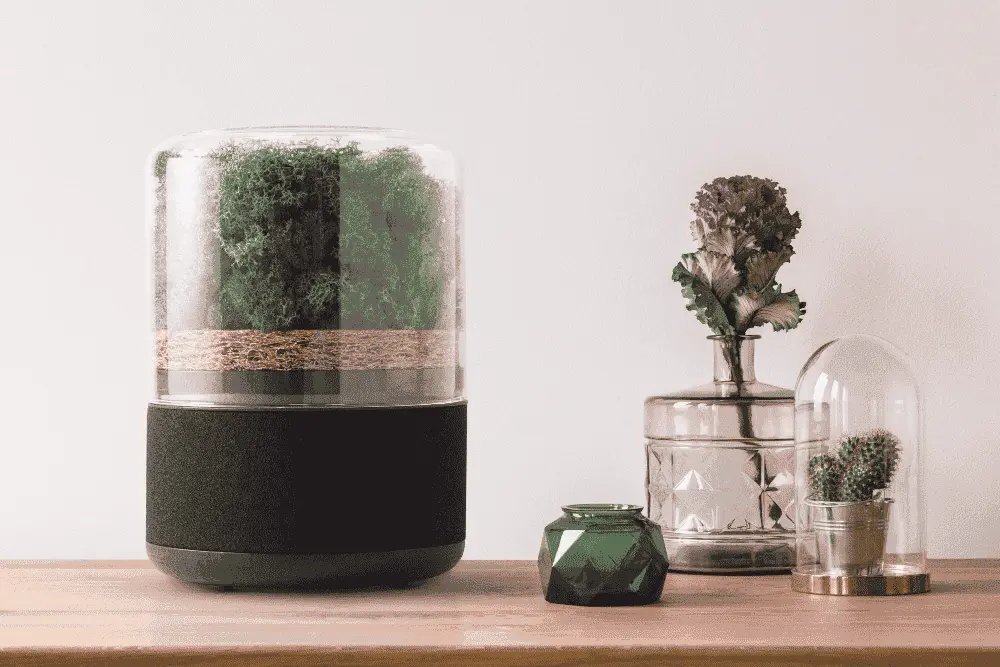
Microplastics aren’t just in our bottled water and oceans; they are also floating in your living room. Every time synthetic clothes tumble in a dryer, nylon carpets experience friction, or polyester blankets and throws are tossed, or nylon clothes experience friction, they shed syntethic fibers. These airborne microplastics and nanoplastics linger in indoor air, where we breathe them in daily. To pull these synthetic particles out of your breathing zone, you need a targeted air purification setup, as well as a strategy on how to reduce the exposure at the source.
The Problem with Microplastics in Indoor Environments
A 2022 Macquarie University–led study (1) published in the peer-reviewed Journal “Environmental Pollution” analysed household dust samples from 29 countries and found that synthetic polymers account for roughly 39–46% of indoor dust deposition in both low- and high-income settings. It was named the “Global Dust Study” and largely attributed these results to synthetic carpets, uphostery, curtains, and other textiles.
Recent peer-reviewed research indicates that levels of indoor airborne microplastic fibers (MPFs) can be 8 to 100 times higher than those found outdoors, with up to 68,000 particles inhaled per day (2). More than 90% of particles are small enough to penetrate deep into the lungs when inhaled. Scientists estimate that people inhale tens of thousands of these particles each year, largely originating from everyday sources like household textiles, rugs, curtains, plastic items, and furnishings.
The Problem with Conventional Air Conditioning: Airborne Microplastics Indoors
Airborne microplastic fibers (MPFs) are an emerging indoor pollutant, yet their behavior and impact remain poorly understood. A 2022 study published in Environmental Pollution (3) found widespread presence of microplastic fibers on filters in split-system air conditioners used across homes, dormitories, and offices.
The research showed that synthetic fibers, such as polyester, rayon, and cellophane, made up 28–35% of all particles captured on AC filters. These fibers build up progressively, with significant accumulation observed after 35–42 days of regular use. Importantly, the study revealed that PET microplastics can be re-released from these filters back into the air, meaning AC systems act not only as collection points but also as sources of indoor microplastic pollution.
This dual role highlights the need to reassess standard air filters for their contribution to indoor microplastic exposure and associated health risks. Opting for a high-quality HEPA filter can help reduce this burden.
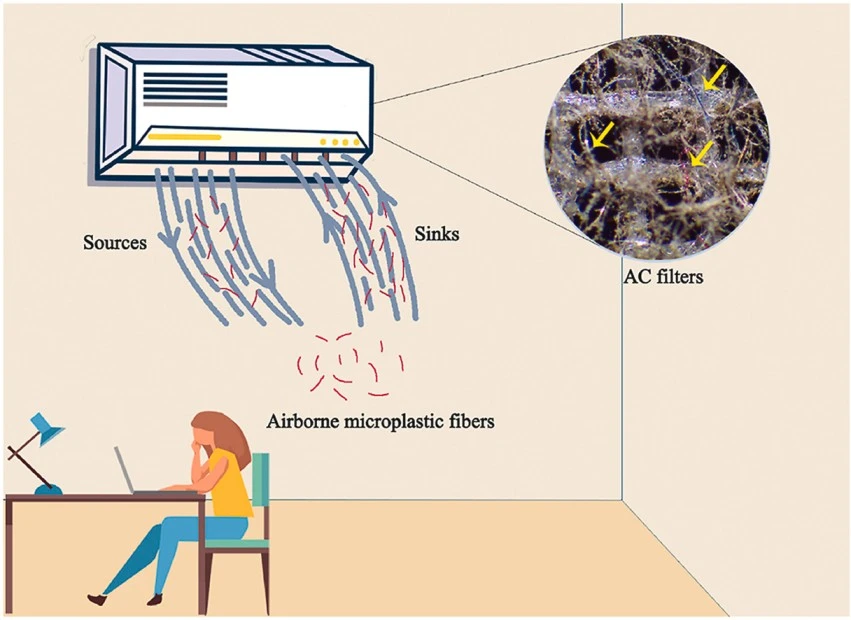
Illustration Source: Chen, at all. “Air conditioner filters become sinks and sources of indoor microplastics fibers”, Environmental Pollution, Volume 292, Part B, 1 January 2022, 118465.
Related: Home Comfort Systems aka HVAC: The Importance Of Air Purification
Solutions: Air Purifiers with True HEPA Air Filters
Can an air purifier actually catch them? Yes, but only if you choose the right technology.
Airborne microplastics typically range from 1 to 5,000 microns, while nanoplastics drop well below 1 micron. A standard filter won’t cut it.
You require an True HEPA filters (H13 or medical-grade), which capture 99.97% of particles down to 0.3 microns, alongside a robust pre-filter to catch floating synthetic fibers before they clog the main system. These are considered to be the golden standard in air filtration.
Beware: Almost all HEPA Filters are made of plastic!
So, the irony is that almost all HEPA filters are made of polypropylene (PP) mesh. Similar to water filtration systems, where reserve osmosis (RO) is set as the golden standard, HEPA air-filters use plastic filtration technology to solve “the plastic dust crisis”. For these reasons, regular filter changes are mandatory so the filters themselves don’t degrade into your airflow over time and re-subspend microplastic particles.
Some systems use multiple technologies together for the ultimate defense:
- A pre-filter (for large synthetic fibers) +
- True HEPA (for micro/nanoplastics) +
- Activated Carbon (to absorb the VOCs and toxic chemicals riding on the plastic)
Related: Plastic Free Water Filters: Can We Find Water Purifiers without Plastic?
3 Best Air Purifiers for Microplastics that are Made with Less Plastic
As mentioned above, most HEPA filters are made of synthetic polymers (plastic). In this article we highlight options that have removed plastic out of their product design either in the housing or in the filter medium. So, with these air filtration systems, we looked both at both the filtration efficiency and the plastic footprint of the units themselves.
This post contains affiliate links, which means we may receive a small commission, at no cost to you, if you make a purchase through a link. This helps us continue the hard work we put into researching products and solutions to plastic/ microplastic pollution.
Please Note: Our health content is for informational purposes only and is not intended as professional medical advice. Consult a medical professional on questions about your health. Please read our disclaimer.
1. IQAir HealthPro Plus Air Purifier (Best for Medical-Grade Glass-Fiber Filtration)
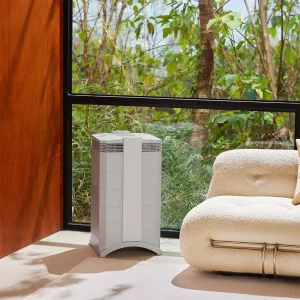
IQAir is widely considered the gold standard for hospital-grade filtration, and their products are manufactured in Switzerland and Germany. Instead of synthetic polymer mesh that can degrade and shed microplastics over time, IQAir’s patented HyperHEPA filter is built from an ultra-dense glass-fibers and cellulose blend. The fibers are bound within a dense, multi-layered mat and sealed tightly into the filter frame. This filter stops particles down to 0.003 microns, trapping elusive nanoplastics. It is a premium, high-ticket investment though.
Filter Type: Pre-Filter, True HEPA, Activated Carbon
Floor Area: 1,125 square feet
Noise Level: 35 db
2. Smart Air Blast MKII / Blast Mini MK II Air Purifier (Best for Steel Housing)
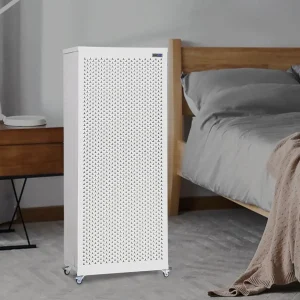
Smart Air is an anti-greenwashing, data-first, and certified B Corp social enterprise that devolves 100% of profits to fund clean air. They promote DIY air filters as a low-cost solution to indoor particulate air pollution, provide open-source test data and host workshops across Asia to teach people how to protect themselves from air pollution.
The entire exterior housing of the Smart Air Blast range is constructed from powder-coated solid steel rather than plastic to prevent toxic off-gassing. Internally, it utilizes thick True HEPA H13 filters to physically capture 99.97% of airborne particles ≥0.3 micron (µm) and effectively trap ultra-fine particles down to 0.07 micron (µm) through diffusion. They remove PM2.5, dust, pollen, mold spores, and fine particulate pollution.
It is highy accessible, as they offer different models, large units for open-concept living areas or commercial properties, and smaller ones for small rooms.
Please note: while the exterior housing is made of steel, the HEPA filter material is made from polypropylene (PP) and polyester (PET).
Filter Type: True HEPA, Activated Carbon (VOC)
Floor Area: 4,500 square feet
Noise Level: 43 db
3. Briiv Plastic Free Air Purifier (Best for 90% Natural Filters & Renewable Materials)

Briiv designed and developed an eco-friendly air purifier that delivers HEPA-level filtration without a trace of plastics in the filter! Its bespoke nano-matrix and natural filtration layers are not specifically certified to capture microscopic plastics though. Instead, it has been designed to target fine particulate matter (PM2.5, PM5, PM10), pollen, pet dander, and odors.
It uses three natural materials to trap microscopic particles, helping improve air quality so you and your family can breathe more easily, think more clearly, sleep better, and reduce everyday exposure to pollution. The manufacturer states that it is as powerful as 3,043 medium houseplants!
Filter Type: HEPA type. Filter elements: Moss, Coconut, Naturally Occuring Carbon and Silk Nanofibers Matrix Filter, Activated Carbon.
Floor Area: 377 square feet, 35 square meter
Noise Level: 47.9 db (quiet mode) – otherwise 60 db
Best True HEPA Filter If You Are On a Budget: COWAY AIRMEGA Mighty2
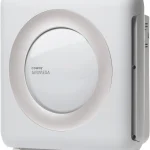
There aren’t any full metal-body true HEPA purifiers under $500 unless you buy a used/refurbished unit. However, if you are on a budget, you can still filter your home’s air with the COWAY AIRMEGA Mighty2, for example. We chose to feature this filter for these reasons:
- Uses a IEST-certified true HEPA filter that has independently tested CADR (Clean Air Delivery Rate) and has decades of third-party lab validation (RTINGS, etc.)
- It can remove up to 99.97% of airborne particles as small as 0.3 microns, including pollen, dust, smoke, pet dander, and other common pollutants. It also cuts over 99.5% of volatile organic compounds (VOCs) and gases such as ammonia (NH₃) and acetaldehyde (CH₃CHO).
- It has a very efficient and compact design → less overbuilt plastic internal components compared to many other smart purifiers
- It features a simple 4-stage system (no heavy plastic sensor arrays or gimmick modules), offers a 3 years warranty.
Filter Type: True HEPA
Floor Area: 1,800 square feet (in 1 hour)
Noise Level: 19 db
Shop on Amazon USA – Canada – UK – Australia
The Best Solution: Reduce Airborne Microplastics by Fixing the Root Cause
Remember: purifiers handle the symptoms but reducing airborne microplastic at the source is the real solution to this issue. Here are a few examples of what to do:
- Switching from dry dusting to damp dusting so plastic fibers don’t re-suspend
- Swapping out synthetic nylon rugs for natural jute or wool rugs and carpets
- Swapping synthetic curtains for curtains made with natural fibers
- Swapping synthetic bedding for bedding made with natural fibers
- Take your shoes off indoors to limit pollutants on floors
Refer to our full guide and checklist on how to reduce your microplastic exposure in textiles, the air & indoor environment.
Related: How to Avoid Microplastics: The Ultimate Guide & Checklist
Our Personal Tips
1. Ventilate Your Home Regularly
Ventilate your home regularly to help reduce indoor airborne microplastics!
A 2025 study (4) published in the Journal Emerging Contaminants conducted on the outskirts of the Seoul metropolitan region found that indoor air contained microplastic levels about 1.8 times higher than those measured outdoors, with plastic fiber particles making up nearly 90% of the indoor load. This is probably due to shedding from textiles, carpets, curtains, furniture, and other synthetic objects…
This reseaerch suggested that extended and regular ventilation is one of the most effective ways to reduce exposure your exposure to microplastic inhalation.
2. Damp Dust Hard Surfaces
Start by damp dusting hard surfaces to capture particles, preventing them from becoming airborne during vacuuming.
3. Vacuum Your Home Regularly
The 2022 Macquarie University–led study (1) referenced earlier in this article, which examined household dust, found that more frequent vacuuming is linked to reduced levels of microplastics. Another key study by Macquarie University researchers (5), published in 2021 in the Environmental Pollution Journal, conducted in metropolitan Sydney homes, found that properties with the least frequent vacuuming had the highest levels of microplastic fibres, especially those with wall-to-wall carpeting.
Make sure your vacuum uses a sealed HEPA filtration system to trap microfibres instead of releasing them back into the air!
FAQs on Air Filters
– What are HEPA Filters? What does HEPA Mean?
HEPA is short for High-Efficiency Particulate Air (also known as High-Efficiency Particulate Arresting) and refers to a filtration standard, no, it’s not a brand. To qualify as a true HEPA filter, it must capture at least 99.97% of airborne particles, including dust, pollen, mould, bacteria, and other contaminants, down to a size of 0.3 microns.
– What is the Difference between HEPA, HEPA Style, and True HEPA Filters?
The key distinction comes down to certification and performance. A True HEPA filter is independently tested and verified to remove at least 99.97% of airborne particles as small as 0.3 microns. By comparison, filters marketed as “HEPA-style,” “HEPA-type,” “HEPA-like”, or just “HEPA” are not held to these formal standards and typically offer much lower filtration efficiency.
– What Does CADR Mean?
CADR stands for Clean Air Delivery Rate. It measures how quickly an air purifier cleans the air.
– Does a Plastic-free Air Purifier Exist?
Unfortunately, a 100% plastic-free air purifier does not exist. In this article we introduced the models that offer a stronger performance while designing out some plastic parts.
Conclusion: Filter Indoor Air and Reduce Plastic in Your Home
In a nushell, to have clean air in your home is important as we spend a lot of hours in this environment. We currently have two options to achieve this: filter your indoor air through the recommendations we provided and stop buying new plastic consumer products for our home. Before buying check the material composition of the item and see if the same item you’d like to purchase is available in natural fibers or materials.
References and Scientific Literature Sources:
(1) https://www.sciencedirect.com/science/article/abs/pii/S026974912201171X
(2) https://journals.plos.org/plosone/article?id=10.1371/journal.pone.0328011#sec013
(3) https://www.sciencedirect.com/science/article/abs/pii/S0269749121020479
(4) https://www.sciencedirect.com/science/article/pii/S2405665024001094
(5) https://www.sciencedirect.com/science/article/abs/pii/S0269749121006461
Do you have any question or comments? Let us know in the comments section below.
Browse our platform for non-toxic plastic alternatives: I’m Plastic Free






Add a comment