

When we were kids, our parents constantly told us that we should brush our teeth at least twice a day. This has a simple reason… It helps maintain healthy teeth later in life. Ideally this includes brushing properly in the morning and in the evening and after every meal when possible.
Flossing is also an important way to keep your teeth clean and has become even more popular in recent years… Younger people, especially seem to pay more attention to their dental health.
In 2023, people around the world spent over US $600 million on dental floss (1), according to market data. With flossing, we feel like our teeth are completely clean and that we’ve removed all the food in between. But most of us don’t really stop to think about what dental floss is actually made of.
What are the Waste Issues With Traditional Dental Floss?
Dental floss and single-use flossers (floss picks) may seem small, but their impact is massive. According to research and estimations by Free Radikal, in North America alone, 4.7 billion single-use plastic flossers are thrown away every year, which is enough to fill over 635,000 trash cans. It’s no surprise they’re ending up on our streets. The problem is that these materials don’t really break down, so over time they can contribute to plastic pollution.
A lot of people don’t realize this, but most dental floss is actually made from plastic materials like nylon (plastic), and most disposable dental picks are made of polypropylene (PP) plastic. After switching to a bamboo toothbrush, the next natural thing to do to better care for yourself and the environment, is to stop using single-use plastic floss and switch to eco-friendly floss, even better if it’s zero-waste floss.
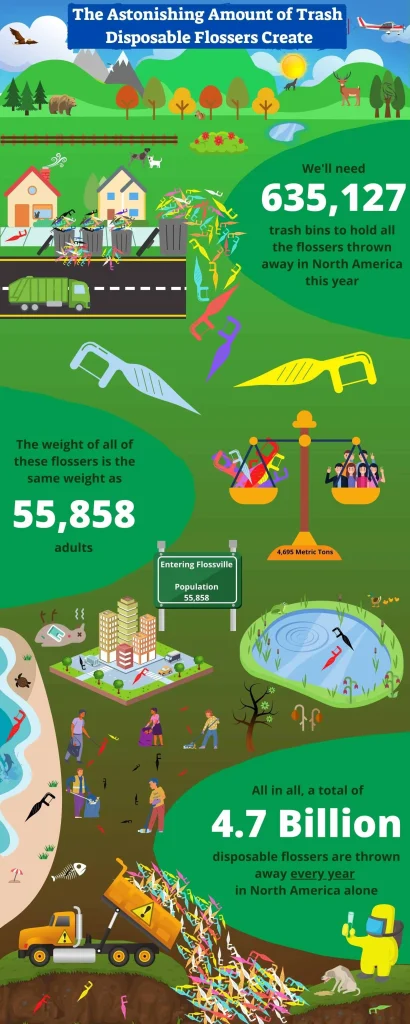
Infographic Credit: Free Radikal
What are the Health Issues with Dental Floss? The Danger of PFAS (Forever Chemicals)
Floss is not something we usually question, we just pick it up and use it as a part of our routine. However, on top of the environmental issues with dental floss, there are also health related issues. Some dental floss is coated with Teflon, the brand name behind polytetrafluoroethylene (PTFE) which is a synthetic fluoropolymer and a type of Per- and polyfluoroalkyl substances (PFAS), also called “forever chemicals”, famous for its non-stick, waterproof, and heat-resistant properties.
A test done in 2022 (2) on 39 different dental floss brands found that around one third of them contained PFAS. In some cases, the levels were surprisingly high, which is concerning when you think about how often we use these products in our life.
PFAS accumulate in both the human body and the environment. Research (2023) links certain exposure levels to higher cholesterol, impaired kidney function, disruptions to immune and thyroid systems, and an elevated risk of cancers such as kidney and testicular cancer. What’s interesting is how little attention this gets. Honestly, most of us never really think about what dental floss is made of. It’s just something we use every day without questioning it.
Related: 4 Microplastic Free Toothbrushes Made with Bamboo and Natural Bristles
What Material is Dental Floss Made of?
Most traditional dental floss is made from nylon or PTFE which is a type of plastic. Nylon floss is made of multiple strands twisted together, while PTFE floss is smoother and slides more easily between teeth. Both materials are synthetic and don’t break down easily in the environment. A 2024 study (3), published in the Journal Environmental Pollution, found microplastics in several common oral care products, including dental floss, and highlighted the environmental and health risks associated with their risks.
How Does Dental Floss Shed Microplastics?
When we use dental floss, especially the plastic types, tiny particles can sometimes break off as it moves between the teeth. These particles are so small that we don’t notice them, but they don’t just disappear. Over time they can end up in wastewater and make their way into the environment.
The 2024 study mentioned above (3) showed that microplastics are present in many everyday oral care products. The research also showed that these tiny plastics can enter the environment, contributing to water pollution, which means even oral care products can be a source of microplastic contamination.
Another study published in 2025 (4) in the Journal of Functional Biomaterials found that plastic coated dental floss can release micro and nanoplastics, which can enter the body through ingestion and also contribute to environmental contamination.
Related: 4 Best Stainless Steel Tongue Cleaners for Microplastic-free Oral Care
5 Tested Brands of Non-toxic Dental Floss that is PFAS-free and Microplastic-free
At I’m Plastic Free we help you eliminate the issue at the source. For all the reasons outlined above, we provide our readers with alternative solutions that do not release microplastics.
This post contains affiliate links, which means we may receive a small commission, at no cost to you, if you make a purchase through a link. This helps us continue the hard work we put into researching products and solutions.
Please Note: Our health content is for informational purposes only and is not intended as professional medical advice. Consult a medical professional on questions about your health. Please read our disclaimer.
1. SuperBee Biodegradable Dental Floss
If you want an easy switch, this is a great option! It’s 100% plant-based and biodegradable, and it works just like regular floss but without the extra plastic, which is a nice way to reduce waste! SuperBee’s dental floss also comes in a glass holder with refills, therefore in completely plastic-free packaging.
Sizes: Pack includes 3×30 m spools of eco dental floss and a refillable glass holder with an easy to retread lid
Ingredients: 100% organic non-GMO corn fiber, natural candelilla wax, peppermint essential oil.
Made in: Thailand
Shop from SuperBee
Shop from SuperBee Australia
Shop from Amazon USA
2. Etee Waxed Silk Dental Floss
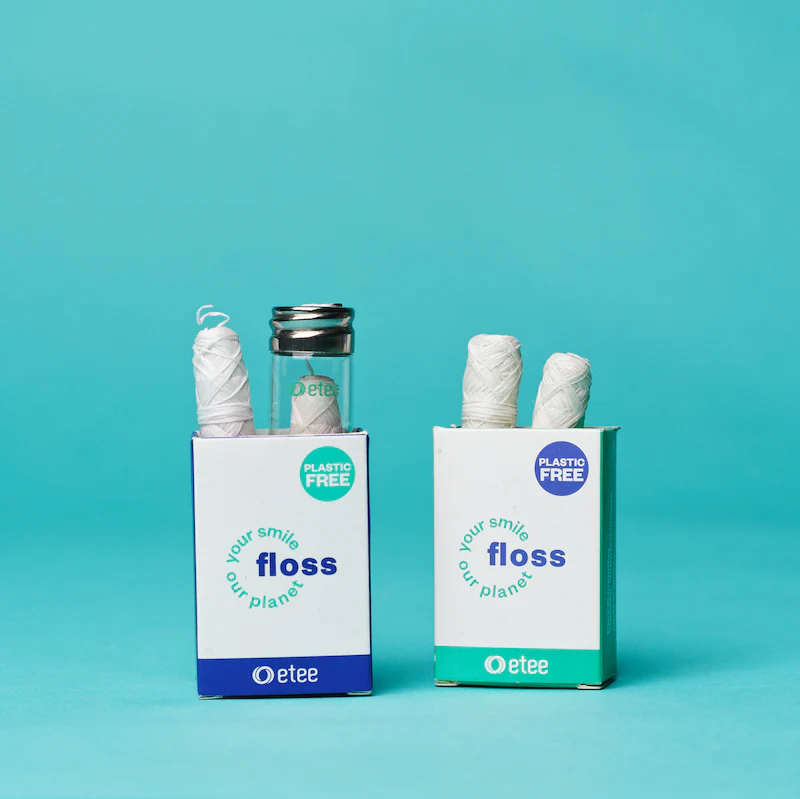
Another good alternative is this Etee plastic free dental floss that comes in a reusable glass container with a stainless steel lid instead of plastic. However, this is not a vegan dental floss.
Size: Each package includes a glass container plus 2 floss spools, each about 30 metres long.
Ingredients: 100% mulberry silk floss, natural candelilla wax, natural peppermint flavor.
Made in: China
Shop from Etee
Related: 7 Best Plastic Free Razor Options for Zero-waste Shaving
3. Gaia Guy Natural Unflavored Silk Dental Floss
If you still want to use dental floss, and keep it in your daily plastic-free bathroom routine, there’s another good option. The Gaia Guy floss is also 100% compostable and comes in a reusable bamboo holder. Once you have the bamboo holder, you only buy the refills. It doesn’t have any artificial flavor. The floss packaging is entirely compostable as well, including the biodegradable ink on the box.
Size: The kit includes 2×33 yards of silk floss
Ingredients: 100% natural silk floss, plant based candelilla wax, unflavored.
Made in: China
Shop from Gaia Guy
Shop from Amazon USA
4. ZWS Silk Floss Zero Waste Dental Floss
ZWS has developed a fully biodegradable silk dental floss. It naturally breaks down in about 60-90 days in your backyard compost, which makes it truly sustainable. To use it, take a small piece, wrap it around your fingers, and gently move it between your teeth. It’s very simple!
Size: 30 metres in a refillable glass jar.
Ingredients: Silk thread, Candelilla plan wax, Organic peppermint essential oil.
Made in: China
Shop from ZWS
Related: 10 Best Toothpaste Without Plastic and BPA
5. Waterpik Water Flosser (Cordless & Recharcheable)
We included an electric water flosser in our review, because it’s a way to floss your gums without worrying about microplastics. While the device itself is made of durable plastic, it eliminates the single-use plastic thread shedding microplastics directly into your mouth.
It is cordless, so there’s no cable. You just fill the small 7 oz water tank, then direct the tip of the flosser between your teeth and gums to clean them. It helps remove plaque quite effectively. What’s nice is that the device is small, practical and quiet, so it doesn’t disturb anyone! For people trying to avoid microplastics and PFAS, this can be a better option.
Size: 3.7×2.5×11.6 inches
Types: 4 different types
- Classic Jet tip
- Orthodontic tip
- Plaque Seeker tip
- Another Classic Jet tip
Water reservoir: 7 oz removable tank
Components: Water reservoir, electronic pump system, Removable flossing tips.
Made in: China (designed and engineered in Fort Collins, Colorado, USA)
Shop from Amazon USA
Our Personal Tip:
Honestly, it’s hard to see the benefit of using a plastic floss when there are so many better plastic-free alternatives out there.
We recommend not to use too much floss at once, a small piece is enough. Using more doesn’t clean better and can actually irritate your gums, plus it’ll cost you more.
Frequently Asked Questions (FAQ) about Non-toxic Dental Floss
– Is Bamboo Floss Made of Real Bamboo?
If you see “100% bamboo floss”, it is highly likely a case of greenwashing. Pure mechanical bamboo fibers cannot be used for floss because they are too short and stiff. They have a rough, jute-like texture that would shred your gums. They have very low tensile strength and would immediately snap between tightly spaced teeth. To solve this, brands that use “bamboo charcoal” or bamboo viscose almost always weave or blend it with traditional polyester, nylon plastic, or poly-lactic acid PLA bioplastic, to give it the strength to glide without snapping.
– How do I know if my dental floss contains PFAS or Teflon?
Avoid any commercial flosses marketed with words like “Glide,” “Satin,” or “Non-stick.” These properties are typically achieved using polytetrafluoroethylene (PTFE), a subclass of PFAS. If the packaging does not explicitly state “PFAS-Free” or list 100% natural materials (i.e. like silk), it is likely synthetic plastic.
– Is Natural Dental Floss as Effective as Regular Plastic Floss?
Yes. Natural fibers like silk and textured corn fiber effectively remove plaque and interdental debris. While they lack the chemical slip of Teflon, their natural texture often provides superior physical scrubbing action.
– Does Dental Floss Increase or Reduce Gum Bleeding?
Regular flossing reduces gum bleeding over time. While initial usage may cause slight bleeding due to localized inflammation (gingivitis), consistent, gentle flossing removes the bacteria causing the irritation. When you start flossing regularly the bleeding usually goes down over time. In fact, studies (5) show that flossing can reduce gum inflammation and bleeding compared to just brushing alone. The most important thing is to use it gently. With regular use, flossing can reduce gum bleeding by around 70%. (5)
– Is Dental Floss Safe to Use Every Day?
Yes. Once a day is enough and safe. You just need to be gentle when using it.
Conclusion
After doing this research and learning all these facts, we started to realize that we should pay more attention to the things we use daily even if they seem harmless at first. It really made us think twice about the everyday products we use without questioning them.
References and Scientific Literature Sources:
(1) https://www.grandviewresearch.com/industry-analysis/dental-floss-market
(2) https://www.ehn.org/pfas-floss
(3) https://www.epa.gov/pfas/our-current-understanding-human-health-and-environmental-risks-pfas
(4) https://pubmed.ncbi.nlm.nih.gov/38092338/
(5) https://www.mdpi.com/2079-4983/16/9/332?utm_source/
(6) https://pubmed.ncbi.nlm.nih.gov/37553277/
This article was written by Natalija Miloradovska Mafilovska and reviewed by I’m Plastic Free Editor, Simona Paganetto
Natalija Miloradovska Mafilovska is a Medical Doctor and Specialist in Public Health – Hygiene and Environmental Health, based in North Macedonia. She completed her specialization at the Institute of Public Health in Skopje, Ss. Cyril and Methodius University. Her interest lies in environmental plastic pollution, with a particular emphasis on the emerging human health and ecological impacts of microplastics.
—
Do you have any question or comments? Let us know in the comments section below.
Browse our platform for non-toxic plastic alternatives: I’m Plastic Free






Add a comment