

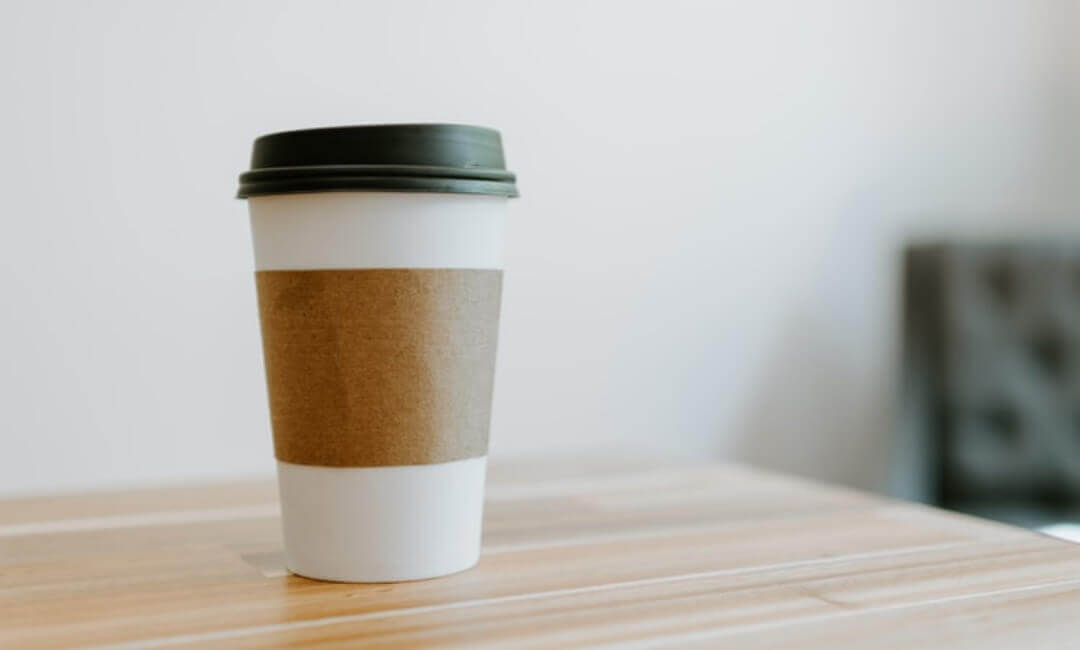
Yes, if you’re using a disposable coffee cup, microplastics may be leaching into your coffee … or tea.
From now on, there is another, very important reason to ditch takeaway coffee cups and switch to plastic-free reusable coffee cups this doesn’t just relate to the environment, it relates to your health.
How are Paper Coffee Cups Made?
Have you ever wondered how “paper cups” are made?
Well, their name is misleading as they are not just made with paper, otherwise you wouldn’t be able to use them for a drink, let alone for a hot drink. These cups are made of paper sheets lined with HDPE (high density polyethylene) grade of plastic (5-10% of the total cups content), and that’s what holds them together and makes them waterproof but makes them also very difficult to recycle, so they end up in landfill.
Take a look at this 5 minute video to see how disposable paper cups are produced:
How Do Disposable Paper Cups Leach Microplastics into Coffee?
A 2021 study (1) published in the Journal of Hazardous Materials investigated hot water (85–90°C / 185–194°F) stored in a disposable paper cup for 15 minutes. The researchers found that the cup’s plastic lining released substantial quantities of micro- and nano-sized plastic particles:
- Micron-sized microplastics: Approximately 25,000 particles were released per 100 millilitres of liquid.
- Sub-micron/nanoplastic particles: Using advanced microscopy to detect particles smaller than 1 micron, researchers estimated that the number reached approximately 10.2 billion particles per 100 millilitres.
The findings suggest that regularly consuming several hot beverages from conventional plastic-lined paper cups could result in the ingestion of tens of thousands of microplastic particles and billions of much smaller particles over time.
Related: 17 Best Plastic-Free Coffee Makers By Style for Delicious Non-toxic Coffee
Disposable Plastic Materials Proven to Release Microplastics
This isn’t the only study about this subject. More research has proven that single-use plastic takewawy containers release microplastics when exposed to hot liquid or food. A 2022 study titled: “Disposable plastic materials release microplastics and harmful substances in hot water” (2), published in the Science of the Total Environment Journal, showed that millions of submicron and microparticles were produced from hot water soaking of plastic packaging, cups, transparent boxes and expandable boxes.
Based on Fourier transform infrared spectroscopy, heat treatment also altered the chemical composition of polyethylene packaging, but it had minor effects on polypropylene cups, transparent boxes and polystyrene expandable boxes. Organic chemicals and heavy metals were also detected in leachate from heat-treated plastics. Read the cited study for all details.
New Research: PLA Biodegradable Paper Cups Release More Micro- and Nanoplastics Than Conventional Disposable Cups
A 2026 study (3) by University of Queensland, published in ACS Food Science & Technology, investigated the release of plastic particles from single-use paper cups lined with either conventional polyethylene (PE) or biodegradable polylactic acid (PLA) when exposed to hot water.
- PLA-lined paper cups: Released approximately 4.3 million nanoparticles per millilitre. By mass, they released around 12 times more plastic material than PE-lined cups.
- PE-lined paper cups: Released approximately 2.7 million nanoparticles per millilitre.
Billions of Disposable Coffee Cups used each Year Around the World
In the meantime, it’s time to ditch disposable paper cups which Australians are quite addicted to, due to their love for coffee on the go, especially before going to work. It’s estimated by Clean Up Australia that 1.84 billion disposable coffee cups are used each year around Australia, therefore 5 million each day.
In the USA, estimates go between 16 and 50 billions disposable cups used each year (we couldn’t find any trustworthy source).
Isn’t it crazy to think how many would be used worldwide?
Solution: Switch to Plastic-free Reusable Cups
Buy a couple of reusable coffee cups, one for your office and one spare one for your car or backpack if you commute, it’ll be easier to remember it each day. If you forgot your BYO cup, sit down and enjoy your coffee in a ceramic mug. The same is true for plastic-free water bottles.
References and Scientific Literature Sources
(1) Ranjith, K. S., & Sudhakar, C. (2021). Microplastics release from disposable paper cups into hot water: An unexplored hazard. Journal of Hazardous Materials, 408, 124412. https://www.sciencedirect.com/science/article/abs/pii/S0304389420321087
(2) Zangmeister, R. A., Radney, J. G., Benkstein, K. D., & Elzey, B. D. (2022). Common consumer plastic items release trillions of sub-micrometer particles per liter into water during normal use. Science of The Total Environment, 843, 157018. https://www.sciencedirect.com/science/article/abs/pii/S0048969721067619
(3) Shi, K., Okoffo, E. D., Rauert, C., & Thomas, K. V. (2026). Release of nanoplastic and microplastic from polyethylene and polylactic acid lined single use paper cups. ACS Food Science & Technology, 6(8), 5328–5336. https://doi.org/10.1021/acsfoodscitech.6c00541
—
Are you interested to learn about microplastics leaching into your tea from single use tea bags? Discover how tea bags are made and find out if your favourite tea brand offer plastic free tea bags.
Browse the I’m Plastic Free platform to discover plastic pollution solutions




5 Disposable Takeaway Coffee Cup Facts To Make You Think - TeaCoffee99
October 9, 2022 at 12:07 am[…] for the average person drinking 3 cups of coffee every day using a paper cup, they ingest 75,000 small microplastic particles that cannot be seen with the naked […]
Simona Paganetto
October 20, 2022 at 1:54 pmThanks for mentioning our blog article!
Dr. Chris DeArmitt FIMMM, FRSC, CChem
November 1, 2022 at 12:16 amIn fact, they did not detect microplastics at all. They used Nile Red Dye which was shown not to work properly for the identification of microplastics. See the facts from independent scientists. The study is called “Microplastics and other harmful substances released from disposable paper cups into hot water” and they did not show that the particles were plastic! It’s much more likely that they were wood fibers from the paper cup. In fact, another study specifically says that Nile Red Dye is not a good way to look for microplastics “Quite a few studies have explored the potential of Nile red a solvatochromic dye in detection of microplastics. However, often Nile red alone cannot be used in quantifying microplastic due to false positives generated by staining of organic matter. “
I'm Plastic Free
November 8, 2022 at 10:56 amHello Dr. DeArmitt, thanks for your comment, we have updated the article to be clear about which study we are referring to. In the future we’ll name the full titles of each study in our blog articles, so they are easier to be identified. We always link the articles to the full studies and we leave it up to the scientists to discuss the scientific methods of the mentioned studies. Our role is to raise awareness about the topic and we just added another study that confirms microplastics does leach into disposable single-use plastic takeaway containers. We understand from your name that you are a consultant for plastic materials to companies including the Furtune 100, and we are open to all constructive comments since we are advocates of free speech. Many thanks.
Add a comment