

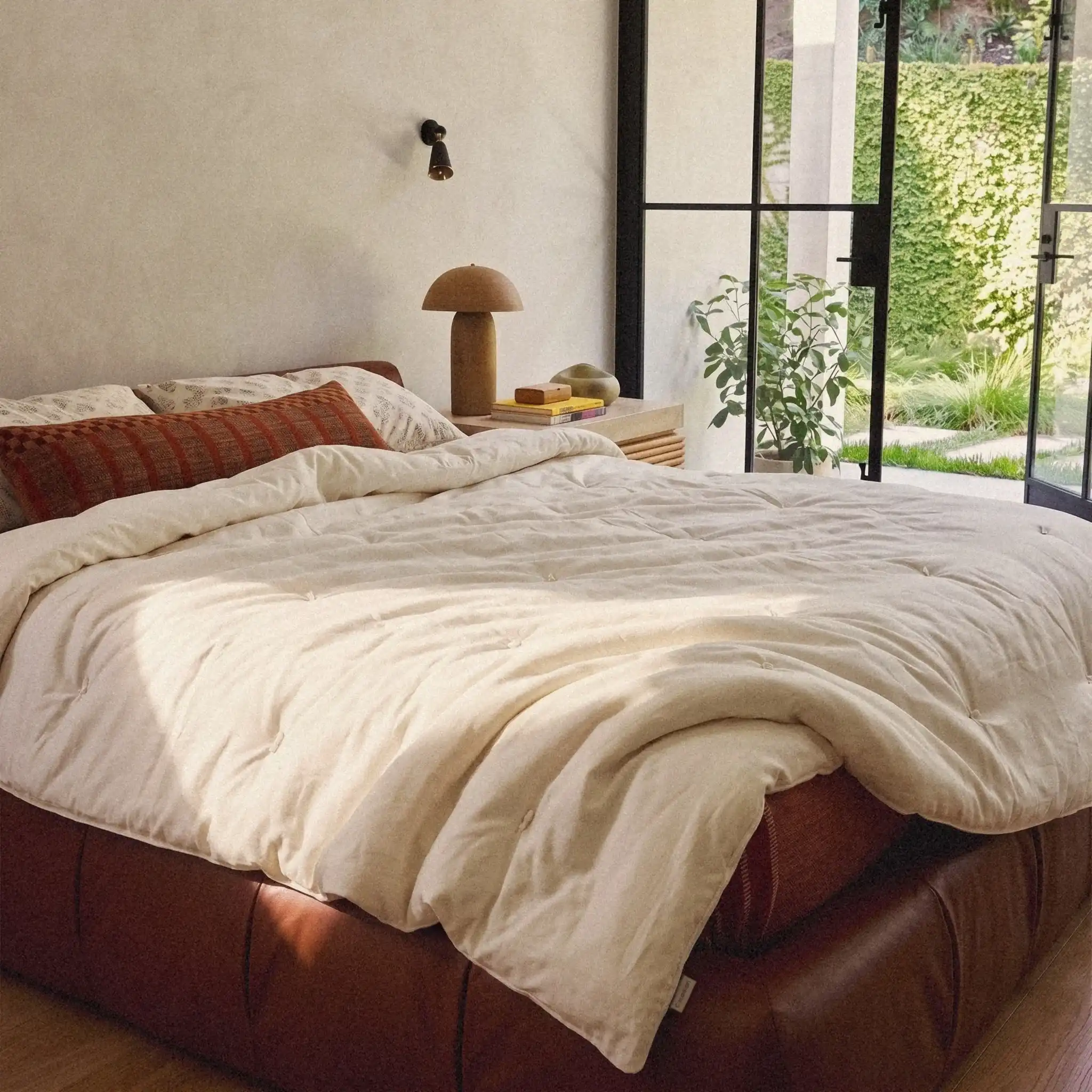
We spend about a third of our lives in bed, with our face just a few centimetres from the comforter. Yet most comforters on the market are filled with polyester, the same plastic used to make water bottles. I’ve spent years researching plastic-free bedding, from pillows to blankets. Here is what the research says about synthetic comforters, and the natural alternatives I trust.
What Are Synthetic Comforters Made Of?
Most synthetic comforters are made of polyester, a plastic made from fossil fuels. The labels rarely say “plastic”, though. Here are the synthetic and chemically processed options you’ll find on the market, and why we avoid them.
| # | Synthetic Option | What It Really Is | Why We Avoid It |
|---|---|---|---|
| 1 | Polyester fiberfill | Virgin polyester (PET), the most common comforter fill | Fossil-based plastic; sheds microfibers into air and water |
| 2 | “Down alternative” and branded fibers | Polyester sold under tech-sounding names such as “microfiber”, “ultrafiber”, “hollowfiber” or “spiral fiber” | Still polyester (the name hides the plastic) |
| 3 | Recycled polyester (rPET) | Polyester made from used plastic bottles | Better for waste, but still plastic and still sheds microfibers |
| 4 | Poly-cotton and nylon shells | Cotton blended with polyester, or nylon/polyester microfiber covers | The fabric that touches your skin is part plastic |
| 5 | “Cooling” comforters | Nylon, polyester or spandex blends, sometimes with gel or chemical cooling coatings | Synthetic fibers plus added chemistry |
| 6 | PLA or “corn fiber” fill | Polylactic acid, a plant-based bioplastic | Still a plastic; it doesn’t break down in a home compost or the ocean |
| 7 | “Bamboo” and eucalyptus comforters | Usually viscose/rayon or lyocell made from wood pulp, often blended with polyester | Chemically processed, not a natural fiber (check the fill label) |
| 8 | Stain- or water-resistant finishes | Chemical coatings, often PFAS | PFAS are “forever chemicals” linked to health concerns (4) |
| 9 | Antimicrobial and anti-dust-mite treatments | Synthetic biocides added to the fill or fabric, sold as “hygienic”, “anti-allergy” or “fresh” | Added chemicals you sleep in every night (often found on natural fills too) |
How Do You Spot a Synthetic Comforter Behind the Marketing Jargon?
Read the fill label, not the product name. Brands often lead with the cover, so “100% cotton cover” or “cotton shell” usually means the fill inside is synthetic. The fill itself is often given a proprietary name that sounds like technology: “ultrafiber”, “microfiber”, “hollowfiber”, “Comfortech”, “spiral fiber”, “cloud fill”, “cooling” or “cool performance”, and “easy care”. All of these are almost always polyester.
Be careful with antimicrobial protection too. Claims like “antibacterial”, “anti-dust mite”, “hygienic” or “odor-control” usually mean the fill or fabric has been treated with a synthetic biocide. This happens on natural comforters as well, so check the product page or ask the brand what was used.
Are Synthetic Comforters Bad for Your Health?
The research isn’t conclusive yet, but there are good reasons for caution. Your comforter sits right in your breathing zone for 7 to 9 hours a night. A 2017 literature review (5) in Building and Environment found that bedding exposes sleepers to dust, allergens, microbes and chemicals, and that body heat and movement can push these particles toward the nose and mouth.
Do Synthetic Comforters Shed Microplastics into Bedroom Air?
Yes, synthetic textiles release fibers into the air, and bedrooms can have high levels. In a 2021 investigation (3) for Good Morning Britain, Professor Fay Couceiro of the University of Portsmouth used specialized air pumps to measure tiny, breathable microplastics (smaller than 10 micrometres) in a family home. The child’s bedroom had the highest level of all the rooms tested. The researchers linked this to carpets, non-cotton bed linen and soft toys, and estimated that each family member was breathing in 2,000 to 7,000 microplastics a day at home.
Please note: this was a one-day investigation in one home, not a study published in a peer-reviewed journal. It shows that indoor air can carry microplastics, but larger studies are needed.
Are Synthetic Comforters Linked to Asthma or Allergies?
Some studies suggest so. A 2003 Tasmanian study (6) of 863 children found that those using both a synthetic pillow and a synthetic quilt were about 5 times more likely to wheeze frequently than children using non-synthetic bedding. The more synthetic bedding items a child used, the higher the risk.
Dust mites may be part of the reason. A small 1996 study (7) in the BMJ found about 8 times more dust mite allergen in polyester-filled pillows than in feather pillows.
Please note: both studies are older and show an association, not proof that synthetic bedding causes asthma. They looked at pillows and quilts, which are made of the same fills as comforters.
Do Comforters Contain PFAS?
Some do, especially those sold as stain- or water-resistant. In a 2022 study (4), Toxic-Free Future tested 20 bedding products. All four comforters tested contained PFAS, all four were labeled stain- or water-resistant, and two contained PFOA, a PFAS that has been phased out in the US. None of the bedding without those claims tested above the screening level. If a comforter promises to repel stains, skip it.
What Natural Fiber Comforter Fills Are There?
There are seven main natural fills: wool, alpaca, down, cotton, hemp, silk and kapok. Each one sleeps differently, so choose based on how warm you sleep and how you like to wash your bedding.
| # | Natural Fill | How It Sleeps | Best For | Watch Out For |
|---|---|---|---|---|
| 1 | Organic wool | Breathable, regulates temperature, naturally flame-resistant | Hot and cold sleepers, all seasons | Usually spot clean only; not vegan; check for antimicrobial treatments |
| 2 | Alpaca | Similar to wool: breathable and warm | All seasons, a wool alternative | Spot clean only; expensive; not vegan |
| 3 | Down and feather | Lightest and warmest for its weight | Cold sleepers (or a lightweight fill for warm climates), a fluffy look | Choose responsibly sourced down (e.g. RDS) with no antimicrobial treatment; not vegan |
| 4 | Organic cotton | Light, breathable, flatter than wool or down | Warm climates, vegans, easy washing | Less warm; can feel heavy when thick |
| 5 | Hemp | Breathable plant fiber that absorbs moisture; flatter and firmer than wool | Hot sleepers, vegans | Few brands; organic claims are often uncertified |
| 6 | Silk | Very light, smooth, drapes close to the body | Hot sleepers, sensitive skin | Expensive; delicate care; not vegan |
| 7 | Kapok | Silky plant fiber from the kapok tree, light and water-repellent | Vegans who want a down-like feel | Few comforters on the market |
Whatever the fill, check the shell too. The best non-toxic comforters use a GOTS-certified organic cotton shell, with no stain-resistant, antimicrobial or wrinkle-free finish.
How Did We Choose These Organic Comforters?
We only selected bedding that met these criteria:
- fill made of natural fibers only: no polyester, PLA or “synthetic down alternative”;
- a natural fiber shell or cover, organic and certified (GOTS, OEKO-TEX or RDS) wherever possible;
- no harsh chemicals, toxic dyes, and PFAS
- no stain-resistant, water-resistant, wrinkle-free or added antimicrobial finishes listed by the brand;
- hands-on testing by our editor for the Circadian comforter (images coming soon) and the Aizome duvet cover.
Because many natural comforters are spot clean only, we’ve also included an organic duvet cover to protect them.
Which Are the Best Non-Toxic Comforters?
| # | Product | Type | Fill | Shell / Fabric | Certification | Price |
|---|---|---|---|---|---|---|
| 1 | Circadian Organic Wool Comforter | Comforter | Organic New Zealand wool | Organic cotton sateen | GOTS | From US$449 |
| 2 | PACT Organic Cotton Quilt | Quilt | Organic cotton | Organic cotton | GOTS, Fair Trade | From US$175 |
| 3 | Avocado Alpaca Duvet Insert | Comforter | 100% Peruvian alpaca | Organic cotton percale | GOTS (shell) | From US$449 |
| 4 | Aizome Organic Duvet Cover | Duvet cover | None | Plant-dyed organic cotton sateen | GOTS (supply chain), OEKO-TEX Class I (product), ZDHC MRSL (Raw inputs), Bluesign (Softening) | From US$317 |
| 5 | Coyuchi Lightweight Down Duvet Insert | Comforter | US white duck down, 600 fill power | Organic cotton | GOTS, Fair Trade (shell) | n.a. |
| 6 | HempOrganicLife Natural Hemp Cotton Duvet Insert | Comforter | Hemp fiber, 400 g/m² | Undyed cotton-linen (80/20) | None listed | From US$157 |
| 7 | Woolcomfort Australian Made Merino Wool Quilt | Quilt / doona | 100% Australian merino wool | Cotton | Woolmark, Australian Made | n.a. |
Prices checked in October 2026 and may change.
This post contains affiliate links, which means we may receive a small commission, at no cost to you, if you make a purchase through a link. This helps us continue the hard work we put into researching products and solutions.
1. Circadian Organic Wool Comforter: Our Top Pick
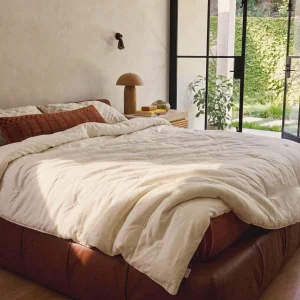
Circadian’s comforter is hand-tufted in New Jersey from layered, long-staple wool from certified organic farms in New Zealand, inside a 300 thread count organic cotton sateen shell. It’s GOTS certified inside and out (license GOTS-10229), with no polyester fill or blends. One weight is sold for all seasons.
Parts & Materials:
- Fill: organic New Zealand wool, layered (not loose)
- Shell: 300 thread count organic cotton sateen
- Corner loops: cotton
- Stitching and tufts: cotton-wrapped polyester thread, which GOTS allows
Sizes: Twin (72″ x 90″), Queen (92″ x 96″), King (96″ x 110″)
Care: spot clean only and air it in the sun. Use the washable Circadian organic cotton duvet cover.
2. PACT Organic Cotton Quilt: Best Vegan Budget Option

If you sleep warm or prefer a vegan option, PACT’s quilt is made entirely of organic cotton, inside and out. It’s lighter than a wool or down comforter, machine washable, and made in a Fair Trade Certified factory with GOTS-certified organic cotton. It can be used on its own in summer or it can be layered for extra warmth in winter.
Parts & Materials:
- Fill: 100% organic cotton sateen
- Shell: 100% organic cotton
- Corner loops: n.a.
- Stitching and tufts: n.a.
Sizes: Twin/Twin XL, Full/Queen, King/Cal King
Care: Machine wash cold. Tumble dry low.
3. Avocado Alpaca Duvet Insert: Best Alpaca Wool Alternative

Avocado’s duvet insert is filled with 100% Peruvian alpaca fiber inside a GOTS-certified organic cotton percale shell. Avocado lists no added treatments for this insert. It comes in a Lightweight or All-Season weight.
Parts & Materials:
- Fill: 100% natural Peruvian alpaca (2,100 g/m² Lightweight or 2,800 g/m² All-Season)
- Shell: GOTS-certified organic cotton percale
Sizes: Twin (91″ x 70″), Full/Queen (96″ x 92″), King/Cal King (107″ x 96″)
Care: spot clean only, air it in the sun and fluff it often. Use a duvet cover.
What we passed on: we didn’t include Avocado’s Down Duvet Insert, because its down is treated with Ultra-Fresh (Allernon-21), a synthetic antimicrobial treatment.
4. Aizome Organic Duvet Cover Set: Best Plant-Dyed Duvet Cover

A natural comforter lasts longer inside a washable cover. Aizome’s duvet cover is made of 340 thread count organic cotton sateen, dyed exclusively with plant pigments, such as Japanese indigo, madder root, gallnuts, with no synthetic dyes and finishing agents, PFAS, formaldehyde, synthetic dyes, and optical brighteners. The product is OEKO-TEX Standard 100 Class I certified, the whole supply-chain GOTS certified, the raw inputs are ZDHC MRSL certified, and the softening is bluesign certified. It’s perfect for everyone with chemical sensitivies, eczema, or for baby’s skin.
Parts & Materials:
- Cover, sheets, and pillow cases: 340 thread count organic cotton sateen
- Dyes: using extracts from medicinal plants (indigo, madder root, gallnuts)
Sizes: Twin, Full/Queen, King/Cal King
Care: machine wash up to 60°C (140°F), lay flat or tumble dry low.
Personal Testing: We use this duvet cover set in pink (dyed with madder root), and it feels perfectly smooth on our skin. It’s an absolute pleasure to sleep under these organic and plastic-free bed sheets and cover every night.
Shop from Aizome – 10% off with code IMPLASTICFREE
VIP Sale: October 19 to November 1. 25% off bedding, towels, and artisan line if you join this list.
I’m Plastic Free’s editor, Simona Paganetto, testing and using the Aizome Organic Duvet Cover Set in her home.
5. Coyuchi Lightweight Down Duvet Insert: Best for Hot Sleepers and Warm Climates
Coyuchi’s lightweight insert is filled with 600 fill power white duck down sourced in the USA, in a down-proof organic cotton shell that is GOTS and Fair Trade certified. The down is double-washed, and stitch-through box construction keeps it evenly spread. Unlike wool or alpaca, it’s machine washable.
Parts & Materials:
- Fill: white duck down, 600 fill power, from a US farm
- Shell: 100% organic cotton, down-proof
Sizes: Twin (70″ x 90″), Full/Queen (92″ x 96″), King (106″ x 96″)
Care: machine wash cold on gentle, tumble dry low until fully dry.
6. HempOrganicLife Natural Hemp Cotton Duvet Insert: Best Hemp Comforter
This handmade comforter from Ukraine is filled with natural hemp fiber grown in Ukraine, inside an undyed 80% cotton, 20% linen shell. It’s one of the few hemp comforters on the market, it’s washable, and it comes in US, Australian and European sizes or custom sizes. You’ll support a small business in a country torn by war.
Parts & Materials:
- Fill: needle-punched hemp fiber, 400 g/m²
- Shell: undyed cotton (80%) and linen (20%)
Please note: the brand describes its hemp as organic but doesn’t name a certification.
Care: gentle cold wash with a (plastic-free) mild liquid detergent, then air dry flat.
7. Woolcomfort Merino Wool Quilt/Doona/Duvet: Best for Australian Made on a Budget
For readers in Australia, Woolcomfort’s quilt is made in Australia from 100% Australian merino wool, encased in a natural cotton fabric. It’s Woolmark certified and comes in Australian sizes from Single to Super King.
Parts & Materials:
- Fill: 100% pure new Australian merino wool, in layers
- Shell: natural cotton, with a diamond stitch and self-fabric piping
Sizes: Single (140 x 210 cm) to Super King (270 x 240 cm)
Care: dry clean only. Use a duvet cover.
How Can You Reduce Microplastics in Your Bedroom?
- Replace the closest items first: comforter, pillows and sheets touch your face every night.
- Read the fill label, not the marketing: “down alternative”, “microfiber”, “hollowfiber” and “cloud fill” all mean polyester.
- Skip stain-resistant and antimicrobial bedding, which can contain PFAS or synthetic biocides.
- Use an organic cotton duvet cover so you can wash the cover and only spot clean the comforter.
- Air your bedroom and vacuum often with a HEPA filter to reduce dust and fibers.
- Don’t throw out a synthetic comforter right away if budget is tight. Wash it less often, in a full load at a lower temperature, and replace it when it wears out.
Why Are Synthetic Comforters Bad for the Environment?
Synthetic comforters are made from fossil fuels and shed plastic microfibers for their whole life. Polyester alone made up 57% of the 124 million tonnes of fiber produced worldwide in 2023, and only 12.5% of it was recycled (2).
Shedding doesn’t only happen in the washing machine. A 2020 study (1) by De Falco and colleagues at the University of Plymouth and Italy’s National Research Council compared polyester garments during washing and normal use. They found that polyester releases about as many microfibers into the air from everyday use as into the water when washed. For one person, that adds up to almost 300 million microfibers a year through washing and more than 900 million into the air. Tightly woven fabrics shed the least, and the authors concluded that better textile design would cut pollution more than filtering wastewater.
Once fibers reach the water, they’re hard to stop. A 2017 IUCN report estimated that washing synthetic textiles is the largest single source of primary microplastics in the oceans, at about 35% (8). And at the end of its life, a polyester comforter is almost impossible to recycle, so it usually ends up in landfill or an incinerator.
Please note: the De Falco study tested polyester clothing, not comforters. Comforter shells and fills are made of the same fibers, but their shedding hasn’t been measured directly.
FAQ About Non-Toxic Comforters
– What’s the difference between a comforter, a duvet and a quilt?
The names overlap, and even brands use them interchangeably. Traditionally, a comforter (US) is a thick, stitched bedcover used on its own, often without a cover. A duvet (UK and Europe) is a soft filled insert designed to go inside a removable, washable cover, which Americans often call a “duvet insert”, while “duvet” in the US can also mean the cover itself. A quilt is traditionally thinner: a top fabric, a layer of batting and a backing, stitched together in a pattern. In Australia, though, “quilt” and “doona” both mean a duvet. That’s why the same product can be sold as a “wool comforter” by one brand and a “wool duvet” or “quilt/doona” by another, so always read the size, fill and weight rather than the name.
– What is the healthiest comforter material?
The healthiest comforter materials are natural fibers: organic wool, alpaca, responsibly sourced down, organic cotton, hemp, silk or kapok, in an organic cotton shell. They don’t shed plastic microfibers, and certified organic options are made without many of the chemicals used in conventional textiles.
– Are down alternative comforters toxic?
Down alternative comforters are made of polyester, a plastic. They aren’t acutely toxic, but polyester sheds microfibers into air and water (1), and some are treated with PFAS stain-resistant finishes (4).
– Is a wool comforter better than down?
Neither is better for everyone. Wool is better at regulating temperature and suits people who get hot at night, but it’s usually spot clean only. Down is lighter and warmer for its weight and is often machine washable. Both are non-toxic when certified and free of added treatments.
– Are organic comforters good for allergies?
They can be. Studies have linked synthetic bedding to more frequent childhood wheeze (6), and polyester pillows to more dust mite allergen than feather pillows (7). If you have a confirmed down or wool allergy, choose organic cotton, hemp or kapok instead.
– What does GOTS certified mean for a comforter?
GOTS (Global Organic Textile Standard) certifies that a textile contains at least 70% organic fibers, with “organic” labels requiring 95%, and restricts harmful chemicals throughout processing. Check that the whole comforter is certified, not just the fabric.
– Is recycled polyester a sustainable comforter fill?
Recycled polyester keeps plastic bottles out of landfill, but it’s still plastic. It sheds microfibers like virgin polyester and is hard to recycle again at the end of its life.
– How often should you replace a comforter?
A well-made natural comforter can last many years if you protect it with a duvet cover and air it regularly. Replace a synthetic comforter when it gets lumpy, flat or starts to pill, and choose a natural one next time.
Conclusion: Is It Worth Switching to an Organic Comforter?
Yes, if you can. Your comforter is the largest textile you sleep under every night, and polyester ones shed microfibers into your bedroom air and into the water. The health effects of inhaling microplastics are still being studied, but choosing natural fibers is a simple way to cut your exposure and plastic pollution at the same time.
Start with a comforter filled with organic wool, alpaca, down, cotton or hemp, protect it with an organic cotton duvet cover, and avoid anything labeled stain-resistant or antimicrobial. Find more swaps in our guides to non-toxic bedding, organic pillows and organic blankets.
How we researched this: we reviewed 8 studies, reports and investigations on synthetic textiles, microfiber shedding, indoor air, bedding and PFAS, and checked each product’s materials and certifications on the brand’s own website or retailer page in October 2026.
Please Note: Our health content is for informational purposes only and is not intended as professional medical advice. Consult a medical professional on questions about your health. Please read our disclaimer.
References and Scientific Literature Sources:
(1) De Falco, F., Cocca, M., Avella, M., & Thompson, R. C. (2020). Microfiber release to water, via laundering, and to air, via everyday use: A comparison between polyester clothing with differing textile parameters. Environmental Science & Technology, 54(6), 3288–3296.
(2) Textile Exchange. (2024). Materials market report 2024.
(3) University of Portsmouth. (2021, November 8). World-first Good Morning Britain and University of Portsmouth microplastics investigation [Press release].
(4) Toxic-Free Future. (2022). Toxic convenience: The hidden costs of forever chemicals in stain- and water-resistant products.
(5) Boor, B. E., Spilak, M. P., Laverge, J., Novoselac, A., & Xu, Y. (2017). Human exposure to indoor air pollutants in sleep microenvironments: A literature review. Building and Environment, 125, 528–555.
(6) Ponsonby, A.-L., Dwyer, T., Kemp, A., Cochrane, J., Couper, D., & Carmichael, A. (2003). Synthetic bedding and wheeze in childhood. Epidemiology, 14(1), 37–44.
(7) Kemp, T. J., Siebers, R. W., Fishwick, D., O’Grady, G. B., Fitzharris, P., & Crane, J. (1996). House dust mite allergen in pillows. BMJ, 313(7062), 916.
(8) Boucher, J., & Friot, D. (2017). Primary microplastics in the oceans: A global evaluation of sources. IUCN.
—
Browse the I’m Plastic Free platform to discover more plastic-free bedding brands.


Add a comment