Packing lunches is enough of a daily challenge without worrying about microplastics sneaking into your food and ultimately into your bloodstream. Many lunch boxes that are marketed as “eco-friendly” still contain hidden plastics and plasticizers. aka plastic associated chemicals (PACs), like bisphenols. This is not just an environmental problem, it can also impact our health.
The safest lunch boxes are plastic-free and are made from 18/8 stainless steel, glass, or solid bamboo with a silicone seal. They are not made with PVC, silicone-only, or melamine/bamboo-fiber composites.
The Environmental Issue with Plastic Containers
Every year over 400 million tons of plastic (1) are produced worldwide, yet less than 10% of plastic waste is recycled effectively. Studies show (2) that single-use plastic containers contribute significantly to plastic waste, with most ending up in landfills or oceans where it breaks down into microplastics. Beyond the waste problem, plastic lunch boxes often contain harmful chemicals like Bisphenol A (BPA). Even the so-called “BPA-free” products use replacement chemicals such as BPS and BPF which research suggests (3) may carry similar health risks. This is why choosing a truly plastic free lunchbox matters. By switching to safer, non-toxic alternatives we can protect both our health and the planet.
How Plastic Food Containers Release Microplastics Into Your Food and Body
When plastic is exposed to heat, scratches or daily wear, it can start to shed tiny fragments known as microplastics and even nanoplastics. These particles can leach into your food especially if you pack warm meals or microwave your food directly from your lunch box. Once ingested, microplastics don’t just pass through the body easily, they stay in your bloodstream, digestive system (4) and lungs raising concerns about the long-term impact on our health.
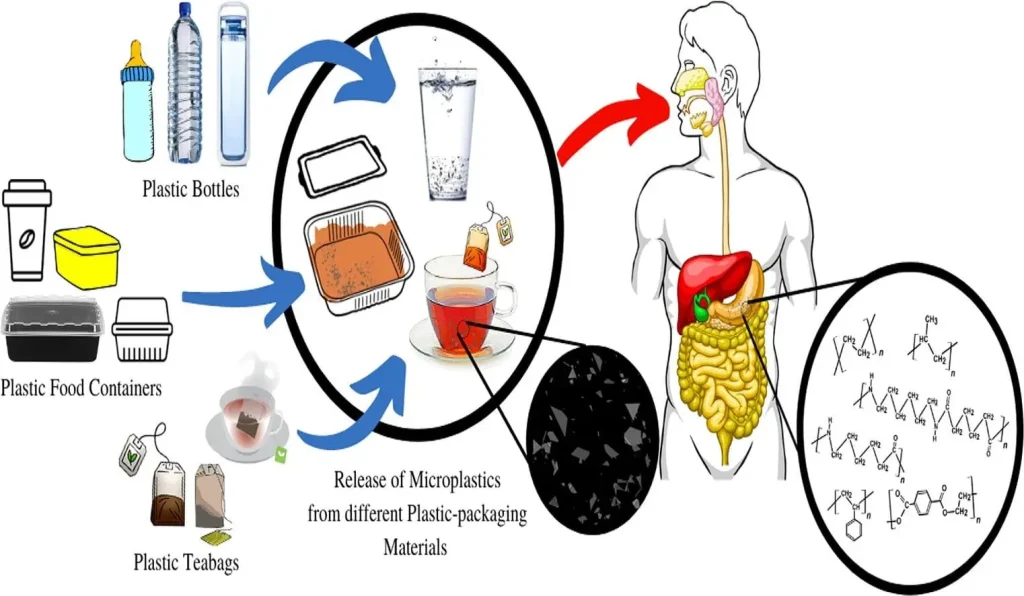
Image credit: Study from the Environmental Nanotechnology, Monitoring & Management Journal (3)
Related: Is It Harmful to Store Food In Plastic Containers?
Plastic Food Containers Release Microplastics in Your Dishwasher
Stop washing your reusable plastic containers and utensils in the dishwasher! A new study by the University of Queensland (UQ) (5), estimated that the average household with a dishwasher releases more than 33 million particles in one year from plastic containers and utensils. This happens because during the mechanical dishwashing, plastic items undergo chemical, thermal, and abrasive cleaning, involving detergents, rinse cycles, and temperatures that can reach up to 70 °C. Therefore, wash any plastic utensil by hand with plastic free dish soap and compostable sponges!
Related: Creating a Sustainable Kitchen: The Best Plastic-free, Non-Toxic Small Kitchen Appliances
What are Other Toxic Lunch Box Materials to Avoid and Why?
– Bendy Plastics Lunch Boxes and Lunch Bags Made of PVC
Many soft plastic lunch bags and lunch boxes are often made from PVC (Polyvinyl Chloride). PVC contains harmful chemicals such as phthalates and heavy metals which are used to enhance flexibility and can leach out over time. A recent study (6) published in collaboration with the Minderoo Foundation found that phthalate exposure is linked to hormone disruption, developmental issues and even impacts children’s respiratory and metabolic health. As children handle their lunch bags daily and eat the food stored directly inside, this is especially concerning. On top of health risks, PVC also harms the environment by releasing toxic chemicals as it breaks down or when it is burned. Choosing PVC-Free and non-toxic alternatives will help reduce chemical exposure and plastic pollution
– Lunch Boxes Made of Bamboo Fibers or Other Molded Fibers (Wheat Straw / Rice Husk etc.)
These lunch boxes are made from melamine–formaldehyde resin, into which powdered bamboo fibers (or other fibers like wheat straw, rice husk etc.) are added and then molded using industrial moulds. It is this resin that is the real problem, as it compromises food safety. Studies on coffee cups made from these materials (7) have shown high migration of formaldehyde resin into the coffee. For these reasons, the Netherlands, Belgium, Luxembourg and other EU member states have actively banned these products from the market.
– Full Silicone Lunch Boxes (Container & Lid)
From our perspective, it’s best to avoid silicone products when they come into contact with hot foods or liquids. A recent study published in the Journal of Hazardous Materials (8) found that silicone bakeware can release siloxanes into both the air and the food. Researchers associate these chemicals with endocrine disruption, reproductive toxicity, and liver toxicity.
8 Plastic Free Lunch Boxes and Food Containers That don’t Release Microplastics (BPA Free and PVC Free)
At I’m Plastic Free we help you eliminate the issue at the source. For all the reasons outlined above, we provide our readers with alternative solutions that do not release microplastics.
This post contains affiliate links, which means we may receive a small commission, at no cost to you, if you make a purchase through a link. This helps us continue the hard work we put into researching products and solutions.
Please Note: Our health content is for informational purposes only and is not intended as professional medical advice. Consult a medical professional on questions about your health. Please read our disclaimer.
1. PlanetBox Rover Classic Stainless Steel Bento Lunch Box (100% Plastic Free & Leakproof)
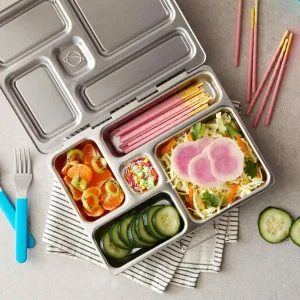
PlanetBox has developed a line of lunchboxes with only stainless steel designed to be long-lasting, durable and zero waste. Made from durable certified 49% post-consumer recycled and 18/8 stainless steel. These lunchboxes are built to handle daily wear and tear and are leakproof. The stainless steel lunchboxes are free from lead, PVC, phthalates and BPA material. They come with a few dip containers that have a silicone lid.
Dimensions: They offer a full range of dimensions and collections including:
- 10 x 7.4 x 1.5 in
- 10.3 x 7.7 x 2 in
- 7.8 x 5.2 x 2.0 in
Our Hands-on Experience: We use these daily for our children and they love them! They are dishwasher safe, built to last and contain zero plastic. My daughter doesn’t like the different types of food touching each other, so this leakproof bento box is perfect for this, as it features several food compartments. The latch snaps shut with a reassuringly secure click, making it leakproof, and the stainless steel feels incredibly robust.
Pros:
- 100% plastic-free and incredibly durable.
- Excellent compartment separation for picky eaters.
- Dishwasher safe and easy to clean.
Cons:
- Slightly heavier than standard lunch boxes.
- Higher upfront investment.
Shop at Amazon USA – Canada
Shop at Biome Australia
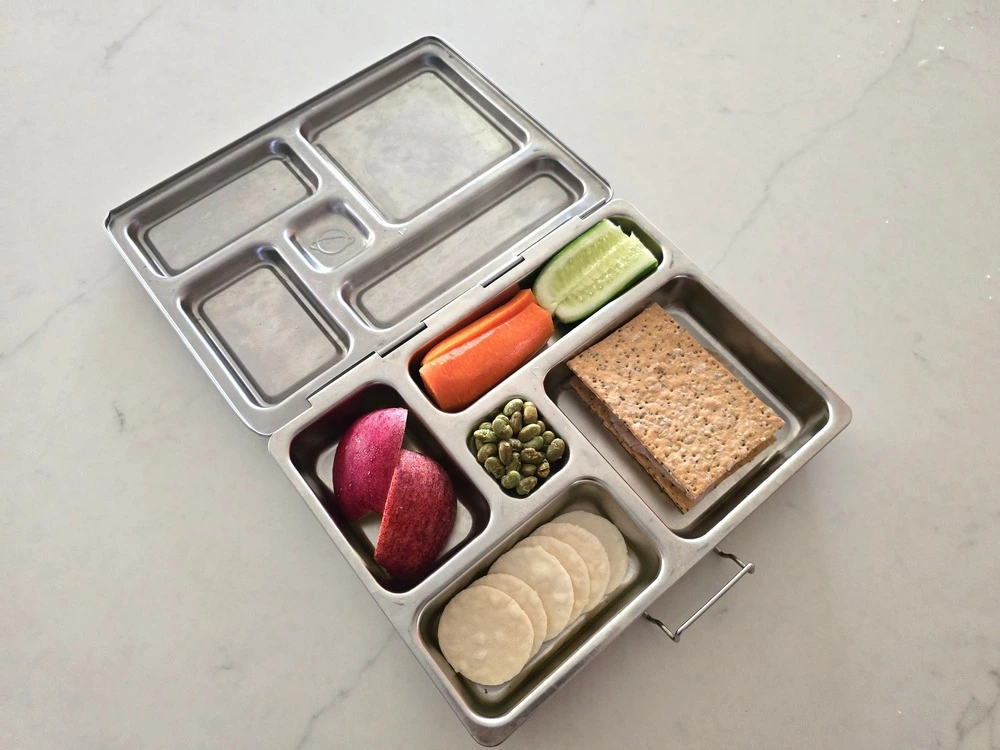
Image Credit: I’m Plastic Free using and testing the PlanetBox Rover plastic-free Lunchbox.
Related: Why You Should Switch To Plastic Free Microwave Food Covers?
2. LunchBots Trio II Snack Container (Not Leakproof)
LunchBots is another great plastic free lunch box alternative in the bento-style. We recommend their containers made from 100% food grade stainless steel to ensure that no plastic or plasticizers touch your food. While LunchBots Trio II is dishwasher safe, it is not leakproof so it is recommended to pack dry foods only.
Dimensions: They offer a full range of dimensions and collections including:
- Large: 8 x 6 x 1.75 in
- Medium: 6 x 5 x 1.75 in
- Small: 5.5 x 4 x 1.5 in
Shop at Amazon USA – Canada – Australia
Related: We tested 11 Non-toxic Cookware Brands: These Have No Synthetic Coatings (2026 Guide)
3. Bambaw Sandwich Lunch Box for Adults and Kids (With Adjustable and Removable Compartment)
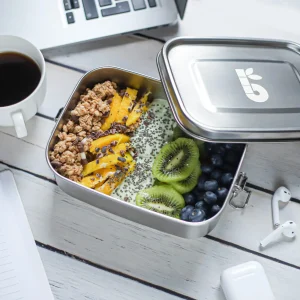
Bambaw offers a simple, durable lunchbox option designed from high-quality stainless steel with a bamboo lid. It’s completely plastic free, making it safe for food contact and better for the planet. This Bambaw lunchbox comes with a removable divider to help keep snacks and meals organised. The silicone ring in the lid makes it leakproof. It’s dishwasher safe and built to last for years of daily use.
Dimensions: BamBaw lunchboxes come in a range of practical sizes, including:
- 6.7 x 5 x 2.1 in (800ml)
- 7.8 x 5.5 x 2.1 in (1200ml)
- 8.6 x 6.2 x 2.1 in (1600ml)
Our Hands-on Experience: We use this brand as it’s a more affordable lunch box compared to PlanetBox. We love that you can use it as a 1 or 3 compartment lunchbox, as it comes with a sliding divider, or you can simply use it as food storage container for the fridge.
Pros:
- Highly adjustable and removable compartments, while keeping it leakproof.
- Affordable price point.
Shop at Amazon USA – Canada – UK – Australia
Shop at Biome Australia
4. GreenLunch Stackable Stainless Steel Bento Box
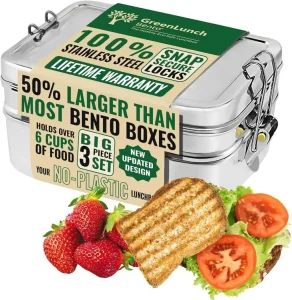
The GreenLunch stackable stainless steel lunchbox is a versatile plastic-free lunch box designed to reduce waste and pack meals sustainably. This eco-friendly bento box is made from 100% stainless steel and features multiple compartments to separate snacks, mains and sides. What we love about GreenLunch is that it’s not only dishwasher safe but backed by a lifetime warranty and crack-resistant design.
Dimensions: The GreenLunch Bento Box comes in two sizes including:
- 1 Tier (2-in-1) spacious food container measuring as 8.5” x 5.5” x 3 ¼”
- 2 Tier (3-in-1) lunch container that holds over 6 cups of food and measures as 18.42 x 8.89 x 13.97 cm
Shop at Amazon USA – Canada – UK – Australia
Shop at Biome Australia
Related: 3 Types of Stylish Plastic Free Reusable Coffee Cups You Can Take Anywhere
5. EcoPreps Glass Meal Container with Bamboo Lid (Airtight, Great as Food Prep Containers)
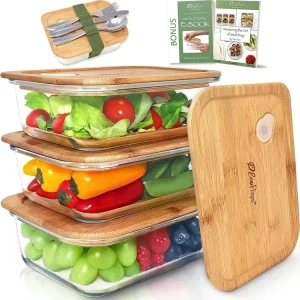
EcoPreps glass lunchbox has a clean, modern, and patented design built for safety and convenience. The set includes three borosilicate glass bento boxes with compartments to keep meals, fruits and snacks separated. Made with natural bamboo lids, these containers are free from BPA, PVC and phthalates. In the lid, they have a silicone seal and vent to keep foods fresh; unlike regular containers, these premium glass containers with bamboo lids stay airtight to prevent spills and leaks. The glass bases are oven safe, microwave safe, freezer friendly and dishwasher safe.
Please note: the bamboo lid is not oven or microwaveable safe and should be washed by hand.
Dimensions: 22.9L x 20.3 W x 15.2H cm
Related: Why is a Plastic-free Blender Better For Your Health
6. SuperBee Waxed Lunch Bags and Beeswax Wraps
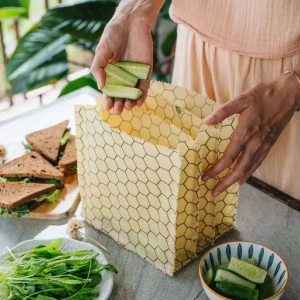
Beeswax wraps are a great sustainable way to wrap your sandwiches of pieces of fruit. They come in different dimensions, shapes, and designs and are a great conversation starter. We recommend the wraps of a B Corp and certified Social Enterprise in Thailand that empowers communities and supports animal welfare, called SuperBee. They are specialized in GOTS certified beeswax wraps and offer a vast range, from lunch bags with 2 or 3 compartmens, to beeswax rolls that you can cut to size, to square wraps in different dimensions. To clean them, you simply remove any debris and wash them under lukewarm water with a plastic free dish soap.
Shop SuperBee – 10% off with code IMPLASTICF10
Shop SuperBee on Amazon USA – Canada
Shop SuperBee and other brands on Amazon UK – Australia
Related: How to Make Beeswax Wraps for Non-toxic Food Storage
7. Reli Brown Paper Lunch Bags
Reli offers brown paper lunch bags in bulk of 500, their dimensions are for example 6″ x 3.5″ x 11.1″ and come with a 6 Lb capacity. They are perfect for a snack on the go without having the weight of a heavy lunch box!
No, if your sandwich is dry, you don’t have to include a plastic zip-loc bag inside the paper!
Related: 5 Non-Toxic, Plastic Free Water Bottles Without Microplastics
8. Ahimsa The Circle Stainless Steel Food Container Set
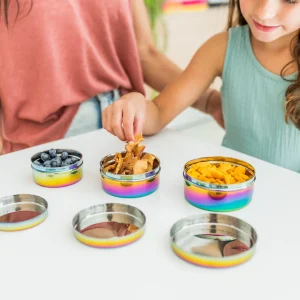
Ahimsa makes pediatrician-designed in the US, durable, non-toxic dinnerware for children as a safer alternative to plastic. Their products are all MADE SAFE certified and include plates, bowls, and cups, are made from durable, food-grade stainless steel to prevent chemical leaching into food and drinks. They are extremely durable for toddlers and dishwasher-safe. They are free of BPA, PVC, and phthalates.
We found these gorgeous set of 3 stainless steel food containers that are perfect store fruits, biscuits, chips, or other snack and perfectly completement a packed lunch.
Dimensions:
- Small – 2.7 oz – 1/3 cup
- Medium – 4 oz – 1/2 cup
- Large – 8 oz – 1 cup
Shop at Amazon USA
Shop at Ahimsa – 25% off with code GIFTJOY25
Shop at Biome Australia (similar containers but with silicone lids)
Common Q & A When Searching for a Non-toxic Lunchbox
– What’s the Safest Material for Kids’ Lunch Boxes?
For kids specifically, food-grade stainless steel (18/8 or 304 grade) is the safest bet. It doesn’t leach chemicals, holds up to daily drops and dishwasher cycles, and has no risk of shedding microplastics the way plastic or bamboo-fiber/melamine boxes can. Glass is also very safe but heavier and more breakable, which matters more for younger kids.
– Are Stainless Steel Lunch Boxes Safer Than Plastic Ones?
Yes. High-quality stainless steel (like 18/8 or 304 grade) is non-toxic, food-safe, and doesn’t leach chemicals into your food. Unlike plastic, it won’t release microplastics, even with hot, acidic, or oily meals. Stainless steel lunchboxes are also extremely durable and can last for years, making them more sustainable than constantly replacing cracked plastic ones. The only thing to note: most stainless steel boxes are not 100% leakproof unless they use a silicone seal, which is considered a safer alternative to plastic.
– What are the Best Zero-waste Alternatives to Traditional Lunch Boxes? Yes, Beeswax Wraps and Paper Lunch Bags
If you are looking for a zero waste lunch solution on the go, think about beeswax wraps and brown paper lunch bags.
– Is Food-grade Silicone Safer Than Plastic for Hot Food?
Many stainless steel lunchboxes use silicone rings or lids to make them leak-resistant. As long as you’re buying LFGB or FDA-approved food-grade silicone, it’s a much safer choice than plastic seals. However, personally, we recommend to avoid using silicone based products in contact with hot food and liquids. A recent study (8) published in the Journal of Hazardous Materials has shown that silicone-based bakeware releases siloxanes into the air and into the food. According to the scientists, these chemicals are linked to endocrine disruption, reproductive toxicity, and liver toxicity.
– Do Bamboo Fiber Lunch Boxes Contain Hidden Plastics Like Melamine?
Yes, they do. Many bamboo lunchboxes on the market are actually made with bamboo fibers blended with melamine resin, which is a type of plastic. These products can still release microplastics and plastic associated chemicals (PACs), especially if scrached and in contact with hot food. A truly plastic-free bamboo lunchbox uses solid bamboo for the lid (like a version of Bambaw or Eco Prep do), paired with stainless steel or glass for the base. These are safe, durable, and avoid hidden plastics disguised as “eco-friendly.” Always check the product description carefully before buying.
– Can I put a Stainless Steel Lunch Box in the Microwave?
No — stainless steel can’t go in the microwave. The metal reflects microwaves instead of absorbing them, which can damage your microwave and create sparks or fire risk. If you need to reheat food, transfer it to a microwave-safe glass container first, then pack it back into the steel lunch box.
Related: The Benefits of Switching to a Plastic Free Electric Kettle: 13 Non-Toxic Kettles To Consider
Conclusion
Switching to a non-toxic lunchbox might feel like a small step, but it’s one that has a big impact. Not only are stainless steel, bamboo, and glass options safer for your health but they’re also designed to last for years, cutting down on single-use plastic waste. Brands like PlanetBox, LunchBots, and Bambaw show that lunchboxes can be durable, stylish, and practical without relying on plastic.
At the end of the day, it’s about making choices that benefit both you and the planet. By investing in a lunch box that’s built to last, you’re reducing waste, protecting your health, and setting a positive example for others. A small swap in your daily routine really can make a difference.
Scientific Research Sources
(1) United Nations Environment Programme. (2024). Taking plastic pollution to task. UNEP Annual Report 2024. https://www.unep.org/annualreport/2024/stories/taking-plastic-pollution
(2) Aggarwal, R. (2024). Comparative life cycle assessment of reusable and single use take-away lunch boxes used in student restaurants. Cleaner Environmental Systems, 14, 100223. https://www.sciencedirect.com/science/article/pii/S2666789424000618
(3) Winkler, J., Liu, P., Phong, K., et al. (2022). Bisphenol A replacement chemicals, BPF and BPS, induce protumorigenic changes in human mammary gland organoid morphology and proteome. Proceedings of the National Academy of Sciences, 119(12), e2115308119. https://pmc.ncbi.nlm.nih.gov/articles/PMC8931256/
(4) Jadhav, E. B., Sankhla, M. S., Bhat, R. A., & Bhagat, D. S. (2021). Microplastics from food packaging: An overview of human consumption, health threats, and alternative solutions. Environmental Nanotechnology, Monitoring & Management, 16, 100608. https://www.sciencedirect.com/science/article/abs/pii/S2215153221001835
(5) Okoffo, E. D., Tscharke, B. J., & Thomas, K. V. (2025). Release of micro- and nanosized particles from plastic articles during mechanical dishwashing. ACS ES&T Water, 5(6), 2870–2881. https://pubs.acs.org/doi/10.1021/acsestwater.4c00768
(6) Minderoo Foundation. (2024). New study reveals alarming human health risks from exposure to chemicals in household plastics. Minderoo Foundation Media Centre. https://www.minderoo.org/media/new-study-reveals-alarming-human-health-risks-from-exposure-to-chemicals-in-household-plastics/
(7) Bouma, K., Kalsbeek-van Wijk, D. K., & Sijm, D. T. H. M. (2022). Migration of formaldehyde from ‘biobased’ bamboo/melamine cups: A Dutch retail survey. Chemosphere, 292, 133439. https://pubmed.ncbi.nlm.nih.gov/34968515/
(8) Li, X., et al. (2025). Silicone bakeware as a source of human exposure to cyclic siloxanes via inhalation and baked food consumption. Journal of Hazardous Materials, 482, 136355. https://www.sciencedirect.com/science/article/pii/S0304389425025105
This article was written by Ella Matthews, and reviewed by I’m Plastic Free Editor, Simona Paganetto
—
Do you have any questions or comments? Let us know in the comments section below.
Browse our platform for non-toxic plastic alternatives: I’m Plastic Free